
Choosing the right keyboard piano stand depends entirely on your specific playing environment, the weight of your instrument, and whether you prioritize portability or permanent stability. There is no single design that fits every scenario; an X-stand excels for gigging musicians with lightweight synthesizers, a Z-stand offers an excellent compromise for seated players needing legroom, and a table-style stand provides a highly stable foundation for heavy 88-key digital pianos in a fixed home setup. Evaluating your physical space, transport needs, and ergonomic requirements will help you select a frame that safely supports your gear and your playing style. In tropical climates like the Philippines, where high humidity can affect both instruments and metal hardware, choosing a durable, powder-coated stand is also essential to prevent rust and maintain long-term structural integrity.
Understanding the Three Main Keyboard Stand Designs
The X-stand is the most common design available, recognizable by its scissor-like, crossed-leg tubular frame. It operates on a central pivot point, allowing the stand to open to various widths and heights or fold completely flat for storage. Because of their simple construction, these stands are typically lightweight and highly affordable, making them a popular entry-level choice for beginners and a convenient option for traveling musicians who need to set up and tear down quickly.
The Z-stand features a distinct profile resembling the letter Z when viewed from the side. It consists of two vertical, heavy-duty steel pillars connected by a horizontal crossbar, with wide base feet and top support arms. This design distributes the weight of the keyboard directly down to the floor through its vertical columns, leaving the entire center area beneath the keyboard completely open. This structural layout provides excellent stability and allows the player to sit comfortably without hitting their knees on the frame.
Products mentioned in this guide
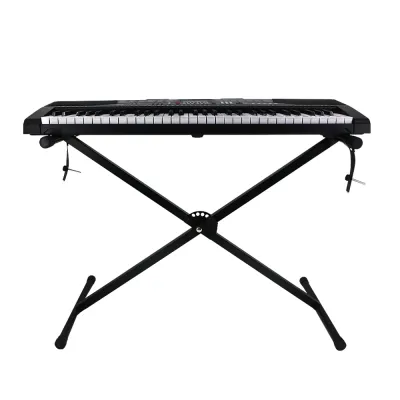
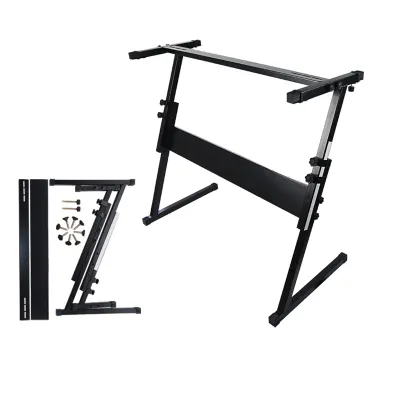
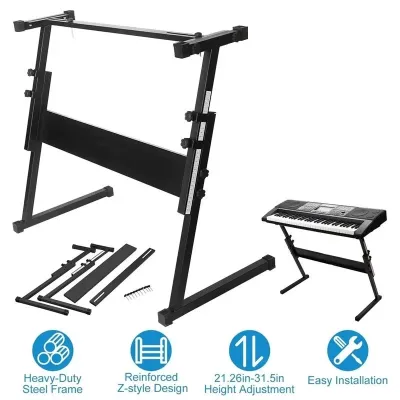
Prices are valid at publication and may change. Please refer to the product page for the latest price.
The table-style stand, sometimes referred to as a platform or H-frame stand, resembles a heavy-duty utility table with four independent, adjustable legs. Some variations use a rigid four-legged frame, while others utilize a wide, rectangular platform supported by two T-shaped leg assemblies. This design offers an exceptionally wide footprint and a highly rigid construction, making it the closest equivalent to the stable, non-moving feel of a traditional acoustic piano cabinet.
Stability and Weight Capacity: Matching Your Keyboard
Stability is the most critical safety factor when choosing a keyboard piano stand, as an unstable frame risks damaging your instrument and disrupting your performance. The stability of a stand is largely determined by its base footprint width and the placement of its crossbars. A wider base provides better resistance against lateral forces, which is especially important during vigorous playing or when performing expressive, high-energy musical passages that cause side-to-side movement.

To determine if a stand is safe for your instrument, always check the manufacturer’s specified weight limit on the product label and compare it against your keyboard’s actual weight. Do not rely on visual appearance alone; a stand may look robust but have joint mechanisms that are prone to slipping under heavy loads. Remember to factor in the weight of any accessories you plan to attach, such as music rests, heavy cables, or second-tier expansion units.
Heavy digital pianos with 88 fully-weighted keys, which often feature hammer-action keybeds, require the rigid, non-flexing support of a Z-stand or a table-style stand. These instruments can weigh anywhere from 15 to over 25 kilograms, and their length means that any flexing in the stand will cause the ends of the keyboard to bounce when you play notes at the extreme high or low registers. A Z-stand or table-style stand minimizes this flexing, ensuring a solid, predictable playing surface.
Conversely, lighter keyboards, such as 61-key or 76-key synthesizers, MIDI controllers, and arranger keyboards, can safely use a robust X-stand. Because these instruments typically weigh under 10 kilograms and have non-weighted keys, they do not exert the same downward and lateral forces as a full-sized digital piano. However, even with lighter keyboards, it is wise to avoid the cheapest, single-braced X-stands if you plan to play enthusiastically, as they can still wobble during fast-paced performances.
Space, Portability, and Setup Flexibility
Portability is a major deciding factor for gigging musicians, music students, and those who need to clear their living space when not practicing. X-stands are the undisputed leaders in portability because their folding mechanism allows them to collapse into a single, flat piece of metal in seconds. This flat profile makes them incredibly easy to slide under a bed, store in a closet, or pack into the trunk of a compact car or a local transport vehicle.
Z-stands present a different set of transport dynamics. While some modern Z-stands feature folding joints or quick-release pins that allow them to collapse relatively flat, many traditional models require partial disassembly using hand screws or hex keys. They also tend to be heavier and bulkier than X-stands, which means they take up more volume in a vehicle and can be more cumbersome to carry over long distances or up flights of stairs.
Table-style stands offer a unique middle ground in terms of portability. Most table stands feature legs that fold inward against the top frame, resulting in a flat but wide package. While they do not fold as compactly as an X-stand, their flat shape makes them relatively easy to stack in a vehicle or store against a wall. The main drawback is that the overall length of the collapsed stand remains fixed to the width of the top frame, which may require a larger storage space.
Floor footprint is another crucial consideration, especially for users setting up in small bedrooms, apartments, or urban condominiums where space is at a premium. While an X-stand takes up less physical space when folded, its footprint when open can actually be quite wide, and the crossed legs prevent you from utilizing the space underneath. A table-style stand or Z-stand, despite having a larger overall footprint, allows you to slide storage bins, pedal boards, or small amplifier units directly underneath the keyboard, maximizing your usable floor space.
Ergonomics and Playing Comfort
Ergonomics play a vital role in preventing physical strain, fatigue, and long-term injury during extended practice sessions. Proper playing posture requires your shoulders to be relaxed, your forearms to be parallel to the floor, and your wrists to remain in a neutral position. Achieving this posture depends heavily on the height adjustment range of your stand and how well it accommodates your preferred playing position, whether seated or standing.
X-stands adjust their height by changing the angle of their intersecting legs, which introduces a significant ergonomic trade-off. As you raise an X-stand to a comfortable standing height, the top support bars draw closer together, narrowing the support surface and making the stand less stable. Conversely, when you lower the stand for a seated position, the legs spread extremely wide, which can make it difficult to position a standard piano bench close enough to the keyboard.
Z-stands and table-style stands handle height adjustments vertically without altering the width of the base or the top support bars. This independent adjustment ensures that the stand maintains its full stability and width regardless of whether you are sitting on a low bench or standing up. This design consistency makes them highly versatile for players of different heights and those who frequently transition between sitting and standing during performances.
Legroom is where the structural differences between these stands become most apparent for seated players. X-stands, particularly double-braced models, create a physical barrier directly where your knees and shins need to go, forcing you to sit further back or splay your knees outward, which can lead to poor posture and back discomfort. Z-stands and table-style stands offer completely unobstructed legroom, allowing you to sit in a natural, ergonomically correct position with easy access to your sustain pedals.
Decision Matrix: Which Stand Should You Choose?
An X-stand is highly suitable if your primary goals are rapid setup, easy transport, and budget-friendly storage. It is the practical choice for mobile musicians, buskers, or players who use lightweight 61-key keyboards and primarily perform standing up or in temporary venues where quick tear-down is essential.
A Z-stand is the ideal choice if you require a balance of heavy-duty support, excellent stability, and comfortable seated legroom. It is well-suited for serious students, intermediate players, and gigging keyboardists who use medium-weight 76-key or 88-key instruments and need a reliable frame that can occasionally be transported to rehearsals or local gigs.
A table-style stand is best suited for permanent home setups, recording studios, or music classrooms where a heavy 88-key digital piano resides. It provides the most stable, wobble-free playing experience, accommodates players of all heights with maximum legroom, and mimics the solid feel of an acoustic piano, making it the preferred option when portability is not a priority.
Before making your final purchase on any online marketplace, verify your keyboard’s physical dimensions, mounting screw locations, and whether your instrument requires a proprietary wooden stand to support an integrated three-pedal unit. Checking these specifications beforehand ensures that your new stand will be fully compatible with your keyboard’s underside structure and your specific performance needs.
Frequently Asked Questions (FAQ)
Can I use a sustain pedal with any keyboard stand?
Yes, standard standalone sustain pedals can be used with all three stand types, but the design of the stand affects how easily you can use them. X-stands can sometimes block ideal pedal placement because of their crossed legs, and they are more prone to sliding forward on smooth tile floors when you press the pedal firmly. Z-stands and table-style stands offer completely open floor space, allowing you to place your sustain pedal or a full multi-pedal board exactly where it feels most natural, while their heavier weight helps prevent the stand from shifting during use.
Are double-X stands better than single-X stands?
Double-X stands feature a second set of intersecting metal bars, which significantly increases their weight capacity and reduces side-to-side wobble compared to single-X models. This makes them a much safer option for heavier keyboards or more energetic playing styles. However, the extra metal bracing makes the stand heavier to carry, slightly bulkier when folded, and further restricts knee clearance for seated players, making them less comfortable for long practice sessions on a bench.

Community discussion
Share your experience or ask a question. Comments are reviewed before publication.