
Upgrading your bass guitar’s pickups is one of the most effective ways to transform your instrument’s tone without the expense of buying a completely new guitar. For beginners looking to make their first upgrade, Wilkinson bass pickups offer an accessible entry point, balancing affordability with reliable construction. Choosing the right model requires a clear understanding of your instrument’s physical routing, your desired musical style, and the technical specifications of your current setup. By matching these factors, you can avoid compatibility issues and achieve a sound that complements your playing. This guide will walk you through the essential steps to select, verify, and prepare for your first pickup upgrade.
Identify Your Bass Configuration and Tonal Goals
Before browsing any catalog, you must identify the physical layout of your bass. The most common configurations are the Precision-style (often called P-bass), which uses a split-coil pickup; the Jazz-style (J-bass), which utilizes two single-coil pickups; and the Music Man-style (MM-bass), which features a large, dual-coil humbucker. Some modern instruments feature hybrid setups, such as the PJ configuration, which combines a split-coil in the middle position with a single-coil at the bridge. Because these pickup shapes are not interchangeable without routing the wood of your guitar, your current bass body dictates the physical category of pickup you must select.
Once you know what fits, define your tonal objectives based on the music you play. If you prefer classic soul, motown, blues, or vintage rock, you will likely want a warm, round, and mid-focused tone. If your interests lean toward modern metal, slap bass, or high-definition fusion, you will require a brighter, punchier sound with clear highs and tight lows. Understanding these preferences helps you decide between different magnet types and winding styles.
Products mentioned in this guide
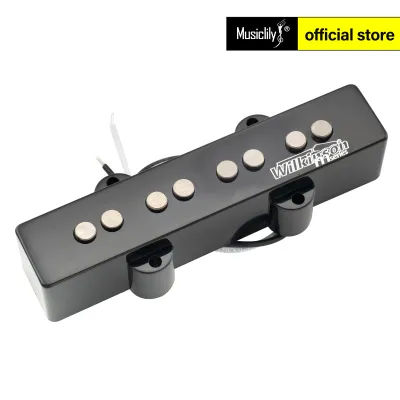
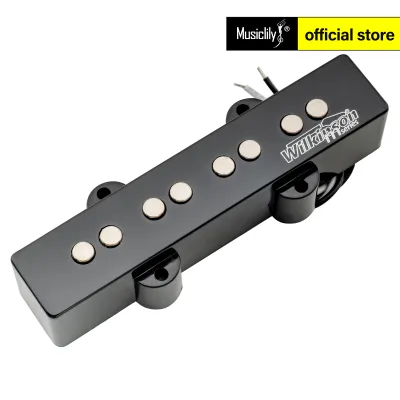
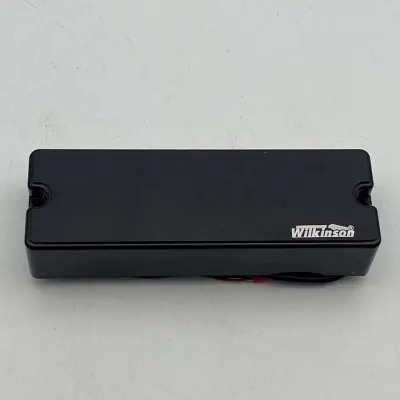
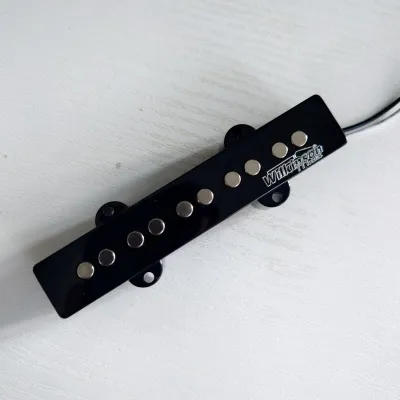
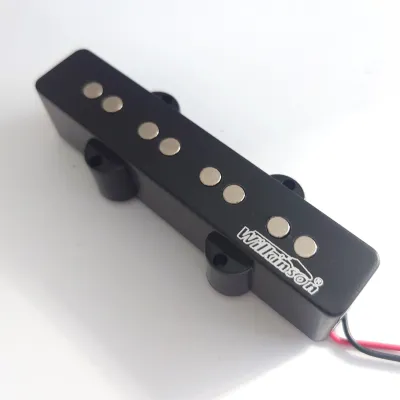
Prices are valid at publication and may change. Please refer to the product page for the latest price.
The physical placement of the pickup on the body also plays a fundamental role in your baseline tone. A pickup positioned close to the neck captures wider string vibrations, resulting in a deeper, bass-heavy sound. Conversely, a pickup mounted near the bridge senses tighter string vibrations, producing a brighter, mid-range focused tone with more bite and articulation. If your bass has multiple pickups, you can blend these positions to achieve a wider variety of sounds.
You must also determine whether your current bass uses an active or passive electronics system. Passive basses rely entirely on the pickups and simple tone controls, requiring no battery power. Active basses include an onboard preamp powered by a 9-volt battery, which allows you to boost or cut specific frequencies. While you can install passive Wilkinson pickups into an active bass, you must ensure the pickup impedance is compatible with your preamp’s input requirements to avoid signal degradation or excessive noise.
Finally, establish a realistic budget for this upgrade. While a set of Wilkinson pickups is generally affordable, often ranging from ₱1,500 to ₱3,500 depending on the model and configuration, you must also account for potential installation costs. If you do not own a soldering iron or feel uncomfortable working on electronics, a professional setup and installation by a local luthier in the Philippines can add another ₱800 to ₱2,000 to your total investment. Balancing these expenses ensures you do not overspend on your first modification project.
Match Wilkinson Pickup Designs to Your Playing Style
The heart of any pickup is its magnet, and Wilkinson utilizes both Alnico and Ceramic magnets across their product lines. Alnico magnets, particularly Alnico V, are known for their warm, organic, and vintage-voiced response. They offer smooth dynamics that respond naturally to the strength of your plucking hand, making them highly suitable for blues, jazz, and classic rock. Ceramic magnets, on the other hand, produce a stronger magnetic field, resulting in a higher output level, a brighter top-end, and a tighter low-end response. This makes ceramic models excellent for aggressive genres like modern rock, metal, and punk, where cutting through a dense mix is essential.

The physical design of the coil also dictates both the tone and the noise level of your instrument. Single-coil pickups, typical of the Jazz Bass design, offer exceptional clarity, detail, and a bright treble response. However, they are inherently susceptible to 60-cycle hum, especially when playing near electronic devices or under fluorescent lighting. Humbuckers and split-coil designs use two coils wound in opposite directions to cancel this hum, providing a quieter performance and a thicker, meatier tone with more pronounced mid-range frequencies.
When looking at specific formats, Wilkinson’s P-style split-coil pickups are designed to deliver that classic, punchy mid-range grunt with built-in hum cancellation. They are highly forgiving for beginners because they sit naturally in almost any musical mix. Wilkinson’s J-style single-coils focus on articulation and brightness, allowing for detailed fingerstyle playing and crisp slap tones. For those with MM-style routing, Wilkinson’s large humbuckers offer a massive, high-output sound that handles heavy distortion and aggressive picking without losing low-end definition.
Another important construction feature to consider is wax potting. Wilkinson pickups are typically vacuum-wax potted, a process where the pickup coils are submerged in a paraffin and beeswax mixture. This secures the delicate copper windings and prevents them from vibrating independently, which eliminates microphonic feedback when playing at high volumes or through high-gain amplifiers. For beginners playing live or in loud rehearsal spaces, choosing a potted pickup is essential for maintaining a clean, feedback-free signal.
To get the most out of your upgrade, match the pickup’s output to your personal playing style and your instrument’s natural acoustic properties. If you have a heavy plucking technique, a high-output pickup might compress your sound too much or cause unwanted distortion at your amplifier. If you play with a light touch, a slightly hotter pickup can help boost your signal and bring out subtle nuances. Additionally, if your bass is naturally bright-sounding, pairing it with a warmer Alnico pickup can help balance the overall frequency response.
Crucial Specifications to Verify Before Purchasing
One of the most common mistakes beginners make is assuming all pickups of a certain style are identical in size. Before purchasing, you must physically measure the length, width, and depth of your existing pickups and compare them to the manufacturer’s technical drawings. For example, on many Jazz Bass models, the bridge pickup is slightly longer than the neck pickup to accommodate the wider string spacing near the bridge. Purchasing a matched set that does not account for this difference can leave you with a pickup that is either too loose or too large for your bass’s routed cavities.
String spacing is another critical dimension to verify. You must measure the distance from the center of the lowest string to the center of the highest string directly over the pickup poles. If the pole pieces of your new pickup do not align reasonably well with your strings, you may experience uneven volume levels across your strings, with some sounding noticeably quieter than others. This is especially important for five-string basses, where string spacing varies significantly between different brands.
Electrical compatibility is equally important to check before finalizing your purchase. Determine whether the pickup features a 2-conductor wire or a 4-conductor wire. A 2-conductor wire is standard for simple installations, while a 4-conductor wire allows for advanced wiring options like coil-splitting or series/parallel switching. You must also verify the resistance values of your current potentiometers. Passive single-coil pickups generally perform best with 250k-ohm potentiometers, which help tame harsh high frequencies, while humbuckers often pair better with 500k-ohm potentiometers to preserve brightness.
Using a digital multimeter is a highly recommended step during this verification process. You can measure the DC resistance (DCR) of your current pickups to establish a baseline. A higher DCR generally indicates more wire turns, which typically translates to higher output and a more mid-focused tone, while a lower DCR suggests a brighter, more vintage-style response. Comparing these measurements with the specifications on the Wilkinson product sheets will give you a clearer expectation of how the new pickups will alter your bass’s output level.
To ensure a successful upgrade, always consult the official manufacturer specification sheets rather than relying on generic descriptions found on online marketplaces. Product titles on retail platforms can sometimes be misleading or incomplete. Verifying the exact model numbers and physical dimensions directly from official technical documentation is the only reliable way to guarantee that the hardware will fit your instrument without requiring irreversible woodwork.
Installation Realities and When to Seek Professional Help
Installing new pickups can be a rewarding DIY project if your new pickups are a direct drop-in replacement. This process typically requires basic soldering tools, wire strippers, and screwdriver sets. If the new pickup fits perfectly into the existing cavity and the wiring diagram matches your current setup, the job involves desoldering the old pickup wires from the potentiometers and soldering the new ones in their place. Taking clear photographs of your control cavity before disconnecting any wires is an excellent way to ensure you have a visual reference during reassembly.
However, several red flags indicate that you should stop the DIY process and seek professional help. If the new pickup is even slightly too large for the existing cavity, attempting to chisel or route the wood yourself can easily ruin the finish or structural integrity of your bass. Complex wiring schemes, such as integrating active preamps, installing push-pull pots for coil-splitting, or dealing with severe grounding hum, can quickly become overwhelming for a beginner. In tropical climates like the Philippines, high humidity can accelerate the oxidation of electronic components, making proper soldering techniques and thorough cavity shielding with copper tape even more critical to prevent unwanted noise.
Shielding your control cavity is a highly beneficial step to perform while your bass is disassembled. Applying conductive copper tape or shielding paint to the inside of the pickup and control cavities helps block electromagnetic interference (EMI) from electronic devices, power outlets, and stage lights. This is particularly important for single-coil pickups, which are highly sensitive to external noise. Ensuring that the shielding is properly grounded to the back of a potentiometer will result in a significantly quieter instrument, especially in humid environments where electrical noise can be more pronounced.
Once the pickups are physically installed, you must adjust their height to optimize your tone. Pickups that are set too close to the strings can cause a harsh, distorted sound and create a magnetic pull that interferes with string vibration, leading to tuning issues and reduced sustain. Conversely, pickups set too far away will produce a weak, thin signal with poor dynamic range. Use a small ruler to measure the distance between the top of the pole pieces and the bottom of the strings while holding down the highest fret, adjusting the mounting screws until you achieve a balanced output across all strings.
If you encounter unfamiliar wiring diagrams, conflicting instructions, or if you feel unsure about using a hot soldering iron near your instrument’s finish, do not hesitate to take your bass to a qualified technician. A professional luthier can ensure that the pickups are installed safely, the electronics are properly shielded against interference, and the instrument is fully set up for optimal playability. This small additional investment can save you from costly mistakes and ensure your upgraded bass performs at its absolute best.
Frequently Asked Questions (FAQ)
Do I need to change my potentiometers when installing new pickups?
You do not always need to change your potentiometers, but doing so can significantly improve your tone if you are changing pickup designs. Passive single-coil pickups, like standard J-bass models, typically use 250k-ohm pots to keep the high frequencies smooth and warm. If you are upgrading to high-output humbuckers or MM-style pickups, switching to 500k-ohm pots can prevent your tone from sounding muddy by allowing more high-end clarity to pass through. Additionally, if your current pots are scratchy, loose, or corroded due to humidity, replacing them during the pickup upgrade is a highly cost-effective way to refresh your entire signal path.
Can I mix different Wilkinson pickup models in a PJ configuration?
Yes, you can mix different models, but you must pay close attention to output balance and phase compatibility. If you pair a very high-output bridge pickup with a vintage-voiced middle pickup, the volume difference between the two positions will be jarring when you switch or blend them. Furthermore, if the two pickups are wound with opposite polarities or are out of phase with each other, combining them will result in a thin, hollow sound with almost no low-end. To avoid these issues, it is usually safest for beginners to purchase a calibrated PJ set from the same manufacturer line, ensuring they are designed to work together harmoniously.
Will a higher output pickup automatically make my bass sound better?
No, a higher output pickup does not guarantee a better tone; it simply changes how the pickup interacts with your amplifier. High-output pickups push your amplifier harder, which can be beneficial if you want a naturally overdriven, aggressive rock sound. However, this increased power often comes at the expense of dynamic range, high-end clarity, and subtle touch sensitivity. If you play genres that require clean, articulate tones, such as jazz, funk, or pop, a moderate or vintage-output pickup will often provide a more balanced and versatile sound that responds better to your playing dynamics.

Community discussion
Share your experience or ask a question. Comments are reviewed before publication.