
Rex Banggawan’s Income Taxation textbook is a cornerstone of accounting education in the Philippines, serving as a primary reference for understanding national tax laws. Because tax legislation undergoes periodic reforms, choosing the right edition is critical for your success.
Whether you are an undergraduate student, a CPA reviewee, or a practicing professional, you must evaluate how well a specific volume aligns with your current needs. This guide outlines the core topics covered in the book, helps you identify your reader profile, and provides a clear framework for verifying that your copy is up to date.
Core Topics and Syllabus Alignment
To determine if this textbook fits your needs, start by comparing its table of contents directly against your course syllabus or professional training outline. A standard income taxation curriculum in the Philippines focuses heavily on the taxation of individuals, corporations, estates, and trusts. You should verify that the book contains dedicated chapters on these distinct taxpayer categories, as the rules governing their deductions, exemptions, and tax rates differ significantly.
Products mentioned in this guide
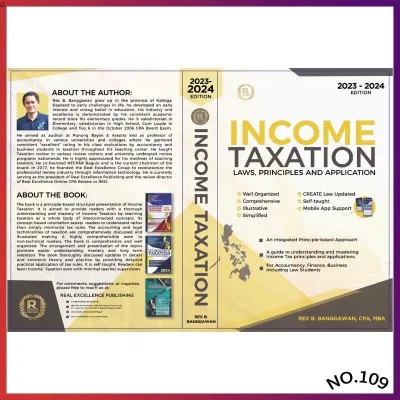
Prices are valid at publication and may change. Please refer to the product page for the latest price.
While some comprehensive volumes touch upon broader business taxes, a dedicated income taxation textbook primarily zeroes in on income-generating activities. Ensure the index includes key concepts such as gross income inclusions and exclusions, allowable deductions (both itemized and optional standard deductions), and the treatment of capital gains versus ordinary gains. If your syllabus requires knowledge of passive income taxation or withholding tax systems, check for specific chapters addressing these mechanisms.
Beyond theoretical definitions, a practical textbook must bridge the gap between law and application. Look for sections that detail administrative requirements, such as filing deadlines, required Bureau of Internal Revenue (BIR) forms, and the remedies available to taxpayers. The presence of step-by-step computational models is essential, as tax accounting requires precise mathematical application of statutory rates to taxable income bases.
Identifying Your Reader Profile and Use Case
Not all readers approach tax law with the same objectives or background knowledge. The effectiveness of this textbook depends heavily on how its pedagogical structure matches your current learning stage, whether you need step-by-step guidance or rapid, high-level review.

Accountancy Students and Academic Learners
For undergraduate students taking their first course in income taxation, the textbook must serve as a structured learning pathway. Look for editions that feature clear chapter summaries, comprehensive glossaries of legal terms, and basic illustrative examples that break down complex statutory language into plain English.
Progressive problem sets at the end of each chapter are vital for academic success. These exercises should start with simple conceptual questions before advancing to basic computational problems, allowing you to build confidence and master foundational principles before tackling complex corporate scenarios.
CPA Board Exam Reviewees
If you are preparing for the Certified Public Accountant (CPA) licensure examination, your requirements are far more rigorous. Reviewees need a book that goes beyond basic definitions to present integrated, multi-topic problems that mimic the complexity of actual board exam questions.
Check if the textbook includes advanced computational scenarios, adaptations of past board exam questions, and time-saving calculation techniques. The material should explicitly highlight common exam pitfalls, such as confusing taxable income with accounting income, and provide clear explanations of how to navigate overlapping tax rules under pressure.
Working Professionals and Practitioners
For accountants, lawyers, and business owners in the Philippines, the textbook serves as a daily desk reference rather than a sequential study guide. In a professional setting, you need quick access to specific tax rules, filing deadlines, and statutory exemptions.
Evaluate whether the book includes references to relevant BIR revenue regulations, circulars, and rulings that support the text. A well-indexed volume with practical compliance checklists and sample tax return computations will save you valuable time when preparing filings or advising clients on tax planning strategies.
How to Verify the Edition and Tax Law Updates
Taxation is a dynamic field where a single legislative amendment can render entire chapters obsolete. Before purchasing or studying from any copy of this textbook, you must verify its publication history and legislative alignment. Begin by inspecting the copyright page, which is usually located at the front of the book. Note the exact publication year, the printing date, and the edition number, as publishers frequently release revised editions to incorporate new laws.
Next, read the preface or the author’s revision notes. This section typically outlines the specific legislative reforms, revenue regulations, or court rulings integrated into the current text. You must ensure that the edition you are using explicitly states that it incorporates the latest legislative acts governing national internal revenue.
To double-check the book’s accuracy, cross-reference a few key figures in the text with official government sources. Compare the tax tables, corporate tax rates, and personal exemption thresholds used in the book’s illustrative examples against the current guidelines published on the official BIR website. If you find discrepancies, the book may be outdated. Additionally, check the publisher’s official website or authorized online storefronts for any published errata sheets, supplementary digital chapters, or announcements regarding upcoming editions.
Making Your Final Decision: Buy, Borrow, or Supplement
Once you have evaluated the textbook against your syllabus and verified its edition, you can make an informed decision on how to acquire and use the material. If the latest edition aligns perfectly with your academic or professional requirements and reflects the current tax code, purchasing a personal copy is a worthwhile investment. Having a clean, up-to-date volume allows you to highlight key passages, write notes in the margins, and keep a reliable reference on hand throughout your studies or career.
If you are on a tight budget, borrowing an older edition from a library or a peer can be a viable alternative, but it comes with significant caveats. You may use older texts to study foundational concepts that rarely change, such as the general definition of income, the distinction between capital and ordinary assets, or basic tax principles. However, you must actively supplement your reading. Always cross-reference the rates, thresholds, and filing procedures in the borrowed book with current BIR issuances and official tax forms to avoid learning obsolete rules.
Finally, recognize the limitations of a general income taxation textbook. If your work or studies involve highly specialized areas—such as international tax treaties, complex corporate mergers, or niche industry incentives—a standard textbook may only provide basic coverage. In these cases, you should supplement the book with specialized professional journals, legal treatises, or direct consultations of the National Internal Revenue Code and its implementing rules.
Frequently Asked Questions (FAQ)
Where can I find authorized copies of this textbook?
To ensure you receive a complete, accurate, and legally printed book, purchase only from authorized sources. You can find legitimate copies through the publisher’s official website, established physical bookstores across the Philippines, and verified flagship stores on major online marketplaces.
Avoid purchasing from unauthorized third-party sellers offering suspiciously low prices, photocopied versions, or digital PDF copies. These unauthorized reproductions are often outdated, may contain missing pages or printing errors, and violate intellectual property laws, depriving authors of their rightful earnings.
Does the book include answer keys for the practice problems?
Most comprehensive taxation textbooks do not include complete answer keys or solution manuals within the student edition itself. These resources are typically restricted to verified university instructors to maintain academic integrity in classroom testing.
However, some editions may provide answers to selected even-numbered problems or offer online student companion resources. Before purchasing, check the book’s preface, back cover, or the publisher’s official online portal to see what supplementary materials are available to self-studying readers and reviewees.

Community discussion
Share your experience or ask a question. Comments are reviewed before publication.