
Finding the right guitar pick—often referred to as a plectrum or a guitar pusher—is one of the most affordable yet impactful ways to shape your instrument’s tone and playability. While many beginners grab whatever pick is closest, experienced players know that this small piece of material acts as the direct bridge between your hand and the strings. The ideal pick is not a single universal product; rather, it is a highly personal combination of thickness, material, and shape tailored to your specific playing style. Strummers require flexibility for smooth, sweeping chord transitions, while lead players need rigidity for precise, rapid articulation. Meanwhile, fingerpickers and hybrid players rely on specialized profiles to navigate complex patterns. Understanding how these physical traits interact with your technique will help you select the right tool for your musical goals.
Every adjustment in pick design alters how the string vibrates, which directly changes the warmth, brightness, and volume of your instrument. By learning to match your pick’s characteristics to your physical approach, you can reduce hand fatigue, improve your timing, and unlock a wider range of tonal dynamics. Whether you are practicing in a quiet bedroom or performing under hot stage lights, the right pick ensures that your physical effort translates efficiently into clean, expressive sound.
Core Selection Criteria: Thickness, Material, and Shape
Pick thickness is measured in millimeters and is the most critical factor determining flexibility and string resistance. Thin picks (typically under 0.60 mm) bend easily, offering low resistance and a bright, clicky attack that blends well in acoustic rhythm playing. Medium picks (0.60 mm to 0.80 mm) balance flexibility and stiffness, making them highly versatile for players who transition between strumming and light lead work. Heavy and extra-heavy picks (above 0.80 mm, often extending past 1.50 mm) offer virtually no flex, providing maximum control, a darker tone, and immediate string response for precise single-note articulation.
Products mentioned in this guide
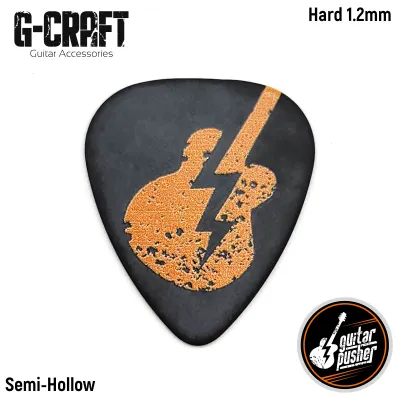
Prices are valid at publication and may change. Please refer to the product page for the latest price.
The material of the pick dictates its durability, grip texture, and tonal warmth. Celluloid is a classic choice, offering a warm, balanced tone and a smooth, glossy feel that mimics traditional tortoise shell, though it can wear down relatively quickly. Nylon is highly flexible, virtually indestructible, and produces a softer, warmer attack, making it a favorite for thin-gauge strummers. Delrin (often processed to have a matte finish) features a powdery texture that provides excellent grip, delivering a bright, articulate tone with high durability. Ultex is extremely stiff, lightweight, and wear-resistant, producing a very bright, clear projection that cuts through dense mixes.
Shape and size variations significantly influence your hand ergonomics and picking accuracy. The standard teardrop (often designated as the 351 shape) is the most common, offering a balanced grip area and a moderately pointed tip suitable for general playing. Smaller, pointier shapes like the jazz profile provide exceptional control and speed by minimizing the distance between your fingers and the string. Large triangle picks offer three identical playing corners, making them highly durable and easy to hold for players with larger hands or those who prefer a substantial grip surface.
In warm, humid environments, sweat can quickly turn a glossy pick into a slippery liability during long practice sessions or live performances. Textured grips, raised molded patterns, and matte finishes help maintain a secure hold without requiring excessive finger pressure. Additionally, the edge of the pick—whether it is rounded, sharp, or features a pre-worn bevel—significantly influences how smoothly the pick glides off the string, affecting both speed and tonal warmth.
Recommended Pick Profiles for Strumming and Rhythm
For players who primarily focus on strumming acoustic or electric guitars, the goal is to achieve a smooth, consistent sweep across all six strings. A pick that is too stiff will catch on the strings, causing an uneven volume spike, harsh attack, and potential string breakage. Therefore, thin to medium picks (ranging from 0.50 mm to 0.73 mm) are generally recommended for rhythm-heavy styles. This flexibility allows the pick to give way as it passes over the strings, creating a natural compression that evens out your strumming dynamics.

Nylon is an exceptional material for pure acoustic strumming because its natural flexibility allows it to bend easily over the strings, producing a soft, pleasant “click” that adds a percussive rhythm to your chords. If you prefer a slightly brighter, more defined chord sound on an electric guitar, a medium celluloid or Delrin pick provides the necessary stiffness to articulate individual notes within a chord while still offering enough give for comfortable strumming.
Standard teardrop or large triangle shapes are ideal for rhythm playing. The larger surface area allows for a relaxed grip, reducing hand fatigue during long sets. When strumming, a tight grip can cause tension in your wrist and forearm; a larger, more flexible pick allows you to maintain a loose, fluid wrist motion, which is essential for keeping perfect time.
Using an overly thick or rigid pick for heavy strumming can lead to several performance issues. The lack of flexibility forces your wrist to absorb the impact of every stroke, which can quickly cause hand fatigue and muscle strain. Furthermore, rigid picks produce a very loud, aggressive attack on acoustic strings, which can overpower vocals or other instruments in an acoustic setting.
Recommended Pick Profiles for Lead Guitar and Fast Picking
Lead guitarists and technical players require a pick that acts as an extension of their fingers, offering immediate feedback and zero delay. When executing fast alternate picking, sweep picking, or precise solos, any flex in the pick translates to lost time and sloppy articulation. For these demanding techniques, rigid picks with a thickness of 1.0 mm to 2.0 mm or more are highly suitable. This rigidity ensures that the instant you move your hand, the string is displaced and notes are articulated cleanly.
Smaller, sharper shapes, such as the classic jazz profile, are the preferred choice for lead players. The pointed tip minimizes the surface area that contacts the string, allowing the pick to glide off effortlessly with minimal resistance. This compact size also forces you to keep your fingers closer to the strings, which naturally improves accuracy and economy of motion.
Materials like Ultex, heavy Delrin, or thick acrylic are excellent for lead work because they resist wearing down into rough edges, even during aggressive playing. These materials produce a bright, clear, and punchy attack that helps single-note lines cut through a full band mix. Using a thin pick for fast lead passages often results in a frustrating fluttering effect, where the pick is still bending from the previous stroke when you are trying to execute the next, leading to a loss of synchronization between your hands.
Recommended Pick Profiles for Fingerpicking and Hybrid Techniques
While traditional fingerpicking relies entirely on bare fingers or fingernails, many players incorporate specialized picks to boost volume, clarity, and tonal consistency. Wearable thumb picks and fingerpicks are designed to fit securely onto your digits, allowing you to execute complex fingerstyle patterns with the added power of a plectrum. This approach is highly common in folk, bluegrass, and acoustic blues.
Thumb picks, typically made of plastic or celluloid, wrap around the thumb and act as a downward-striking pick for bass notes, while the remaining fingers pluck the treble strings. Fingerpicks, which can be made of metal or plastic, wrap around the tips of your index, middle, and ring fingers to mimic the action of long fingernails. Metal fingerpicks offer a bright, metallic attack that is highly favored in bluegrass and banjo playing, while plastic options provide a warmer, more natural tone.
Hybrid picking is another popular technique, especially in country, rock, and fusion styles. This approach involves holding a standard medium-heavy flat pick between your thumb and index finger for fast single-note lines, while using your middle and ring fingers to pluck adjacent strings. This setup requires a pick with a balanced thickness (around 0.88 mm to 1.14 mm) that is rigid enough for precise flatpicking but small enough not to obstruct your other fingers as they pluck the strings.
Transitioning to wearable picks or hybrid picking involves a notable learning curve. Finding the correct fit is crucial; plastic thumb picks can often be customized by carefully dipping them in warm water to soften the plastic, allowing you to shape them to the unique contour of your thumb. It is common to experience some initial awkwardness as you adjust to the altered distance between your hand and the strings.
Quick Comparison: Pick Specifications by Playing Style
To help you quickly identify a starting point for your playing style, the table below summarizes the recommended specifications for different techniques. Keep in mind that these profiles serve as general guidelines, and your personal comfort should always be the final deciding factor.
| Playing Style | Recommended Thickness | Ideal Shape/Size | Best Material Traits | Primary Benefit |
|---|---|---|---|---|
| Strumming / Rhythm | Thin to Medium (0.50mm – 0.73mm) | Standard or Large Triangle | Flexible Nylon or Celluloid | Smooth string gliding, reduced wrist fatigue |
| Lead / Soloing | Heavy to Extra Heavy (1.00mm – 2.00mm+) | Small Teardrop or Jazz Profile | Rigid Ultex, Delrin, or Acrylic | Precise articulation, fast string release |
| Fingerpicking | Wearable Thumb/Fingerpicks | Contoured finger/thumb bands | Metal (bright) or Plastic (warm) | Balanced volume between bass and treble |
| Hybrid Picking | Medium-Heavy (0.88mm – 1.14mm) | Standard or Small Teardrop | Matte-textured Delrin or Ultex | Seamless transition between flatpicking and plucking |
While these configurations are highly effective for their respective styles, do not hesitate to experiment outside these boundaries. For example, some jazz players prefer thick, rounded picks for a warm, dark rhythm sound, while some rock rhythm players use heavy picks for an aggressive, punchy chord attack.
Pre-Purchase Checks and Finding Your Ideal Grip
When shopping for a new guitar pusher, it is important to look beyond generic labels like “thin” or “heavy.” Different manufacturers use varying standards, so a “heavy” pick from one brand might feel like a “medium” from another. Always check the exact millimeter measurement printed on the pick or packaging to ensure consistency across different brands.
Instead of buying a bulk pack of a single pick type, look for budget-friendly variety packs or sampler sets, which typically cost between ₱150 and ₱400. These sets allow you to experiment with different thicknesses, shapes, and materials in your own playing environment, helping you identify what feels most comfortable without a significant financial commitment.
Regularly inspect your current picks for wear patterns. If you notice the tip has become heavily rounded, or if the edges have developed rough grooves and burrs, it is time to replace them. Playing with a worn pick can negatively affect your tone, cause unwanted string friction, and hinder your technical progress.
If you continue to experience severe hand fatigue, wrist tension, or pain despite experimenting with different pick profiles, stop and consult a qualified guitar instructor or a physical therapist. While a pick can optimize your comfort, persistent pain is often a sign of improper hand posture or excessive grip tension that requires professional guidance to correct.
Frequently Asked Questions (FAQ)
Does the color or graphic on a guitar pick affect its tone or grip?
Printed graphics, logos, and dyes generally do not alter the acoustic properties or flexibility of the base material. The core composition of the plastic or nylon remains the primary driver of the pick’s tone and flexibility.
However, heavy ink layers or glossy finishes applied to the surface can slightly affect the grip texture. Some players find that smooth, printed graphics become slippery when exposed to sweat, while others prefer the slight raised texture that some printed logos provide. If grip is a primary concern, it is best to prioritize picks with molded-in textures or matte finishes rather than relying on printed designs.
How often should I replace my guitar pick?
The replacement frequency depends heavily on your playing style, string gauge, and the pick material. Visual and tactile signs of wear, such as deep grooves along the edges, a heavily rounded tip, or frayed plastic fibers, indicate that a pick has reached the end of its useful life.
Players who use thin picks or play with aggressive strumming techniques may need to replace their picks more frequently as the material fatigues and loses its springiness. To avoid being caught without a usable tool, it is highly recommended to keep several spare picks in your guitar case, gig bag, or accessory pouch.
Can I use a coin or a makeshift object as a guitar pusher or pick?
Using metal coins or hard household objects as makeshift picks is not recommended because they can severely damage your instrument. Metal-on-metal contact will quickly wear down your guitar strings, scratch the pickguard or body finish, and can even cause permanent damage to your frets.
Additionally, makeshift items lack the ergonomic bevel, flexibility, and edge geometry of manufactured picks. This makes them difficult to control, leading to poor tone, inconsistent volume, and potential hand strain. To protect your instrument and maintain a consistent, controllable sound, it is always best to stick to purpose-built guitar picks.

Community discussion
Share your experience or ask a question. Comments are reviewed before publication.