
Choosing your first acoustic guitar can feel overwhelming when you are confronted with a wall of technical specifications, exotic wood names, and complex body shapes. For a beginner, the specifications that truly matter are those directly affecting physical comfort and ease of fretting. Prioritizing the instrument’s physical size, neck playability, and structural durability over cosmetic details ensures you build a solid foundation without unnecessary frustration.
By focusing on how a guitar feels in your hands and how its construction matches your local environment, you can avoid common pitfalls that lead many new players to give up early. Here is a practical breakdown of the specifications that deserve your attention and those you can safely ignore.
Body Shape and Size: Matching Comfort to Your Playing Style
An acoustic guitar’s body shape dictates both its physical ergonomics and its natural acoustic projection. The classic Dreadnought is the most common shape on the market, known for its deep body and robust volume. However, its large frame can feel incredibly bulky for smaller players or those who prefer practicing while seated on a couch.
Products mentioned in this guide

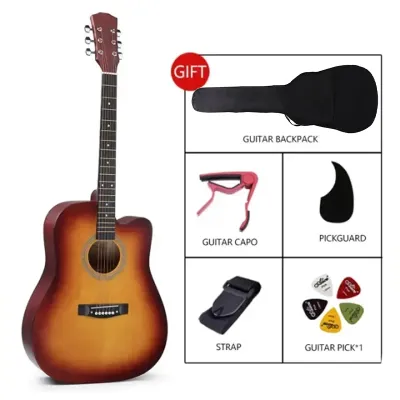
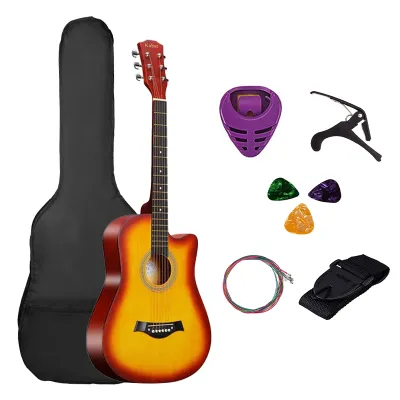


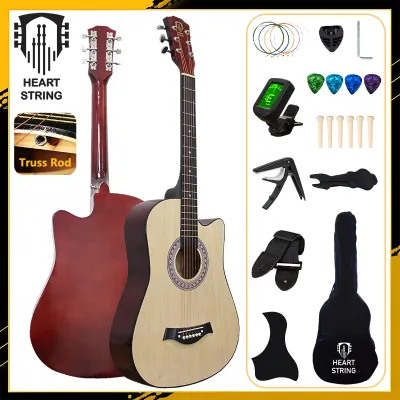
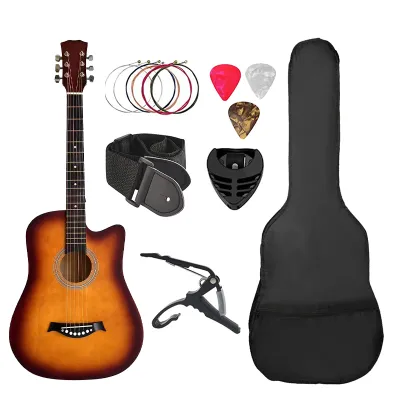

Prices are valid at publication and may change. Please refer to the product page for the latest price.
For a more comfortable alternative, look at Concert, Grand Auditorium, or Parlor shapes. These designs feature a pinched waist and a shallower body depth, allowing the instrument to sit lower on your lap. This ergonomic positioning reduces shoulder strain and makes it much easier to drape your strumming arm naturally over the lower bout of the guitar.
Scale length—the distance between the nut and the bridge—is another critical specification that directly impacts playability. A shorter scale length reduces the overall tension of the strings, making them softer and easier to press down. This is a massive advantage for beginners who have not yet developed finger calluses or hand strength.
Before finalizing your choice, use this quick physical checklist in the store:
- Sit down and rest the guitar on your leg without a strap; your fretting arm should reach the first fret comfortably without fully straightening your elbow.
- Ensure your strumming shoulder does not feel raised or tense when resting your forearm on the edge of the body.
- Stand up with a guitar strap to verify that the body does not feel excessively bottom-heavy or prone to slipping.
Tonewoods: Solid vs. Laminate and What They Mean for Sound
When reading guitar specifications, you will constantly encounter the terms “solid wood” and “laminate.” Laminate wood consists of several thin layers of wood pressed and glued together. It is highly durable, cost-effective, and exceptionally resistant to temperature and humidity fluctuations. In tropical climates like the Philippines, where high humidity and sudden weather shifts can warp delicate instruments, a laminate construction offers excellent peace of mind and requires far less maintenance.

Solid wood, on the other hand, consists of a single continuous piece of timber. A solid wood top (or soundboard) vibrates much more freely than laminate, producing a richer, louder, and more resonant tone that actually improves as the wood ages. However, solid wood is more sensitive to cracking under extreme dry or humid conditions and carries a higher price tag.
For a beginner, a hybrid approach is often the smartest choice. Look for a guitar with a “solid top” paired with “laminate back and sides.” Because the top soundboard is responsible for roughly 80 percent of the guitar’s acoustic tone, this combination gives you the rich resonance of solid wood where it matters most, while retaining the structural durability and affordability of laminate on the back and sides.
To verify what you are actually buying, inspect the edge of the soundhole closely. On a genuine solid-top guitar, you will see the natural wood grain lines wrap continuously from the top surface down through the inner edge of the soundhole. If the edge looks perfectly uniform, painted over, or shows distinct horizontal layers like plywood, it is a laminate top, regardless of what the marketing label suggests.
Neck Profile and Action: The True Drivers of Playability
The neck of the guitar is your primary point of contact, making its physical dimensions crucial to your daily practice. The neck profile refers to the shape of the back of the neck. Most modern beginner guitars feature a slim “C-shape” profile, which fits comfortably in the palm of most hands and allows for an easy grip during early chord transitions. Avoid thick, vintage “V-shape” or classical-style flat necks starting out, as they require a wider hand span that can quickly cause finger fatigue.
Nut width determines the spacing between the strings. A standard nut width of around 43 millimeters (1.69 inches) is the sweet spot for most beginners. If the nut is too narrow, your fingers may accidentally crowd adjacent strings and muffle your chords; if it is too wide, stretching your fingers to reach basic chord shapes becomes unnecessarily difficult.
String action—the height of the strings above the fretboard—is the single most important factor in how easy a guitar is to play. If the action is too high, you will have to press down incredibly hard to produce a clean note, resulting in sore fingers and poor technique. If the action is too low, the strings will rattle against the metal frets, causing an annoying buzz.
When shopping, look for a guitar with an adjustable truss rod, which is a metal rod running inside the neck that allows a technician to adjust the neck relief and action. It is highly recommended to budget a small amount of ₱ for a professional setup at a local music shop. A technician can adjust the nut, saddle, and truss rod to ensure the action is as low and comfortable as possible for a beginner.
Specs You Can Safely Ignore as a Beginner
It is easy to get distracted by premium cosmetic features that add to the cost of a guitar without offering any practical benefit to your learning journey. Gold-plated tuning machines, multi-colored body binding, and intricate fretboard inlays look beautiful, but they have absolutely zero impact on how the instrument plays or sounds. Standard chrome die-cast tuners are perfectly reliable and will keep your guitar in tune just fine.
Similarly, do not worry about exotic back-and-side tonewoods like koa, rosewood, or cocobolo. While experienced players appreciate the subtle tonal differences these woods offer, a beginner’s ear will rarely distinguish them, especially on laminate-body instruments. Standard mahogany or maple laminates are excellent, reliable choices.
Finally, complex internal bracing patterns and premium bone nuts or saddles are details you can safely overlook. Standard factory-installed plastic components are entirely sufficient for your first year of playing. Focus your attention on a comfortable neck and a body shape that makes you want to pick up the instrument and practice every single day.
Frequently Asked Questions (FAQ)
Does a cutaway body shape significantly reduce acoustic volume?
A cutaway is a scooped-out section of the guitar body near the neck joint designed to give your hand easier access to the higher frets. While removing a portion of the body technically reduces the internal air volume of the soundbox, the actual difference in unplugged volume and projection is virtually imperceptible to the human ear. If you plan to play lead melodies or high-register solos, a cutaway is a highly practical design choice that will not compromise your overall acoustic tone.
Should I prioritize a built-in pickup for my first acoustic guitar?
Unless you have immediate plans to perform live on stage or plug directly into a PA system, a built-in pickup is not a priority for a beginner. Onboard electronics add extra weight, require battery maintenance, and increase the retail price of the instrument. That extra cost is often better spent on a higher-quality solid wood top or a professional setup. If your needs change in the future, you can easily have a high-quality aftermarket pickup installed by a local luthier.

Community discussion
Share your experience or ask a question. Comments are reviewed before publication.