
Selecting your first acoustic guitar is a highly personal decision that directly impacts how quickly you progress. When looking at the Kawes acoustic guitar lineup, the choice comes down to physical compatibility rather than finding a single universally optimal model. For a complete beginner, the physical comfort of holding the instrument and pressing down on the strings is the single most important factor in maintaining a consistent practice routine. By understanding how different body sizes, such as 38-inch and 41-inch frames, and body styles, like cutaway and non-cutaway designs, affect your playing posture and tone, you can select an instrument that feels like an extension of your body.
Understanding Kawes Guitar Sizes for Beginner Comfort
A 38-inch guitar is often classified as a parlor or 3/4-size instrument. It features a shorter scale length, which means the frets are spaced closer together. This closer spacing is incredibly beneficial for players with smaller hands, younger learners, or adults with a shorter arm span, as it reduces the physical stretch required to form basic chords like C major or G major.
The smaller body also rests more comfortably under the arm, preventing shoulder strain during long practice sessions. This makes it an excellent choice for casual practicing in a variety of seating positions.
Products mentioned in this guide
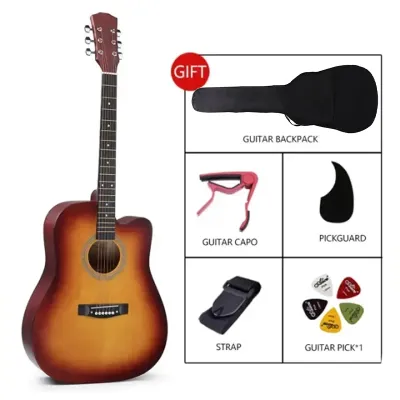
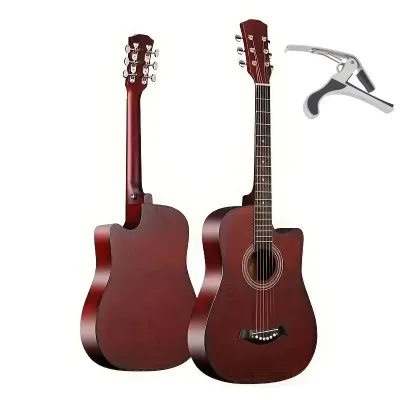
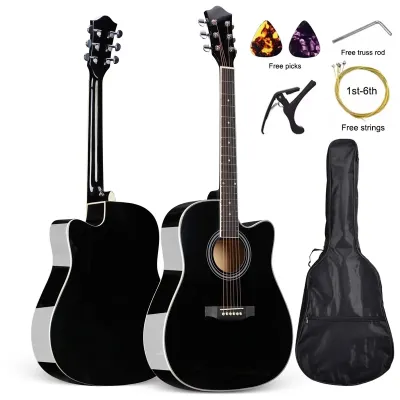
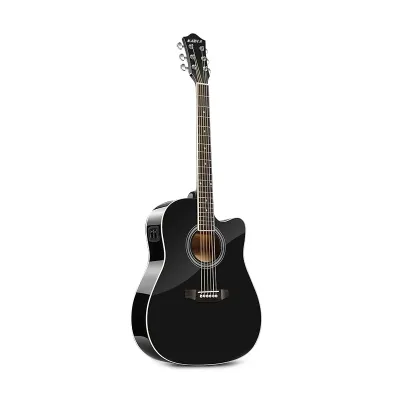
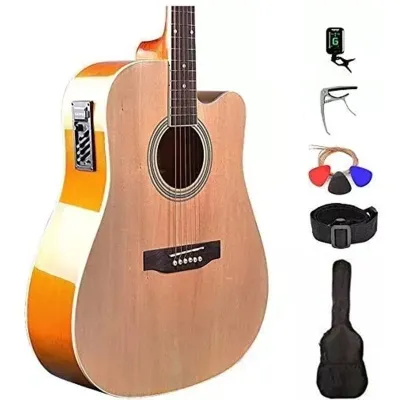
Prices are valid at publication and may change. Please refer to the product page for the latest price.
Conversely, a 41-inch guitar represents the standard dreadnought size. This is the classic acoustic guitar shape that most people picture. The larger body cavity allows for a much deeper, louder, and more resonant sound, with a pronounced bass response.
For average to tall adults, a 41-inch model provides excellent ergonomics, allowing the right arm to drape naturally over the lower bout of the instrument. However, for smaller individuals, reaching around a 41-inch body can cause the shoulder to shrug upward, leading to muscle fatigue and tension in the neck and back.
To estimate the most comfortable size at home before making a purchase, you can perform a simple arm-span and hand-span check. Stand naturally and extend your fretting arm. If your arm length from shoulder to wrist is under 60 centimeters, or if your comfortable hand span (from the tip of your thumb to the tip of your pinky finger when fully splayed) is under 18 centimeters, a 38-inch model will likely offer a much more manageable learning curve.
If your measurements exceed these marks, the standard 41-inch size will provide the proper physical resistance and scale length for your frame. This ensures your hands have enough room to navigate without feeling cramped.
Another factor to consider is how size influences string tension and neck width. Shorter scale lengths, like those found on 38-inch models, naturally require less tension to tune the strings to standard pitch. This lower tension makes the strings feel softer and easier to press down, which is a massive advantage for beginners who have yet to develop finger calluses.
A 41-inch model, with its longer scale length, requires higher string tension. This means your fingers will have to work slightly harder initially, though this helps build finger strength and calluses more rapidly. Understanding these physical differences helps you choose an instrument that matches your current physical comfort level.
Cutaway vs Non-Cutaway: Which Body Style Fits Your Learning Goals?
The silhouette of your guitar plays a significant role in both its acoustic properties and its playability. A traditional non-cutaway acoustic guitar features a symmetrical, figure-eight body shape. This classic design maximizes the internal volume of the soundbox, allowing air to vibrate freely and produce a balanced, warm, and full-bodied tone.

If your primary goal is to learn rhythm guitar, strum open chords, accompany singing, or play traditional folk and acoustic rock, a non-cutaway model is highly recommended. The complete body ensures you get the maximum natural resonance and projection from the wood.
A cutaway guitar, on the other hand, features a scooped-out section on the upper treble bout, right where the neck meets the body. This design modification is purely functional: it allows your fretting hand to easily reach the higher frets (typically past the 12th fret) without being blocked by the guitar body.
If you are drawn to fingerstyle arrangements, classical pieces, or acoustic lead solos that require navigating the entire length of the fretboard, a cutaway model provides the necessary physical clearance. It allows for a seamless transition into more advanced playing styles later on.
For the vast majority of complete beginners, starting with a non-cutaway body style is highly practical. During the first six to twelve months of learning, almost all instructional material, chord shapes, and basic exercises are confined to the first five frets of the guitar. You will rarely, if ever, need to access the upper register of the fretboard during this initial phase.
Choosing a non-cutaway model ensures you do not sacrifice any lower-end resonance or volume, giving you a richer sound as you practice your first chords. However, if you have a specific, immediate goal to learn modern fingerstyle techniques, a cutaway model remains a viable and stylish alternative.
Essential Physical Checks Before Buying Your First Kawes Guitar
Whether you are purchasing your guitar from a local music store or ordering through an online marketplace, performing a thorough physical inspection is crucial to ensure the instrument is set up correctly for a beginner. The most critical specification to check is the string action, which refers to the distance between the bottom of the strings and the top of the frets, usually measured at the 12th fret.
If the action is too high, you will have to exert excessive force to press the strings down, resulting in severe finger pain and poor note clarity. Conversely, if the action is too low, the strings will vibrate against the frets, causing an annoying buzzing sound. Look for an action height of around 2.0mm to 2.5mm on the high E string and 2.5mm to 3.0mm on the low E string.
Next, run your hand gently along both sides of the neck to inspect the fret edges. In tropical climates like the Philippines, fluctuations in humidity can cause the wood of the fretboard to shrink slightly, leaving the metal fret ends protruding. These sprouting frets can feel sharp and can easily scratch your hand as you slide up and down the neck.
Ensure the fret edges are smooth and flush with the wood. Additionally, turn each tuning peg slowly to verify that they operate smoothly without slipping, sticking, or feeling loose, as stable tuning gears are essential for keeping your instrument in tune.
When buying from online platforms, you must take extra precautions since you cannot handle the instrument beforehand. Always verify the seller’s return and replacement policies to ensure you can exchange the guitar if it arrives damaged or warped. Carefully examine user-uploaded photos in the review section to confirm the actual appearance of the wood finish, as promotional images can sometimes be misleading.
Finally, inspect the bridge (where the strings attach to the body) and the nut (at the top of the neck) to ensure there are no visible cracks, gaps, or signs of lifting. These checks help prevent structural instability and ensure your guitar remains playable for years to come.
Building Your Beginner Shortlist: Matching Specs to Your Needs
To make your final decision, you can synthesize these physical and stylistic factors into a personalized decision matrix. If you have a smaller physical build, shorter arms, or are buying for a teenager, and your main goal is to strum chords and sing, a 38-inch non-cutaway Kawes guitar is the most logical and comfortable starting point.
If you are an adult of average or tall height who wants to focus on fingerstyle arrangements and solo melodies, a 41-inch cutaway model will provide the necessary scale length, resonance, and upper-fret access. This combination supports both physical comfort and long-term musical growth.
Budget is another practical consideration, especially when evaluating beginner bundles. Many Kawes guitars are sold as packages that include accessories such as a gig bag, a digital clip-on tuner, spare strings, picks, and a strap. While these bundles offer excellent convenience, always evaluate the quality of the guitar itself first.
It is far better to spend your budget in ₱ on a well-constructed, highly playable guitar and buy accessories separately later, rather than choosing a lower-quality instrument simply because it comes with a large bundle of cheap accessories. Prioritizing the instrument’s build quality will save you frustration and money in the long run.
Whenever possible, visit a local physical store in the Philippines to hold the different sizes in your lap. Pay close attention to how the weight feels against your body and how comfortably your hand wraps around the neck profile. If visiting a store is not feasible, select an online seller that offers a reliable trial period. This allows you to unbox the guitar at home, check the setup, and ensure that the physical dimensions feel comfortable before committing to the instrument long-term.
Frequently Asked Questions (FAQ)
Is a 38-inch Kawes guitar considered a full-size instrument?
A 38-inch guitar is generally classified as a compact, parlor, or 3/4-size acoustic guitar rather than a standard full-size dreadnought. However, it is a fully functional, legitimate musical instrument and should not be confused with a toy. It is specifically designed for younger players, petite adults, or travelers who require a highly portable instrument.
For adults with smaller frames or shorter arm spans, a 38-inch model can serve as an excellent, highly comfortable primary instrument that makes the initial stages of learning significantly easier. It allows you to focus on technique without fighting the bulk of a larger body.
Do I need an acoustic-electric (pickup) model as a beginner?
For the vast majority of complete beginners, a pure acoustic model without built-in electronics is more than sufficient. Acoustic-electric guitars feature an internal pickup and preamp system that allows you to plug the instrument into an amplifier or PA system, which is essential for live performances, band rehearsals, or direct recording.
Since your initial months of learning will be spent practicing privately at home, you do not need this amplification capability. Choosing a pure acoustic model allows you to allocate your entire budget toward the structural quality and playability of the guitar itself, ensuring you get the best possible wood and construction for your money.

Community discussion
Share your experience or ask a question. Comments are reviewed before publication.