
Choosing your first portable keyboard is an exciting milestone, but navigating the differences between entry-level models can quickly become overwhelming. For those exploring the portable Casiotone lineup, the decision often comes down to two popular models: the Casio CT-S300 and the Casio CT-S100. Both instruments share a sleek, highly portable footprint designed for modern spaces, but they cater to fundamentally different learning paths.
The direct verdict depends entirely on your musical goals and budget. The Casiotone CT-S300 is the superior choice for serious beginners, students taking formal lessons, and anyone interested in digital music production, primarily because it features touch-sensitive keys and a USB-MIDI port. On the other hand, the Casiotone CT-S100 serves as a highly simplified, budget-friendly option best suited for young children, casual hobbyists, or those who simply want a basic, fuss-free instrument to play familiar melodies without worrying about expressive dynamics.
Core Specifications and Direct Comparison
To understand why these two models diverge in performance, it helps to look at their core hardware specifications side by side. While they share the same physical aesthetic and key count, the internal components and connectivity options differ in ways that directly impact how long the instrument will remain useful as you progress.
Products mentioned in this guide
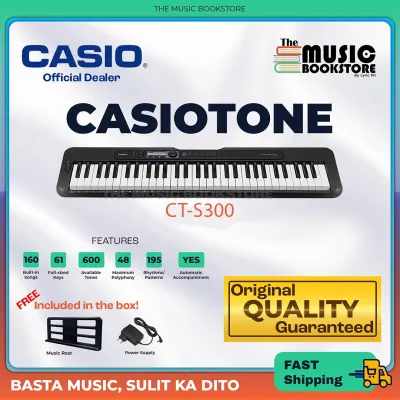
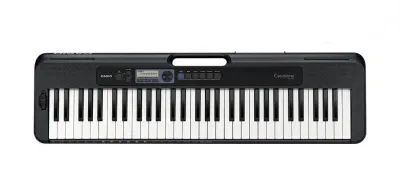
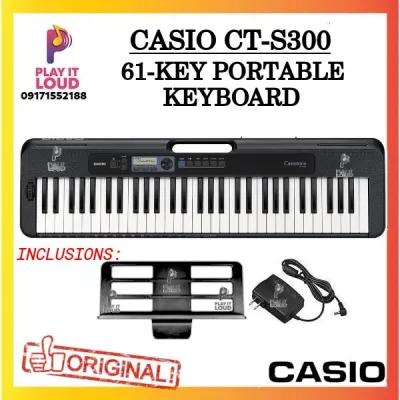
Prices are valid at publication and may change. Please refer to the product page for the latest price.
| Feature | Casiotone CT-S100 | Casiotone CT-S300 |
|---|---|---|
| Number of Keys | 61 standard-size keys | 61 standard-size keys |
| Touch Sensitivity | No | Yes (2 sensitivity levels, off) |
| Pitch Bend Wheel | No | Yes |
| Sustain Pedal Jack | No | Yes (1/4-inch jack) |
| USB-MIDI Connectivity | Micro-B (verify data limits) | Micro-B (class-compliant MIDI) |
| Built-in Tones | Basic selection | Expanded selection |
| Built-in Rhythms | Standard accompaniment | Expanded accompaniment |
Because manufacturers occasionally update hardware revisions or regional packages, you should always verify the exact specifications, included accessories, and port configurations against the official product manual or local distributor documentation before finalizing your purchase.
Keyboard Action and Playability for Beginners
The most critical difference between these two keyboards lies in the keyboard action, specifically the presence of touch sensitivity. The CT-S300 features touch-responsive keys, meaning the volume and character of the sound change depending on how hard or soft you strike the keys. If you press a key gently, it produces a soft, quiet tone; if you strike it quickly and firmly, the sound is loud and bright.

In contrast, the CT-S100 lacks touch sensitivity. No matter how much force you apply to the keys, the volume remains completely uniform. For absolute beginners, a non-touch-sensitive keyboard might initially feel easier to play because it requires less finger control to maintain a steady volume. However, this lack of dynamic response quickly becomes a limitation. Without touch sensitivity, you cannot perform classical pieces, expressive pop ballads, or modern songs that rely on subtle emotional shifts between quiet and loud passages.
Learning on a keyboard with touch response, like the CT-S300, is essential for developing proper finger strength, hand posture, and musical expression. If you plan to transition to an acoustic piano or a fully weighted digital piano in the future, practicing on a touch-sensitive keybed ensures you do not develop bad habits, such as hitting the keys with flat fingers or failing to control your dynamics. If possible, visit a local music showroom to physically press the keys on both models; feeling the physical resistance and hearing the dynamic feedback firsthand can make your decision much clearer.
Sounds, Rhythms, and Built-in Learning Tools
Beyond the physical feel of the keys, the internal sound engines of these two models offer different levels of creative flexibility. The CT-S300 comes equipped with an expanded library of built-in tones and accompaniment rhythms compared to the more streamlined CT-S100. This broader sound palette allows beginners to experiment with different genres, from traditional grand pianos and electric organs to modern synthesizer leads and drum kits.
For young children or those who prefer a straightforward user interface, the simplified sound bank of the CT-S100 can actually be an advantage. With fewer buttons and options to navigate, younger players are less likely to get distracted by sound effects and can focus entirely on learning basic note layouts and simple melodies. However, older beginners and teenagers may find that they quickly outgrow a limited sound library once they begin experimenting with songwriting or playing along with their favorite tracks.
Both models offer built-in metronomes and basic lesson functions to help you practice timing, but the CT-S300 provides better integration with modern educational software. By connecting the keyboard to a tablet or smartphone, students can access interactive learning apps that guide them through sheet music, offer real-time feedback, and turn practice sessions into engaging games. Before purchasing, check the compatibility requirements of your preferred learning app to ensure it supports the specific operating system of your mobile device.
Portability, Design, and Connectivity Options
Both the CT-S100 and the CT-S300 excel in physical design, featuring a lightweight chassis and an integrated carrying handle molded directly into the body. This makes either keyboard incredibly easy to move around the home, pack into a gig bag, or transport to music lessons and school performances.
For players living in tropical climates like the Philippines, portability and power flexibility are major practical considerations. Both keyboards can run on standard AA batteries, which is incredibly convenient during sudden power outages or when playing outdoors where wall outlets are unavailable. Additionally, because high humidity and dust can affect electronic key contacts over time, the lightweight design makes it easy to store the keyboard in a protective gig bag or cover it with a dust cloth when not in use.
When it comes to connectivity, the CT-S300 offers a much more robust set of ports. It includes a dedicated 1/4-inch jack for a sustain pedal, which is a fundamental accessory for sustaining notes and creating smooth transitions between chords. The CT-S100 does not support a sustain pedal, which severely limits its usability for standard piano repertoire. Both models feature a headphone jack for silent practice, which is essential for busy households or late-night sessions, but you must verify the exact cable types and adapter sizes needed to connect your specific headphones or external speakers.
Price Evaluation and Value for Money
Because retail prices fluctuate across physical music boutiques, authorized dealers, and online marketplaces, it is important to evaluate these instruments based on long-term value rather than just the initial price tag. The CT-S100 is naturally the more affordable option, making it an attractive entry point if you are on a strict budget or unsure if you or your child will stick with the instrument.
However, when calculating the true cost of ownership, the CT-S300 often represents better value for money. If you purchase the CT-S100, you may find yourself needing to upgrade to a touch-sensitive keyboard within six to twelve months as your playing skills improve. This means you will end up spending more money in the long run compared to investing slightly more upfront for the CT-S300, which can easily support your learning journey for several years.
When shopping in the local market, be cautious of unauthorized online sellers offering unusually low prices, as these listings may exclude essential accessories like the power adapter or music stand, and they rarely include a valid manufacturer warranty. Always verify what is included in the box and prioritize authorized dealers who offer reliable customer support and warranty coverage to protect your investment against manufacturing defects.
Final Decision Framework: Which Model Fits You?
To make your final choice as straightforward as possible, consider how your specific circumstances align with the following buying guidelines.
Choose the Casiotone CT-S100 if:
- You are shopping for a young child: The simplified interface and lack of complex settings make it an excellent, distraction-free toy or introductory instrument for toddlers and early elementary students.
- You have a strict budget limit: If you cannot stretch your budget past the entry-level price point, the CT-S100 provides a reliable, brand-name option that is far better than generic, unbranded keyboards.
- You only want to play casual melodies: If you do not plan to take formal piano lessons and simply want to play basic melodies or trigger simple backing rhythms for fun, the lack of touch sensitivity will not hinder your enjoyment.
Choose the Casiotone CT-S300 if:
- You are taking formal piano lessons: The touch-sensitive keys are absolutely essential for learning dynamics, building finger strength, and preparing for acoustic pianos.
- You want to connect to a computer or tablet: The reliable USB-MIDI connectivity and sustain pedal input make the CT-S300 a highly functional MIDI controller for music production software and interactive learning apps.
- You want an instrument that grows with you: The expanded sound library, pitch bend wheel, and expressive keybed ensure that you won't need to upgrade to a new keyboard after just a few months of practice.
Verify first before you buy:
- Check local stock and bundle deals: Many retailers offer bundles that include a keyboard stand, a sustain pedal, headphones, or a carrying bag, which can save you a significant amount of money compared to buying these accessories separately.
- Confirm power adapter compatibility: Ensure the package includes a compatible power adapter suitable for your local voltage standards, or prepare to purchase compatible rechargeable AA batteries for portable play.
- Verify app compatibility: If you plan to use a specific learning app, double-check the connection requirements and ensure you have the correct USB adapter cable to link your tablet or phone to the keyboard's Micro-B port.
Frequently Asked Questions (FAQ)
Can I connect these keyboards to a computer for music production?
Yes, but your experience will differ significantly between the two models. The Casiotone CT-S300 features a class-compliant USB Micro-B port that supports MIDI, allowing you to connect it directly to a computer, tablet, or smartphone to control virtual instruments in digital audio workstations (DAWs) or interactive learning apps. The CT-S100 also features a USB port, but its MIDI capabilities and driver compatibility can be more limited depending on your operating system. Always check the manufacturer’s official specifications to verify if the CT-S100 supports full MIDI communication with your specific computer software before purchasing it for recording purposes.
Do I need to buy a separate sustain pedal and stand?
In most cases, yes. Standard retail packages for both the CT-S100 and CT-S300 typically include only the keyboard itself, a music sheet stand, and a power adapter. Keyboard stands and sustain pedals are usually sold separately, though some retailers offer them as part of a promotional bundle. If you choose the CT-S300, purchasing a compatible sustain pedal with a standard 1/4-inch plug is highly recommended, as it is essential for playing intermediate piano pieces. Note that the CT-S100 does not have a sustain pedal input, so you cannot use a physical sustain pedal with that model.
Are these keyboards suitable for advanced piano students?
No, neither of these models is suitable for advanced classical piano study. Both instruments feature 61 non-weighted, synth-style keys, which lack the heavy resistance and physical hammer action of an acoustic piano. Advanced piano repertoire requires a full 88-key keyboard with fully weighted keys to execute complex dynamics, rapid repetitions, and wide octave leaps. While the CT-S300 is an excellent, highly portable tool for beginners, casual practice, or songwriting, students progressing to intermediate and advanced classical levels should look to upgrade to a dedicated 88-key weighted digital piano.

Community discussion
Share your experience or ask a question. Comments are reviewed before publication.