
Starting a career in the fast-paced financial sector of the Philippines can be intimidating, especially if your academic background did not heavily emphasize advanced mathematics. When entering roles in corporate finance, investment analysis, or business planning, you will quickly realize that success relies less on memorizing abstract formulas and more on translating raw data into strategic decisions. Choosing the right managerial statistics book is your first step toward bridging this gap. The ideal textbook acts as a practical guide, transforming complex quantitative concepts into intuitive, actionable insights that you can immediately apply to your daily tasks.
For young professionals, the search should focus on resources that prioritize conceptual clarity over rigorous mathematical proofs. Instead of spending hours deriving equations by hand, you need to understand what the numbers mean for a company’s bottom line. A well-chosen book will help you build analytical confidence, allowing you to communicate effectively with senior management and make data-driven recommendations that drive business growth.
Key Criteria for Choosing a Beginner-Friendly Statistics Book
When browsing through the vast selection of academic and professional literature, it is easy to get overwhelmed by dense, formula-heavy volumes. To find a book that truly serves a beginner in finance, you must look for specific pedagogical features that prioritize practical business application. The primary goal of managerial statistics is to help you make decisions under uncertainty, which means the text should focus on the “why” and “how” of data analysis rather than the tedious mechanics of manual calculation.
Products mentioned in this guide
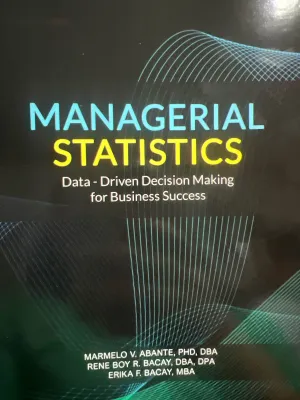
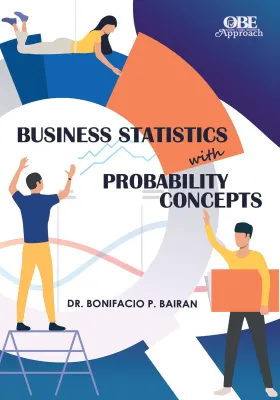
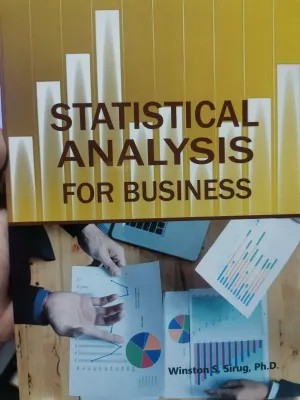
Prices are valid at publication and may change. Please refer to the product page for the latest price.
First, prioritize books that offer intuitive explanations and visual data representations. A high-quality textbook uses charts, graphs, and flowcharts to explain statistical concepts before introducing any mathematical notation. Visual aids help demystify abstract ideas like variance or probability distributions, making them easier to grasp for those who identify as visual learners. Look for chapters that conclude with conceptual summaries, which distill complex topics into key takeaways that you can easily review before a meeting or presentation.
Second, the inclusion of real-world business, economics, and finance case studies is non-negotiable. Abstract formulas mean very little without context. A great managerial statistics book will place you in the shoes of a financial analyst, a portfolio manager, or a marketing strategist. By working through scenarios that involve real corporate data—such as analyzing consumer spending habits in Southeast Asian markets or evaluating the risk profile of a new investment project—you learn how statistical tools are applied in actual corporate environments.
Third, pay close attention to the author’s writing style and the book’s overall tone. For non-math majors, a conversational, encouraging tone can make a significant difference in maintaining engagement. The text should guide you through step-by-step problem-solving frameworks, breaking down complex analyses into manageable phases. This structured approach prevents cognitive overload and helps you develop a systematic way of thinking about data that will serve you throughout your career.
Finally, ensure the textbook emphasizes the interpretation of statistical outputs rather than manual computation. In modern financial roles, software handles the heavy lifting of calculation. Your value as a professional lies in your ability to look at a software-generated regression table or hypothesis test result and explain what it means for the business. Choose a book that dedicates ample space to interpreting computer outputs, helping you translate statistical jargon into clear, professional language that stakeholders can easily understand.
Essential Topics the Book Must Cover for Finance Roles
To ensure your chosen textbook is a valuable investment for your career, it must cover a specific suite of statistical tools that are standard in entry-level finance and business analysis. While statistics is a broad field, certain core topics are directly applicable to the daily responsibilities of a financial professional. Verifying that these topics are thoroughly explained will help you build a solid foundation for your analytical tasks.

Descriptive statistics and data visualization form the bedrock of any financial analysis. Your book must teach you how to summarize large datasets using measures of central tendency (like mean and median) and measures of dispersion (such as standard deviation and variance). Additionally, it should cover how to present this data clearly using histograms, scatter plots, and box plots. In your daily work, you will often be asked to clean and summarize financial reports or market trends; mastering these basic tools ensures your presentations are both accurate and visually compelling.
Probability distributions and risk assessment basics are equally critical, especially for roles involving portfolio management and financial forecasting. The textbook should introduce you to key concepts like the normal distribution, binomial distribution, and expected value. Understanding these probability models allows you to assess the likelihood of various financial outcomes, quantify investment risks, and make informed decisions when dealing with volatile market conditions. A solid grasp of risk assessment helps you contribute meaningfully to discussions about asset allocation and capital budgeting.
Another essential area is hypothesis testing and confidence intervals. These tools are vital for validating business strategies, evaluating the success of marketing campaigns, or conducting A/B testing on financial products. Your book should guide you through the process of setting up null and alternative hypotheses, choosing the correct test statistic (such as t-tests or z-tests), and interpreting p-values. This knowledge empowers you to determine whether a change in financial performance is statistically significant or simply the result of random market fluctuations.
Lastly, the textbook must provide a comprehensive introduction to simple and multiple regression analysis. Regression is one of the most powerful tools in a financial analyst’s toolkit, used for identifying correlations, predicting future revenues, and modeling complex financial variables. The book should explain how to build a regression model, evaluate its goodness of fit using R-squared, and check for potential issues like multicollinearity. Mastering regression analysis allows you to uncover the underlying drivers of business performance and build reliable forecasting models that support long-term strategic planning.
How to Evaluate Book Formats and Learning Aids
Selecting the right book involves more than just checking the table of contents; you must also evaluate how the material is delivered and what supplementary tools are provided. The right format and learning aids can significantly enhance your self-study efficiency, helping you retain complex information and apply it to practical scenarios.
Start by assessing the availability of digital learning resources, such as downloadable datasets, practice problem solutions, and self-test quizzes. Learning statistics requires active practice, and you cannot master the material simply by reading. Having access to the raw data files used in the book’s examples allows you to replicate the analyses on your own computer. Detailed, step-by-step solutions to end-of-chapter problems are also invaluable, as they allow you to identify errors in your logic and correct them before moving on to more advanced topics.
When deciding between a physical textbook and an e-book, consider your personal study habits and daily routine. Physical textbooks are excellent for deep-focus study sessions, allowing you to easily flip between pages, write margin annotations, and avoid the screen fatigue that often comes with long hours of digital work. On the other hand, e-books offer unmatched portability, allowing you to study during your daily commute or reference key concepts while at your desk. Many digital editions also feature search functions, making it quick and easy to find specific terms or formulas when you are in the middle of a project.
Additionally, verify if the book includes access codes for online learning platforms, interactive dashboards, or supplementary video tutorials. Many modern publishers offer companion websites that feature interactive simulations, which can help you visualize statistical concepts like the Central Limit Theorem in real-time. Video tutorials can also be incredibly helpful, providing a visual walkthrough of complex procedures that might be difficult to follow through text alone. However, be sure to check whether these digital resources require an active subscription or are included in the purchase price of the book.
Finally, pay close attention to the software integration focus of the textbook. The book you choose should teach statistical concepts using the tools that are currently standard in your target industry. For most entry-level finance roles, Excel is the absolute standard, and a book that integrates Excel formulas and Data Analysis Toolpak instructions will provide immediate practical value. If you are aiming for roles that lean toward quantitative research or data science, you might instead look for textbooks that incorporate programming languages like Python or R, helping you build highly marketable technical skills.
Where to Buy and Verify Editions in the Philippines
Sourcing academic textbooks in the local market requires a careful approach to ensure you receive authentic, high-quality materials that contain all necessary learning aids. Because international editions and older versions are common, taking the time to verify your purchase will save you from frustration and ensure you have the exact resources needed for your professional development.
To guarantee authenticity, purchase your books from reputable sources such as university bookstores, authorized physical retailers, or official brand stores on major online marketplaces. These sellers work directly with publishers, ensuring that you receive genuine copies that are free from printing defects. When shopping on e-commerce platforms, look for verified mall badges or official distributor stores to avoid counterfeit products that may have missing pages or low-quality printing.
Always cross-check the ISBN-13 of the book before finalizing your purchase. The International Standard Book Number is a unique 13-digit identifier that specifies the exact edition, format, and publisher of the text. Publishers frequently release updated editions to correct errors, update datasets, and introduce new software instructions. Buying an outdated edition might mean you are working with obsolete software guides or missing critical chapters. Comparing the ISBN-13 listed on the publisher’s official website with the seller’s listing is the most reliable way to ensure you are getting the correct, up-to-date version.
Be highly cautious of unauthorized sellers offering textbooks at suspiciously low prices. While a cheap physical copy may seem tempting, these are often pirated reproductions. Beyond the ethical and legal concerns, pirated books almost never include valid access codes for digital learning platforms, online homework systems, or downloadable datasets. Lacking these resources can severely limit your ability to practice and master the material, ultimately costing you more in lost learning opportunities.
If you are on a tight budget, exploring the second-hand market for physical copies is a viable alternative. Many university students and young professionals sell their gently used textbooks after completing their courses. When buying second-hand, inspect the physical condition of the book for excessive highlighting or missing pages. Most importantly, keep in mind that any digital access codes included with a second-hand book have likely already been redeemed, meaning you may need to purchase digital access separately if it is required for your studies.
Frequently Asked Questions (FAQ)
Do I need a strong calculus background to understand managerial statistics?
No, you do not need a background in calculus to master managerial statistics. Most business-focused textbooks are specifically designed for students and professionals who may not have a strong mathematical background. These resources rely primarily on basic algebra, arithmetic, and logical reasoning. The primary focus of managerial statistics is on conceptual understanding, software execution, and the practical interpretation of results, rather than deriving complex mathematical proofs or performing manual calculus calculations.
Should I choose a book that focuses on Excel or Python?
Your choice should depend on your immediate career goals and the daily tasks of your target role. For most entry-level finance and business analysis positions, an Excel-focused book is highly recommended. Excel is the universal language of corporate finance, and mastering its statistical functions will allow you to perform daily modeling and reporting tasks efficiently. However, if you plan to transition into quantitative finance, risk modeling, or data science, a book that integrates Python or R will help you build the programming skills necessary for handling large-scale data automation and advanced statistical modeling.

Community discussion
Share your experience or ask a question. Comments are reviewed before publication.