
Choosing your first electronic keyboard is a critical decision that shapes your early learning experience, finger technique, and overall enjoyment of music. For many beginners in the Philippines, the choice often comes down to two highly popular 61-key models: the Yamaha PSR-E273 and the Casio CT-S1. While both instruments target entry-level players, they represent fundamentally different philosophies of what a beginner instrument should be. The yamaha psr e273 is designed as an interactive, feature-rich learning station packed with sound effects, auto-accompaniment styles, and onboard educational games. In contrast, the Casio CT-S1 stripped-back approach prioritizes high-quality piano tones, touch-sensitive keys, and a minimalist aesthetic that fits modern living spaces.
Your final decision should depend on your primary learning goals, musical preferences, and how you plan to practice. If you are buying a keyboard for a young child, want an all-in-one educational tool with interactive quizzes, or enjoy playing along with full backing bands, the Yamaha PSR-E273 offers an engaging, self-contained package. However, if your goal is to transition to an acoustic piano, practice expressive dynamics, or connect your instrument to modern learning apps on a tablet, the Casio CT-S1 is the more capable and future-proof investment. Balancing these distinct features against your budget and space constraints will guide you to the right keyboard for your musical journey.
Core Specifications: Yamaha PSR-E273 vs Casio CT-S1
To understand how these two instruments compare on paper, it is helpful to look at their core technical specifications. These metrics establish a baseline for what each keyboard can achieve in terms of performance, connectivity, and physical portability.
Products mentioned in this guide
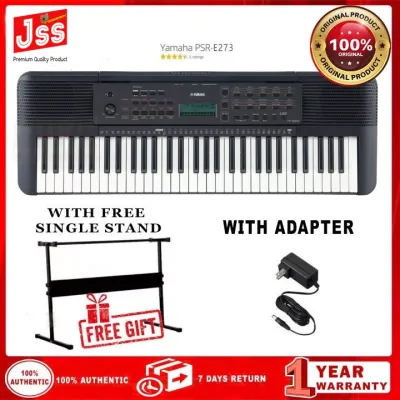
Prices are valid at publication and may change. Please refer to the product page for the latest price.
| Feature | Yamaha PSR-E273 | Casio CT-S1 |
|---|---|---|
| Number of Keys | 61 keys (organ-style) | 61 keys (piano-style) |
| Touch-Sensitive Keys | No | Yes (3 sensitivity levels, plus Off) |
| Maximum Polyphony | 32 notes | 64 notes |
| Tone Generation Engine | AWM Stereo Sampling | AiX Sound Source |
| Built-in Tones | 384 Voices + 17 Drum/SFX Kits | 61 Tones (including Advanced & Casio Classic Tones) |
| Auto-Accompaniment Styles | 143 Styles | None |
| USB MIDI Connectivity | No | Yes (Micro-USB Type-B) |
| Bluetooth Capability | No | Yes (via optional WU-BT10 adapter) |
| Weight (Without Batteries) | 4.0 kg (8.8 lbs) | 4.5 kg (9.9 lbs) |
| Power Options | 12V DC Adapter or 6 AA batteries | 9.5V DC Adapter or 6 AA batteries |
These specifications highlight a clear divide. The Yamaha PSR-E273 focuses on a massive variety of sounds and auto-accompaniment features to keep casual players entertained. The Casio CT-S1, on the other hand, doubles the polyphony limit and introduces touch-sensitive keys, making it a far more expressive instrument for serious piano study.
Sound Engines and Audio Quality
The auditory experience of an electronic keyboard relies heavily on its internal sound engine and speaker design. Yamaha and Casio handle tone generation differently in these models, resulting in distinct acoustic profiles that suit different musical genres and environments.

The Yamaha PSR-E273 utilizes Yamaha’s long-running Advanced Wave Memory (AWM) Stereo Sampling engine. This system delivers reliable, traditional acoustic instrument sounds, alongside a vast library of 401 total voices. If you enjoy experimenting with synthesizers, woodwinds, brass, and novelty sound effects (such as animal noises and sirens), the Yamaha provides endless variety. However, with a maximum polyphony of 32 notes, the PSR-E273 can struggle with note dropouts if you play dense chords while running an auto-accompaniment style and holding down a sustain pedal.
In contrast, the Casio CT-S1 features the advanced AiX Sound Source, which is designed to reproduce the complex resonances of acoustic instruments. Instead of focusing on hundreds of generic sounds, the CT-S1 offers 61 highly curated, premium tones. The acoustic piano samples are notably richer and more dynamic than those on the Yamaha, capturing the subtle decay of the strings. Additionally, the CT-S1 includes vintage electric piano, organ, and classic synthesizer sounds modeled after iconic instruments from the 1970s and 1980s. With 64-note polyphony, the Casio easily handles complex classical pieces without cutting off active notes.
Speaker performance also differs significantly. The Yamaha PSR-E273 is equipped with two 12cm speakers driven by a 2.5W + 2.5W amplifier, delivering clear, mid-range-focused sound suitable for a quiet bedroom. The Casio CT-S1 uses a unique horizontal bass reflex system paired with specialized oval speakers (2.5W + 2.5W). This design produces a surprisingly warm, full-bodied sound with noticeable bass response despite the keyboard’s slim profile. If you practice in a larger living room or a space with high ambient noise, the Casio’s sound projection feels more robust and immersive.
For quiet, late-night practice sessions—especially in shared apartments or condominiums where noise is a concern—both keyboards feature a dedicated headphone output. Yamaha uses a standard 1/4-inch stereo headphone jack, while Casio utilizes a 1/8-inch (3.5mm) mini-jack. Be sure to verify your headphone plug size before purchasing, as you may need a simple adapter to connect your existing headphones.
Keybed Feel and Playing Experience
The physical sensation of pressing the keys is one of the most critical factors for any keyboard learner. It directly impacts the development of your finger strength, hand posture, and musical expressiveness.
The most significant limitation of the Yamaha PSR-E273 is its lack of touch-sensitive keys. On this model, every key strike produces the same volume, regardless of whether you press the key gently or strike it with force. While this is acceptable for absolute beginners learning basic note locations, it presents a major obstacle as you progress. Without touch sensitivity, you cannot practice dynamics (playing piano/soft or forte/loud), which is fundamental to classical, jazz, and expressive pop music. If you plan to transition to an acoustic piano or a fully weighted digital piano in the future, learning on a non-touch-sensitive keyboard can lead to poor finger habits that are difficult to correct later.
The Casio CT-S1 addresses this issue by providing touch-sensitive, velocity-responsive keys. The keyboard measures the speed and force of your key strikes, allowing you to control the volume and tonal character of each note. This feature makes the CT-S1 feel much closer to a real piano. The keys themselves are shaped like traditional acoustic piano keys with closed, boxed sides, rather than the thin, open-backed organ-style keys found on the Yamaha. The Casio keybed also features a subtle matte texture on the key surfaces, which helps prevent your fingers from slipping during long practice sessions in warm, humid tropical climates.
While neither keyboard features fully weighted hammer-action keys (which are heavier and typically found on more expensive digital pianos), the Casio CT-S1 offers a far superior keybed feel. It provides just enough spring resistance to help beginners build basic finger strength while offering the dynamic control necessary to play expressively.
Built-in Lessons and Device Connectivity
Modern technology has transformed how beginners learn to play the keyboard. Onboard educational tools and digital connectivity can make self-guided practice much more effective and engaging.
Yamaha designed the PSR-E273 to be a completely self-contained learning tool. It features the Yamaha Education Suite (Y.E.S.), which includes structured, three-step lesson functions to help you learn built-in songs at your own pace. You can practice one hand at a time while the keyboard waits for you to play the correct note. It also includes a unique “Quiz Mode” that plays sound effects or musical notes and asks you to identify them, which is excellent for developing ear training in young children. However, the PSR-E273 completely lacks a USB port, meaning you cannot easily connect it to a computer, iPad, or smartphone to use modern interactive learning apps like Simply Piano, Flowkey, or Yousician.
Conversely, the Casio CT-S1 embraces modern digital connectivity. It features a micro-USB Type-B port that allows you to connect the keyboard directly to your tablet, smartphone, or computer. It is class-compliant, meaning it works instantly without requiring complex driver installations. This allows you to use the keyboard as a MIDI controller for digital audio workstations (DAWs) or interactive learning apps. Additionally, the CT-S1 is compatible with Casio’s free Chordana Play app, which guides you through songs using a visual falling-notes interface.
For those who prefer a wireless setup, the Casio CT-S1 supports the optional Casio WU-BT10 Bluetooth MIDI and Audio Adapter (sold separately). When plugged into the keyboard’s USB Type-A port, this adapter allows you to stream audio from your phone directly through the keyboard’s high-quality speakers, or send wireless MIDI data to your tablet. This level of connectivity makes the Casio CT-S1 a far more versatile option for tech-savvy learners who want to leverage digital learning platforms.
Design, Portability, and Power Flexibility
For many household settings, the physical footprint, weight, and visual appeal of an instrument are just as important as its technical specifications. This is especially true in compact urban homes or for players who need to transport their instrument frequently.
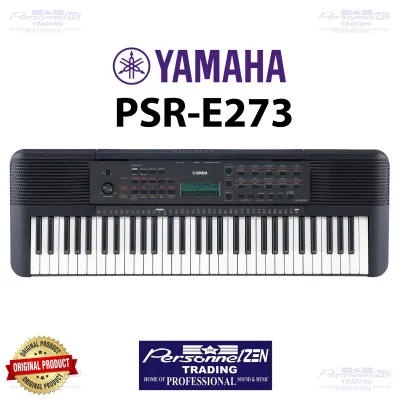
The Yamaha PSR-E273 features a traditional, utilitarian portable keyboard design. It has a wide gray-and-black plastic chassis, a small central LCD screen, and a control panel crowded with buttons, labels, and text. While this interface makes it easy to select specific voices and styles directly, it occupies a larger physical footprint. The PSR-E273 weighs 4.0 kg, making it highly portable and easy to move around the house or pack into a car.
The Casio CT-S1 takes a radically different design approach, embracing a sleek, minimalist aesthetic. It features a very narrow chassis with a stylish fabric speaker grille, rounded corners, and a clean control panel with only a few essential buttons. There is no screen; instead, you select tones and settings using simple button combinations. This modern look allows the CT-S1 to blend seamlessly into contemporary home decor, looking more like an elegant piece of furniture than a plastic toy. It is available in black, white, and red finishes. Despite its solid build, it weighs only 4.5 kg and features integrated strap locks, allowing you to attach a standard guitar strap and play while standing.
Both keyboards offer excellent power flexibility, which is highly practical in areas prone to power fluctuations or for outdoor performances. They can run on their included AC power adapters or on six standard AA batteries.
- Yamaha PSR-E273: Offers approximately 5 hours of continuous operation on alkaline batteries.
- Casio CT-S1: Offers approximately 3 hours of continuous play on alkaline batteries due to its more powerful sound processor.
If you plan to use battery power frequently, investing in high-quality rechargeable Ni-MH batteries is highly recommended to reduce long-term costs and environmental waste.
Pricing, Inclusions, and True Value
When evaluating the cost-effectiveness of these instruments, it is important to look beyond the initial purchase price and consider the total cost of ownership, including essential accessories.
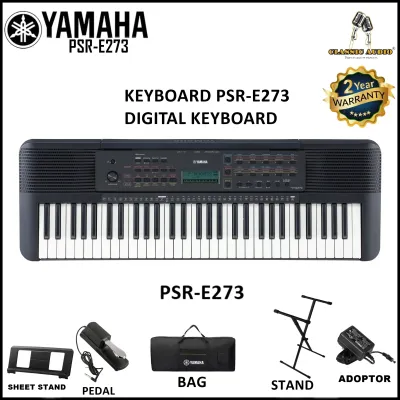
In the Philippine market, the Yamaha PSR-E273 is positioned as a highly budget-friendly entry point. It typically retails in the price band of ₱7,500 to ₱9,500 at authorized local music retailers and official online flagship stores. The standard retail package generally includes:
- The PSR-E273 keyboard unit
- A detachable music rest
- A compatible AC power adapter (usually the Yamaha PA-130)
- An owner's manual
The Casio CT-S1 sits in a slightly higher price tier, reflecting its superior keybed, advanced sound engine, and premium design. It generally retails in the price band of ₱11,500 to ₱14,500, depending on the retailer and any ongoing promotions. The standard box contents usually include:
- The CT-S1 keyboard unit
- A detachable music rest
- A compatible AC power adapter (Casio AD-E95100L)
- Strap locks for attaching a guitar strap
- An owner's manual
To calculate the “true cost” of getting started, you must factor in several essential accessories that are not included in either standard package:
- Sustain Pedal: Essential for learning proper piano technique. A standard 1/4-inch sustain pedal (such as the Yamaha FC5 or a generic equivalent) will cost between ₱800 and ₱1,500.
- Keyboard Stand: A sturdy double-X stand is highly recommended to keep the keyboard stable and at the correct playing height, costing around ₱1,000 to ₱2,000.
- Dust Cover: Essential for protecting the internal electronics and key contacts from tropical dust and humidity, costing approximately ₱300 to ₱600.
While the Yamaha PSR-E273 has a lower upfront cost, the Casio CT-S1 offers significantly better long-term value. Because the Casio features touch-sensitive keys and USB MIDI connectivity, it can support your learning journey for several years. The non-touch-sensitive Yamaha, while cheaper, may require you to upgrade to a better instrument within six to twelve months as your playing skills outgrow its technical limitations.
Final Decision Framework
To make your final purchase decision, evaluate your specific learning environment, musical goals, and budget against these conditional guidelines.
Choose the Yamaha PSR-E273 if:
- You are buying for a young child: The interactive Quiz Mode, animal sound effects, and built-in educational games are excellent for keeping young minds engaged.
- You want a self-contained learning system: You prefer to learn using the keyboard's built-in screen and lessons, without needing to connect to a tablet or computer.
- You love backing bands and variety: You enjoy playing along with auto-accompaniment styles, drum beats, and a massive library of diverse instrument sounds.
- You are on a strict budget: You want the lowest possible entry price to see if you or your child will commit to learning the keyboard.
Choose the Casio CT-S1 if:
- You want to learn proper piano technique: The touch-sensitive keys are absolutely essential for developing dynamic control and finger strength.
- You prioritize piano sound quality: You want rich, realistic acoustic piano tones and warm speaker performance rather than hundreds of synthetic sound effects.
- You plan to use learning apps: You want to connect the keyboard easily to an iPad, Android tablet, or computer via USB or wireless Bluetooth to use apps like Simply Piano or Chordana Play.
- You value home aesthetics: You prefer a sleek, compact, and modern instrument that looks great in a living room or bedroom.
Verify first before you buy:
- Authorized Source: Always purchase from authorized local music distributors in the Philippines (such as Yupangco Music for Yamaha or JB Music for Casio) to ensure you receive an authentic product and a valid local warranty.
- In-Store Testing: If possible, visit a local showroom to feel the difference between the non-touch-sensitive keys of the PSR-E273 and the textured, touch-sensitive keys of the CT-S1 in person.
- Accessory Compatibility: Ensure that any third-party sustain pedal or stand you purchase is fully compatible with the specific model you choose.
Frequently Asked Questions (FAQ)
Do I need a sustain pedal for these beginner keyboards?
Yes, a sustain pedal is highly recommended for any beginner learning to play the keyboard. A sustain pedal keeps notes ringing out even after you lift your fingers off the keys, which is essential for playing smooth, connected passages (legato) in most piano music. Neither the Yamaha PSR-E273 nor the Casio CT-S1 includes a sustain pedal in the standard box, so you will need to purchase one separately. Both keyboards feature a standard 1/4-inch (6.3mm) sustain pedal jack on the rear panel, making them compatible with almost any universal sustain pedal. When buying a third-party pedal, ensure it has a polarity switch so it functions correctly with your chosen brand.
Can I connect these keyboards directly to my smartphone or tablet?
You can easily connect the Casio CT-S1 to a smartphone or tablet, but doing so with the Yamaha PSR-E273 is highly difficult. The Casio CT-S1 features a class-compliant Micro-USB Type-B port. To connect it to an iOS device, you will need a Lightning-to-USB Camera Adapter or a USB-C to Micro-USB cable. For Android devices, a standard USB On-The-Go (OTG) adapter is required. Alternatively, you can use the optional Casio WU-BT10 Bluetooth adapter for a wireless connection. The Yamaha PSR-E273 does not have a USB port or MIDI output, meaning it cannot transmit digital MIDI data to learning apps; it only features an analog Aux Input, which allows you to play audio from your phone through the keyboard’s speakers, but does not support interactive app-based learning.

Community discussion
Share your experience or ask a question. Comments are reviewed before publication.