
Choosing the right piano stand is just as important as selecting the keyboard itself, as it directly impacts your playing posture, instrument safety, and overall performance comfort. The ideal stand depends on your keyboard’s weight, your playing environment, and whether you prioritize portability or structural stability. While some musicians require a lightweight frame that folds flat for quick transport between gigs, others need a heavy-duty, stationary platform that can support a fully weighted 88-key digital piano without wobbling. Understanding how X-stands, Z-stands, and table stands differ in construction and ergonomics will help you make an informed decision that protects your investment and enhances your playing experience.
Understanding the Core Differences in Stand Designs
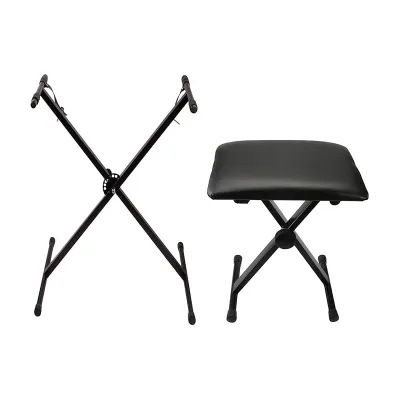
Piano stands are generally categorized by their frame geometry, which dictates how they support weight and how easily they can be transported. The X-stand is the most common design, featuring a classic scissor-like cross-legged frame. It operates on a central pivot point, allowing the stand to fold completely flat for storage or transport. Because of this mechanism, adjusting the height of an X-stand also changes its width; setting it higher makes the support base narrower, while lowering it widens the footprint.
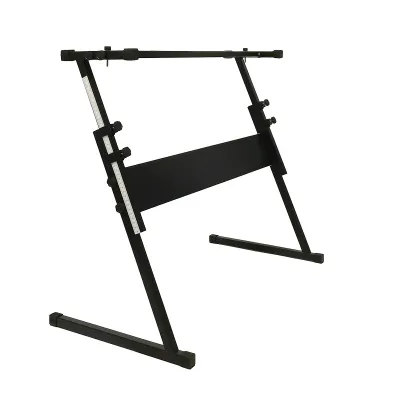
The Z-stand utilizes a parallel-leg design shaped like the letter Z, with two vertical side frames connected by a horizontal center crossbar. This structure distributes weight straight down to the floor along two wide base bars. Unlike the X-stand, the height and width adjustments on a Z-stand are completely independent of each other. This design keeps the space directly beneath the keyboard entirely open, providing a structural profile that closely resembles a traditional desk.
Products mentioned in this guide
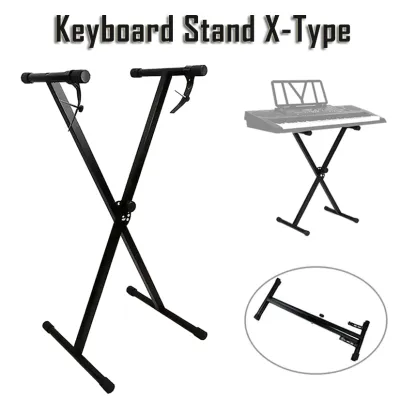
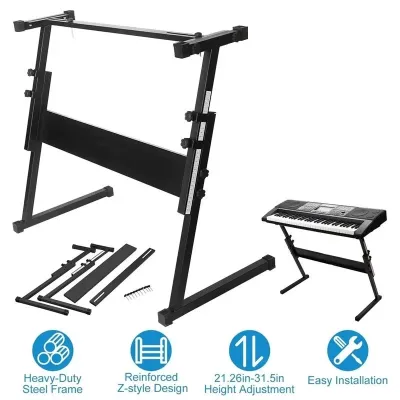
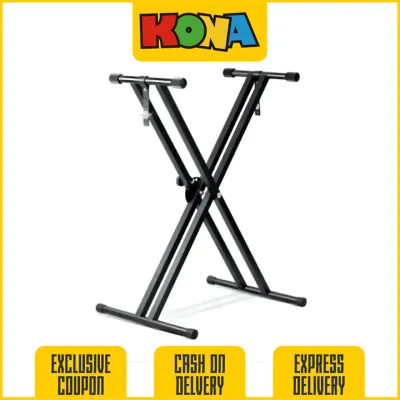
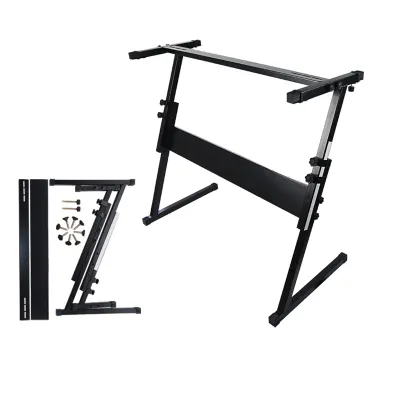
Prices are valid at publication and may change. Please refer to the product page for the latest price.
Table stands, sometimes referred to as platform or utility stands, feature a four-legged design similar to a folding table. The legs typically fold inward flat against the top frame for transport, and each leg can often be adjusted individually to compensate for uneven floors. For home environments, furniture-style wooden stands are a specialized subset of table stands. These are solid, cabinet-like structures designed specifically for particular digital piano models, offering a permanent, aesthetically integrated look that mimics an acoustic upright piano.
Comparing Stability, Space, and Ergonomics
Stability is a primary concern for any keyboardist, especially when playing dynamic passages or using heavy, weighted-action keys. X-stands are highly convenient but are inherently more prone to lateral wobble because they rely on a single central bolt or clutch mechanism. This side-to-side movement can be amplified on tiled floors or uneven surfaces. In contrast, Z-stands and table stands offer superior weight distribution. By spreading the load across four contact points or two wide, parallel base plates, these designs minimize sway and remain highly stable even under aggressive playing styles.

Legroom and pedal access are critical for maintaining proper ergonomics during long practice sessions. The crossing bars of an X-stand occupy the exact space where your knees and shins naturally rest when seated. This design forces players to either splay their knees outward or sit too far back from the keys, both of which can lead to poor posture and lower back strain. Z-stands and table stands leave the entire under-keyboard area clear. This open space allows you to sit at the correct height with your knees bent at a natural 90-degree angle, while also providing plenty of room to position sustain and expression pedals exactly where you need them.
Portability and storage requirements vary greatly depending on whether you are a touring musician or a home hobbyist. X-stands excel in portability, folding down into a single, flat piece that can easily fit into a car trunk, a closet, or behind a door. Z-stands are significantly bulkier; even when disassembled or folded, their rigid side frames require more storage space and take longer to set up. Table stands offer a middle ground, folding relatively flat while maintaining a rectangular footprint that is slightly wider than a collapsed X-stand but much easier to pack than a Z-stand.
Matching the Stand to Your Keyboard and Playing Style
Selecting the right stand requires analyzing your specific instrument and how you plan to use it. If you play a lightweight, 61-key or 76-key synthesizer, arranger keyboard, or MIDI controller, an X-stand is often the most practical and budget-friendly choice. It is highly suitable for temporary setups, casual home practice, or situations where you must frequently pack up and move your gear. However, if you plan to use an X-stand, look for double-braced models rather than single-braced versions, as the extra parallel bars provide a significant boost in structural integrity.
A Z-stand is the ideal match for medium-to-heavy 88-key stage pianos and workstations. If you perform live on stage, play while standing, or practice complex classical pieces that require heavy key strikes, the rigid frame of a Z-stand ensures your keyboard remains perfectly still. The open legroom also makes it the preferred option for seated players who use multiple floor pedals. While it represents a larger physical footprint and a higher price point, the ergonomic benefits and stability are essential for serious keyboardists.
Table and furniture stands are best suited for dedicated home or studio environments. If you own a premium 88-key digital piano with weighted hammer-action keys and want it to serve as a permanent fixture in your living space, a matching wooden furniture stand is highly recommended. These stands often support proprietary triple-pedal units that bolt directly into the frame, preventing the pedals from sliding away during use. For multi-keyboard setups or heavy mixing gear in a studio, a heavy-duty steel table stand provides a flat, unyielding surface that can handle substantial weight without flexing.
Before making a final decision, always cross-reference your keyboard’s physical dimensions and weight with the stand’s specifications. Never assume a stand will fit your keyboard based on brand matching alone. Measure the depth of your keyboard’s base to ensure it will sit securely on the stand’s support arms without hanging over dangerously, and verify that the stand’s minimum width adjustment is narrow enough to support your instrument’s frame.
Key Specifications to Verify Before Buying
To ensure safety and compatibility, you must carefully verify several manufacturer specifications before purchasing a piano stand. The most critical metric is the weight capacity. Compare the net weight of your keyboard—which can be found in your owner’s manual—against the maximum load rating of the stand. Keep in mind that dynamic playing increases the downward force applied to the stand, so it is wise to choose a stand with a weight capacity that comfortably exceeds your keyboard’s actual weight.
Height adjustment range is another vital factor, particularly if you alternate between sitting and standing while playing. Standard acoustic piano keys sit approximately 72 to 74 centimeters above the floor. Ensure the stand can be adjusted to position your keyboard’s keys at this height when you are seated on your bench. If you prefer to play standing up, verify that the stand can extend high enough to keep your elbows at a comfortable 90-degree angle without requiring you to hunch forward.
Width and depth adjustability determine how securely the keyboard rests on the support arms. Some stands feature adjustable width bars that slide outward to accommodate longer instruments, while others have fixed widths. Ensure the support arms are deep enough to cradle the bottom of your keyboard securely. Many stands also include rubberized grip pads or locking straps that screw into the bottom of compatible keyboard models to prevent the instrument from sliding off the frame.
Finally, consider pedal compatibility and floor conditions. If you live in a humid tropical climate, steel stands with high-quality powder coating are essential to prevent rust over time. Additionally, check the feet of the stand; adjustable leveling feet are highly beneficial for stabilizing your setup on slightly uneven tiled floors. If you plan to use a heavy sustain pedal, ensure the bottom crossbars of the stand do not interfere with the pedal’s placement or cause it to slide out of reach while you play.
Frequently Asked Questions (FAQ)
Can I use an X-stand for a heavy 88-key digital piano?
While some double-braced X-stands are rated to support the weight of a heavy 88-key digital piano, they are generally not recommended for daily use with these instruments. The high center of gravity of a heavy keyboard combined with the narrow top support bars of an X-stand can make the entire setup top-heavy and prone to tipping if bumped. Furthermore, the lack of legroom makes seated playing highly uncomfortable on an 88-key instrument, as you cannot sit close enough to maintain proper arm and wrist alignment. For heavy 88-key digital pianos, a Z-stand or a dedicated table stand is a much safer and more ergonomic choice.
Do all piano stands support sustain pedals?
All piano stands can accommodate standard, independent single sustain pedals that sit directly on the floor, though the ease of placement varies. On an X-stand, the lower crossing bars can sometimes limit where you can comfortably place the pedal, occasionally causing it to slide backward during play. Z-stands and table stands offer completely unobstructed floor space, making it easy to position any standard floor pedal. However, if you wish to use a traditional triple-pedal unit (sustain, soft, and sostenuto) that mimics an acoustic piano, these typically require a compatible, model-specific wooden furniture stand to provide the necessary mounting points and structural support.
Community discussion
Share your experience or ask a question. Comments are reviewed before publication.