
Choosing the right organ keyboard stand is just as critical as selecting the instrument itself, directly impacting your playing posture, safety, and overall musical experience. The ideal stand depends entirely on your instrument’s weight, your playing posture, and whether you need to transport your setup. X-frame stands offer maximum portability for lightweight keyboards, Z-frame stands provide superior legroom and stability for mid-weight instruments, and table stands deliver a permanent, rock-solid foundation for heavy digital pianos and studio work. By matching the structural design of these stands to your specific playing environment—whether a compact apartment or a dedicated music studio—you can protect your investment and ensure a comfortable performance.
Understanding the Core Designs
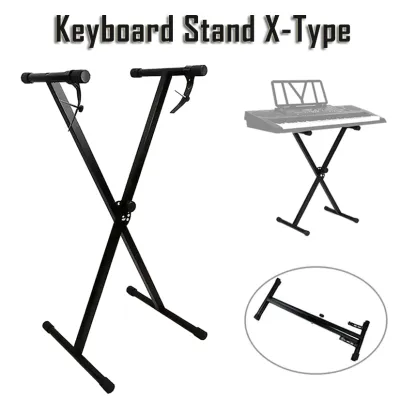
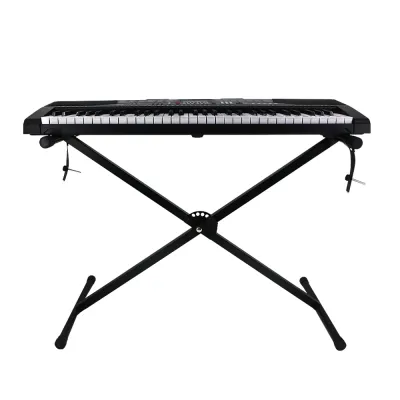
To make an informed decision, you must first understand how each of these three primary stand types is engineered. The X-frame organ keyboard stand is the most common design on the market, recognizable by its cross-braced legs that intersect at a central pivot point. This structure operates much like a pair of scissors, allowing the stand to fold completely flat for storage or transport. It is highly favored by gigging musicians and beginners who need to clear up floor space in multi-use rooms.
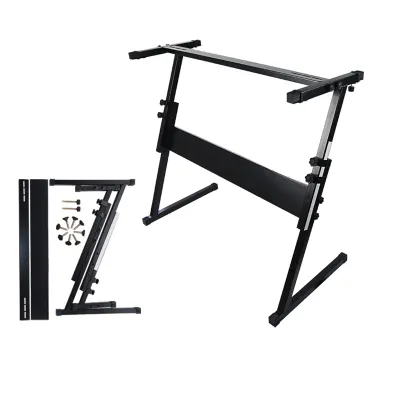
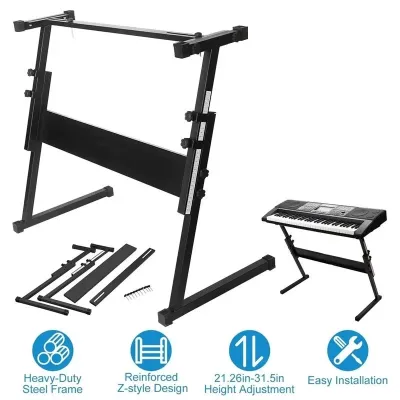
The Z-frame stand, as the name suggests, features two vertical pillars shaped like the letter “Z” connected by a center crossbar. This design distributes the weight of the keyboard straight down to a wide, rectangular base footprint. Unlike the X-frame, the Z-frame does not have crossing bars directly underneath the center of the keyboard, leaving the space beneath the instrument entirely open.
Products mentioned in this guide


Prices are valid at publication and may change. Please refer to the product page for the latest price.
The table stand, sometimes referred to as a platform or desk-style stand, consists of four independent legs or a heavy-duty perimeter frame resembling a utility table. This design is built for maximum structural rigidity and is frequently integrated with studio furniture or set up as a permanent fixture. It provides a flat, level surface that can support the heaviest digital pianos and multi-keyboard setups without bowing or shifting.
Key Comparison Dimensions for Your Setup
Stability and Weight Capacity
When comparing stability, the physical footprint and center of gravity of each stand type play a decisive role in how your instrument behaves during intense play. X-frame stands have a narrower base relative to their height, which can cause a slight side-to-side wobble when you play energetically on the upper or lower registers. This effect is amplified when the stand is adjusted to its tallest setting, as the base footprint narrows even further.

Z-frame stands offer a significantly lower center of gravity and a wider, more stable base footprint that resists tipping. The vertical pillars absorb lateral forces, making them highly reliable for mid-weight keyboards and synthesizers. However, for heavy 88-key digital pianos with fully weighted hammer-action keys, table stands generally offer the highest rigidity. The four-legged design distributes weight evenly across four distinct points on the floor, virtually eliminating any flexing or swaying. Always check the manufacturer’s stated maximum load capacity on the product label rather than relying on visual estimates, as material thickness and weld quality vary greatly.
Portability and Storage
If you frequently travel for gigs, rehearsals, or community events, portability is likely your top priority. The X-frame stand excels in this category due to its quick-collapse mechanism. With a single pull of a spring-loaded pin or clutch, the entire stand folds flat in seconds, making it easy to slide into a car trunk or carry with one hand.
Z-frame stands are considerably less travel-friendly. While many models can be disassembled, doing so usually requires loosening several hand screws or bolts, which adds time to your setup and teardown routine. They are also heavier and bulkier to transport even when broken down. Table stands are generally intended for permanent or semi-permanent placement in a home or studio. Although some table stands feature folding legs, their overall frame remains wide and heavy, making them impractical for daily travel.
Ergonomics and Legroom
Ergonomics are crucial for preventing fatigue and maintaining proper playing posture, especially during long practice sessions. Standard X-frame stands present a major ergonomic challenge: the crossing metal bars directly obstruct your knees and shins when you sit down. This forces many players to sit further back or splay their legs outward, which can lead to back strain and makes it difficult to reach foot pedals naturally.
Z-frame stands solve this issue by keeping the lower space completely open. With no central obstruction, you have ample legroom to sit comfortably at the correct height, and you can position sustain, expression, or damper pedals exactly where you need them. Table stands offer similar ergonomic freedom, providing a completely clear space beneath the keyboard. When integrating a table stand with an existing desk or bench, you must consider the fixed height and depth of the stand to ensure your elbows remain at a comfortable 90-degree angle relative to the keys.
Matching the Stand to Your Playing Scenario
Selecting the right stand is a matter of balancing your instrument’s physical requirements with your daily playing habits.
Choose an X-frame stand if you prioritize mobility and space-saving convenience. This type is ideal if you frequently travel to different venues, play a lightweight portable keyboard or arranger, or need to pack your gear away after every practice session to keep your living area tidy. It is a practical, cost-effective solution for casual players and temporary setups.
Choose a Z-frame stand if you play seated for long periods, use multiple foot pedals, or need a balance of stability and moderate portability. The open legroom makes it excellent for students, intermediate players, and semi-professional musicians who practice daily at home but still want the option to move their setup occasionally. It provides the necessary support for medium-weight 61-key and 76-key instruments without compromising your posture.
Choose a table stand if you have a dedicated studio space, use a heavy 88-key digital piano or stage piano, and prioritize absolute stability over mobility. This setup is perfect for home studios, music schools, and permanent living room installations where the keyboard remains in one place. The rigid frame ensures that even the most demanding classical pieces or energetic synth solos will not cause your instrument to shake.
Before making your final choice, verify first if your instrument has an unusual depth, non-standard mounting holes, or exceeds typical weight limits. Some vintage organs and specialized synthesizers have unique bottom profiles that may not sit securely on standard rubber grip pads, requiring specialized brackets or custom platform adjustments.
What to Verify Before You Buy
To ensure a safe and seamless setup, you must verify several critical product specifications before finalizing your purchase. First, check the exact weight of your organ or keyboard against the stand’s official maximum load rating. Do not guess the weight of your instrument; consult its user manual or specification sheet, keeping in mind that accessories like music rests and power supplies add to the total load.
Next, verify the adjustable width range of the stand. The support arms must be wide enough to cradle the rubber feet on the bottom of your keyboard securely. If the stand is too narrow, the keyboard may balance precariously; if it is too wide, the instrument’s chassis might sag or slip between the bars.
Confirm the height adjustment mechanism and its minimum and maximum range. Look for secure locking systems, such as a heavy-duty steel pin-lock or a reinforced clutch mechanism, rather than simple friction grips which can slip over time under heavy loads. In humid tropical climates, ensure the metal parts are powder-coated to resist rust, and check that the rubber feet are non-slip to prevent sliding on tiled or polished wooden floors.
Finally, ensure the stand includes or supports necessary accessories if your setup expands. If you plan to add a second keyboard later, verify if the stand is compatible with official tier extensions. Check if there are dedicated mounting points for music stands, headphone hooks, or pedal attachments to keep your playing area organized.
Frequently Asked Questions (FAQ)
Can I use an X-frame stand for a heavy 88-key digital piano?
While some heavy-duty, double-braced X-frame stands are rated for heavier loads, standard single-braced models are not recommended for heavy 88-key digital pianos. The high center of gravity and narrow footprint of an X-frame can cause significant wobbling during expressive play, creating a tipping hazard. For heavy, fully weighted instruments, it is highly recommended to use a Z-frame or a table stand to ensure absolute stability and protect your instrument from accidental falls. Always verify the exact weight limit on the product label before attempting to mount a heavy piano.
Do table stands require drilling into the desk?
No, the vast majority of table-style keyboard stands are completely freestanding structures designed to sit on the floor, over a desk, or as independent units. They do not require any drilling, clamping, or permanent modification to your existing furniture. However, if you are purchasing a specialized under-desk keyboard tray or a studio-specific slide-out mount, you must consult the installation manual to verify if mounting brackets, screws, or drilling are required for secure attachment.
Community discussion
Share your experience or ask a question. Comments are reviewed before publication.