
W. Timothy Gallwey’s classic work, originally published in 1974, revolutionized sports psychology by shifting the focus from physical mechanics to mental mastery. Over the decades, this influential text has transcended the tennis court to become a foundational guide in the personal development space. Its core premise is simple yet profound: the opponent within our own heads is far more formidable than the one across the net. For readers navigating modern life, this book offers a refreshing departure from typical high-pressure self-help guides that demand constant hustle and aggressive self-correction.
In the Philippines, where daily life often involves navigating high-stress environments—from the fast-paced demands of local business process outsourcing offices to the exhausting daily commute through dense urban centers—mental fatigue is a common challenge. Balancing strong family commitments with professional aspirations can create a quiet but persistent pressure to perform. This article evaluates how the book’s core philosophy can be applied to these everyday challenges, helping you manage stress, improve focus, and overcome self-doubt. Additionally, we provide a practical framework to help you select complementary self-help literature that aligns with your personal growth journey, ensuring your reading list translates into meaningful, real-world progress.
Core Concepts: Understanding the 'Inner Game' Philosophy
At the heart of the inner game philosophy is the distinction between two distinct aspects of the mind, which the author labels Self 1 and Self 2. Self 1 is the conscious, analytical, and highly critical mind. It is the voice that tells you what you did wrong, issues constant instructions, and judges your performance harshly. In contrast, Self 2 is the subconscious, natural, and highly capable self. It represents the body’s inherent intelligence, muscle memory, and natural ability to learn through observation and action without the interference of verbal commands.
Products mentioned in this guide



![[READY STOCK] The Inner Game of Tennis Paperback English Book by W. Timothy Gallwey Peak Performance Sports Psychology Classic 身心合一的奇迹力量](https://img.alicdn.com/imgextra/i1/2726038367/O1CN01DYI5AE2Bg8Ud03T1h_!!0-item_pic.jpg_q50.jpg_.webp)

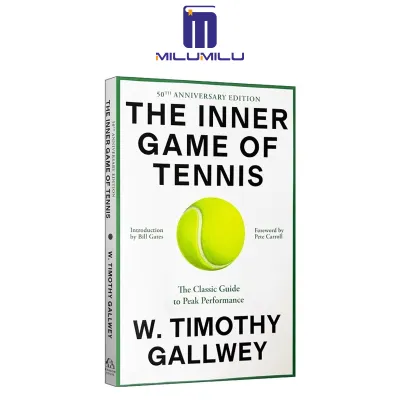
Prices are valid at publication and may change. Please refer to the product page for the latest price.
The conflict between these two selves is where performance anxiety and self-doubt thrive. When Self 1 constantly criticizes and micromanages, it disrupts the natural flow of Self 2, leading to physical tension, mistakes, and frustration. Peak performance is achieved not by trying harder or forcing compliance, but by quietening Self 1. This allows Self 2 to operate freely, a state of mind characterized by relaxed concentration and non-judgmental awareness.
Relaxed concentration is not a state of passive laziness; rather, it is a focused, effortless state of flow where you observe things exactly as they are without immediately labeling them as good or bad. Instead of judging a mistake as a personal failure, you simply observe the outcome as data and allow your natural abilities to adjust. This shift from self-judgment to objective observation is the key to unlocking sustainable growth and learning.
These principles extend far beyond sports and are highly applicable to modern daily anxieties. In a professional setting, such as presenting a major project proposal or handling a difficult client call, an overactive Self 1 can cause you to stutter, overthink, or freeze. By practicing non-judgmental awareness, you can observe your nervousness without letting it spiral into panic. Similarly, when learning a new skill—whether it is mastering a new software suite, practicing a musical instrument, or even learning to drive in chaotic city traffic—quieting the inner critic allows your natural learning mechanisms to take over, making the process smoother and far less exhausting.
Evaluating the Book for Everyday Personal Development
Evaluating this book as a general self-help resource requires assessing how well its sports-centric metaphors translate to everyday life. For most readers, the transition is remarkably seamless. The tennis court serves as a clear, simplified laboratory for human behavior. When the text describes a player overthinking a backhand, it is easy to see the direct parallel to an office worker overthinking an email or a student second-guessing an exam answer. The physical feedback of a tennis ball hitting a racket provides an immediate, tangible illustration of how mental tension directly affects physical and cognitive performance.

This book is particularly valuable for a specific profile of readers: those who struggle with chronic overthinking, perfectionism, performance anxiety, or a harsh inner critic. If you find yourself constantly rehearsing conversations, dwelling on minor mistakes made during a meeting, or feeling paralyzed by the fear of failure, these insights offer a practical path toward mental relief. It teaches you to trust your capabilities and reduce the mental friction that drains your daily energy.
However, readers should also be aware of the book’s limitations. Because it was written primarily as an experiential guide rather than a clinical manual, it lacks the structured, step-by-step cognitive behavioral frameworks found in modern psychology books. It relies heavily on intuitive understanding and self-reflection rather than structured worksheets or clinical exercises. If you require highly structured, evidence-based interventions for deep-seated psychological challenges or clinical anxiety, this book should be viewed as a philosophical companion rather than a standalone therapeutic tool.
How to Select Complementary Self-Help Books
Building a well-rounded personal development library requires a deliberate selection process. Rather than simply buying the latest trending title on social media, you can maximize your growth by choosing books that complement the inner game philosophy. The first step in this decision-making framework is to identify your primary obstacle. If your main struggle is maintaining focus amidst digital distractions, you should look for books on deep work and attention management. If your challenge is translating mental clarity into daily routines, your focus should shift toward habit formation and systems design.
Next, evaluate the author’s background to match your preferred learning and evidence style. Some readers thrive on books written by clinical psychologists or neuroscientists who provide dense, research-backed data and clinical case studies. Others prefer experiential coaches, philosophers, or practitioners who share narrative-driven insights and practical, real-world anecdotes. Understanding whether you need scientific proof or relatable storytelling will help you stay engaged with the material.
Finally, consider the book’s structure in relation to your reading habits and lifestyle. If you prefer active learning, look for workbook-style guides that feature writing prompts, self-assessments, and daily exercises. If you have a busy schedule with limited reading time, a highly structured book with short, actionable chapters or bulleted summaries may be more practical. For those who enjoy deep reflection during a long commute or quiet weekend mornings, a narrative-driven or philosophical text might be the ideal fit.
Recommended Themes and Categories for Further Reading
To build upon the foundation of relaxed concentration, look for books in the category of mindfulness and acceptance. These resources expand on the concept of observing thoughts without judgment, teaching you how to detach from negative self-talk and stay grounded in the present moment. This category is highly beneficial for managing the daily stress of urban living, helping you maintain a calm demeanor even during long delays or high-pressure situations.
Once you have learned to quiet the inner critic, the next logical step is to establish structured routines. Books focusing on habit formation and systems design provide the practical scaffolding needed to turn mental clarity into consistent action. While the inner game helps remove the mental blocks that prevent you from starting, habit-focused books teach you how to design your environment, break down complex goals into manageable steps, and build sustainable daily routines that require minimal willpower.
Additionally, exploring books on cognitive reframing can help you actively dismantle the negative narratives generated by Self 1. These resources offer structured cognitive exercises to challenge irrational beliefs, perfectionist standards, and cognitive distortions. By combining the non-judgmental awareness of the inner game with the active reframing techniques of cognitive behavioral approaches, you create a robust mental toolkit that addresses both the subconscious and conscious aspects of personal growth.
Pre-Purchase and Format Checklist for Self-Help Books
Before purchasing any personal development book, it is essential to verify the specific edition and format to ensure a high-quality reading experience. Check the publication history to see if there are revised or anniversary editions, which often contain updated prefaces, modern examples, or additional chapters that add valuable context.
When sourcing books in the Philippines, pay close attention to language, translation quality, and regional availability. If you are purchasing physical copies from local bookstore chains or online marketplaces, verify that the seller is reputable to avoid low-quality, unauthorized reprints that often suffer from missing pages, blurry text, or poor binding. For translated works, check reader reviews to ensure the translation is accurate and flows naturally.
If you prefer digital reading, confirm device compatibility before buying. Ensure the file format (such as EPUB or proprietary e-reader formats) is fully compatible with your specific e-reader, tablet, or smartphone application. For audiobooks, listen to the sample clip first to evaluate the narrator’s tone, pacing, and audio clarity, as a distracting narration can hinder your ability to absorb complex psychological concepts during your commute or workout.
Lastly, take advantage of online previews to review the table of contents and read a sample chapter. This quick check allows you to assess whether the author’s writing style resonates with you and whether the content addresses your current personal development stage, saving you both time and money.
Frequently Asked Questions (FAQ)
Do I need to play tennis to understand the book's concepts?
No, you do not need any athletic background or knowledge of tennis to fully understand and apply the book’s concepts. The author uses tennis simply as a familiar, practical vehicle to illustrate universal psychological principles. The dynamics of self-criticism, focus, and learning are identical whether you are hitting a ball, writing a report, learning a language, or managing a team.
How long does it typically take to see results from these mental frameworks?
Applying these mental frameworks is a gradual process rather than an overnight transformation. While you may experience immediate moments of clarity or relief when you first practice non-judgmental awareness, lasting behavioral change requires consistent practice. Over time, observing your thoughts without judgment becomes a natural habit, leading to reduced anxiety and improved focus in high-pressure situations.
Are audiobooks effective for this type of personal development reading?
Audiobooks can be highly effective for conceptual and philosophical books, making them excellent companions for long daily commutes or physical activities. However, if a book contains specific exercises, diagrams, or frameworks that you wish to study closely, having a physical copy or a digital text format is often more practical. Many readers find value in listening to the audiobook for initial inspiration and keeping a print copy for active study and highlighting.
Community discussion
Share your experience or ask a question. Comments are reviewed before publication.