
To choose the correct nut file set, you must match the individual file thicknesses to your specific string gauges while selecting an edge profile that suits your guitar type. A file that is too thin will cause the string to bind in the slot, leading to severe tuning instability, while a file that is too thick will allow the string to slide side-to-side, resulting in annoying fret buzz and lost sustain. By matching your file set to your instrument’s unique setup, you ensure a clean, rounded slot bottom that supports the string perfectly.
Filing a nut is one of the most impactful adjustments you can make to a guitar’s playability. It determines the action at the first fret, directly affecting how comfortable the instrument feels to play. Choosing the right tool prevents permanent damage to your instrument and ensures your strings glide smoothly through the slots during tuning and bending.
Identify Your Guitar Type and Nut Material
Guitar nuts are not one-size-fits-all components. Electric, steel-string acoustic, and classical guitars feature distinct structural differences in nut width, string spacing, and fretboard radius. Electric guitars typically have narrower nuts (often 41mm to 43mm) and tight string spacing, requiring highly precise file handling. Steel-string acoustics have slightly wider nuts and carry much higher tension, demanding files that can handle thicker bass string gauges. Classical guitars feature very wide, flat fingerboards and use thick nylon strings, which require wide, smooth, round-bottomed slots that standard electric or acoustic file sets cannot accommodate.
Products mentioned in this guide
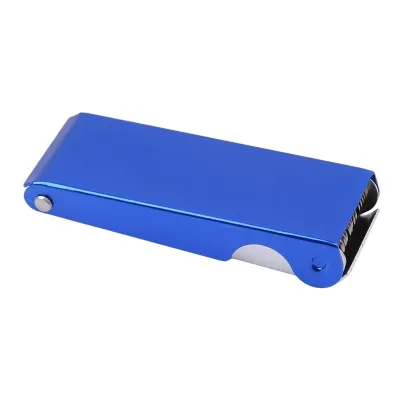
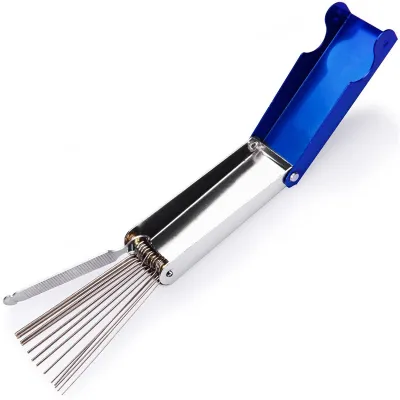

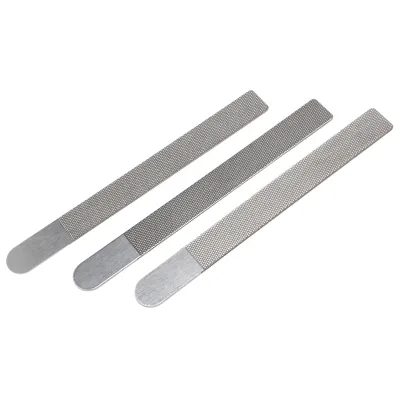
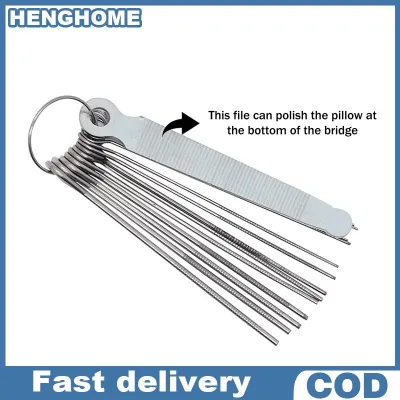
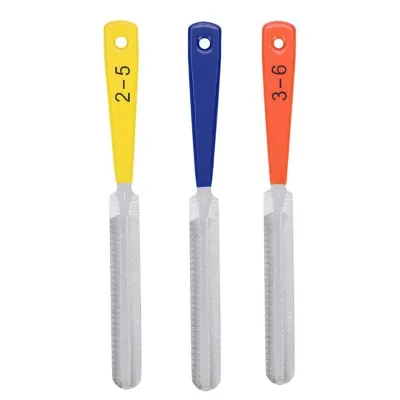
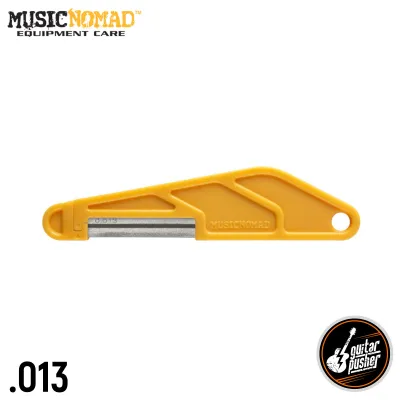
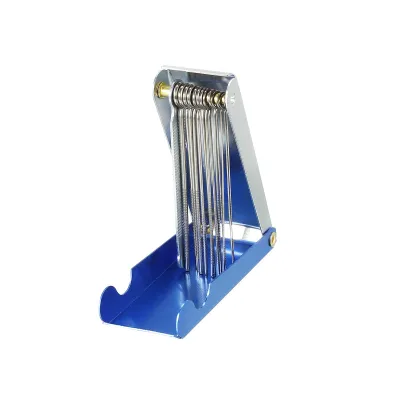
Prices are valid at publication and may change. Please refer to the product page for the latest price.
The hardness of the nut material heavily influences how quickly a file cuts and which tool you should choose. Common materials include:
- Plastic: Found on budget instruments. It is soft and easy to file, but highly prone to melting or binding under the friction of rapid file strokes.
- Bone: The traditional standard for high-quality tone. It is very dense and offers excellent wear resistance, but requires sharp, high-quality files. Filing bone produces a fine white powder and a distinct, sulfur-like odor.
- Tusq and Synthetic Composites: Engineered for consistent density without natural soft spots. They file smoothly and predictably, making them highly user-friendly for DIY setups.
- Brass: Extremely hard and durable. Standard steel files will dull rapidly on brass; cutting these slots effectively requires specialized diamond-coated files.
Before purchasing a nut file guitar set, use this quick diagnostic checklist to identify your current nut material. First, perform a visual inspection under a bright light; plastic is perfectly uniform and often shows tiny mold lines, whereas bone has subtle organic grain lines or tiny pores. Second, try the tap test by gently tapping the nut with a small metal tool, such as a screwdriver; plastic produces a dull, quiet thud, while bone and Tusq emit a bright, glass-like ring. Finally, perform a scraping test on a hidden edge with a utility knife; plastic shaves off in curly, ribbon-like peels, whereas bone and Tusq shave off as a dry, fine powder.
Edge profiles also dictate file selection. Single-edge files feature a single cutting thickness and often come with comfortable handles, offering maximum control and comfort. Double-edge files feature a different thickness on each side, which saves money and space but requires careful handling to maintain the correct angle. Tilted headstocks (such as 3-aside configurations) require files with adequate clearance so you do not accidentally scratch the headstock veneer or the adjacent tuning pegs.
Match File Thickness to Your Exact String Gauge
The fundamental rule of nut slotting is that the slot width must match the string gauge or be slightly wider. Ideally, the slot should be 0.001 to 0.002 inches (0.025 to 0.05 mm) wider than the string diameter. This tiny clearance prevents the string from binding in the slot while keeping it perfectly centered. In tropical climates like the Philippines, high humidity causes the wood of the neck to swell and contract, making a perfectly sized nut slot even more critical to prevent tuning jumps and binding.

If you do not have the original string packaging to verify your gauges, use a digital caliper or micrometer to measure the diameter of each string. Take the measurement near the headstock where the string has not been worn down by fretting. Once you know your exact gauges, you can select the corresponding file sizes.
Refer to this table to map common string configurations to the recommended nut file thicknesses:
| String Type / Note | Standard Gauge (Inches) | Recommended Nut File Size (Inches) |
|---|---|---|
| Electric High E (.009 Set) | .009 | .010 |
| Electric High E (.010 Set) | .010 | .010 or .011 |
| Electric B String (.010 Set) | .013 | .013 or .014 |
| Electric G String (.010 Set) | .017 | .018 or .020 |
| Electric D String (.010 Set) | .026 | .026 or .028 |
| Electric A String (.010 Set) | .036 | .036 or .040 |
| Electric Low E (.010 Set) | .046 | .046 or .050 |
| Acoustic High E (.012 Set) | .012 | .012 or .013 |
| Acoustic Low E (.012 Set) | .053 | .054 or .056 |
| Classical 1st String (Nylon) | .028 | .028 or .030 |
| Classical 6th String (Nylon) | .043 | .044 or .046 |
Filing slots for wound strings presents different challenges than filing plain strings. Wound strings (like the low E, A, and D strings) have a textured outer wrap. If the slot bottom is rough or V-shaped, the wraps will catch on the sharp edges, causing tuning jumps and audible clicking. The file for a wound string must create a perfectly smooth, round U-shape. Plain strings (high E, B, and sometimes G) are smooth but can easily wedge into a slot that is too narrow, causing the string to pinch and go sharp when you bend notes.
Decide Between a Full Set or Individual Files
Choosing between a complete nut file set and individual files depends on your budget, usage frequency, and the variety of instruments you maintain. A full set is the ideal choice if you own multiple guitars with different setups, frequently experiment with different string brands, or perform setups for others. It ensures you always have the right tool on hand for any string gauge transition.
Conversely, purchasing individual files or a partial set is highly practical if you only maintain a single personal guitar with a fixed, preferred string gauge. For example, if you only play an acoustic guitar strung with .012-.053 light strings, you do not need a massive collection of files. You can save money by purchasing three double-edged files or a few targeted single-edged files that cover those specific sizes.
Consider the cost-to-value ratio in Philippine Pesos (PHP). Precision, luthier-grade nut file sets generally range from ₱4,500 to ₱9,000 on specialty music e-commerce platforms. While this upfront cost is significant, it is a lifetime investment. Individual files typically cost between ₱800 and ₱1,500 each. If you only need to adjust two or three slots on a single guitar, buying individual files is highly cost-effective. However, if you plan to maintain a collection of instruments, a full set quickly pays for itself by saving you from paying ₱1,500+ per guitar setup at a professional repair shop.
Always evaluate the exact composition of a pre-packaged set before buying. Do not select a set based solely on the number of files in the box. A set labeled “Electric Guitar Set” might only go up to .042, which will be useless if you decide to use a heavy-bottom .052 set. Verify that the decimal measurements of the files in the set align perfectly with the string gauges you actually use.
Safe Filing Steps and When to Stop
Before you begin filing your instrument’s nut, always consult your guitar manufacturer’s care instructions and warranty guidelines. If the instructions conflict or if you are unsure of the process, stop immediately and consult a qualified professional luthier.
To ensure a safe and successful filing process, follow these preparation steps:
- Protect the surrounding wood: Apply two or three layers of low-tack painter's tape to the headstock veneer and the fretboard directly adjacent to the nut. This prevents accidental scratches if the file slips.
- Mark the slots: Use a soft graphite pencil to color the bottom of the nut slots. The dark graphite acts as a visual guide; as you file, the pencil mark will disappear, showing you exactly where the file is removing material.
- Use feeler gauges: Stack feeler gauges on the fretboard right against the nut. The stack should match the height of your first fret plus approximately 0.010 inches (0.25 mm). This stack acts as a physical metal stop, preventing you from filing the slot too deep.
Hold the file at an angle that matches the pitch of the headstock, sloping downward toward the tuning pegs. This ensures that the string makes contact with the nut at the very front edge (the side facing the fretboard). If the slot is flat or slopes forward, the string will buzz and lose its clear intonation.
Stop filing immediately if the file begins to bind or stick in the slot, which indicates that the material is melting or the file is too tight. You must also stop if you notice any hairline cracks or chipping in the nut material, or as soon as the file touches your feeler gauge stack. If you accidentally file a slot too deep, do not attempt to fill it with bone dust and superglue; this temporary fix lacks the density of a solid nut, leading to poor tone and rapid wear. A deeply over-filed nut should be replaced entirely with a new, professionally cut blank.
Frequently Asked Questions (FAQ)
Can I use standard hardware files instead of specialized nut files?
No, standard hardware files are not suitable for guitar nuts. Hardware files have flat or V-shaped cutting edges, which will create a V-shaped slot. A V-shaped slot pinches the sides of the string, causing severe tuning instability and friction. A dedicated nut file guitar has a rounded, U-shaped bottom that perfectly matches the circular profile of the string, ensuring smooth movement and stable tuning.
How do I know if my nut slots are already too deep?
You can perform a simple, non-destructive test. Press the string down firmly at the third fret. While holding it down, look closely at the clearance between the bottom of the string and the top of the first fret. There should be a tiny, microscopic gap—about the thickness of a single sheet of paper or a thin business card. If the string rests directly on the first fret with zero clearance, the slot is already too deep and will cause open-string buzzing.
Community discussion
Share your experience or ask a question. Comments are reviewed before publication.