
Selecting the perfect Fishman acoustic pickup for your guitar requires balancing your instrument’s physical build, your playing style, and your typical performance environment. In tropical climates like the Philippines, where high humidity and temperature fluctuations can cause acoustic guitar wood to swell or shrink, choosing a pickup system that remains stable under changing physical conditions is crucial. If you frequently perform in loud, humid live venues or outdoor events, a feedback-resistant under-saddle piezo system provides the most reliable signal. Conversely, if you play fingerstyle in controlled, air-conditioned environments or recording studios, a blended system featuring an internal microphone or a magnetic soundhole pickup will capture the natural, woody resonance of your instrument. By understanding how different transducer technologies interact with your guitar’s construction, you can make an informed decision that preserves both your tone and your instrument’s structural integrity.
Assess Your Guitar's Build and Installation Constraints
Before purchasing any pickup system, you must evaluate how its physical installation will affect your guitar. Under-saddle piezo pickups require a thin sensor element to sit directly beneath the saddle inside the bridge slot. This installation demands a perfectly flat slot bottom and a small hole drilled through the bridge and soundboard to route the wire to the internal preamp or endpin jack. You must verify whether your guitar’s saddle slot width is compatible with standard pickup dimensions, typically measuring either 3/32-inch or 1/8-inch. A mismatch will result in poor string-to-string balance or physical damage to the bridge.
For players who prefer to avoid permanent modifications, magnetic soundhole pickups offer a non-invasive alternative. These units clamp directly onto the edges of the soundhole, allowing you to route the cable externally or internally. However, you must measure your soundhole’s diameter to ensure a secure fit, as some smaller parlor guitars or travel instruments have soundholes too narrow for standard magnetic pickups. Additionally, you must check the clearance beneath the soundboard; some internal bracing patterns or decorative rosettes can interfere with the mounting clamps of magnetic transducers.
Products mentioned in this guide
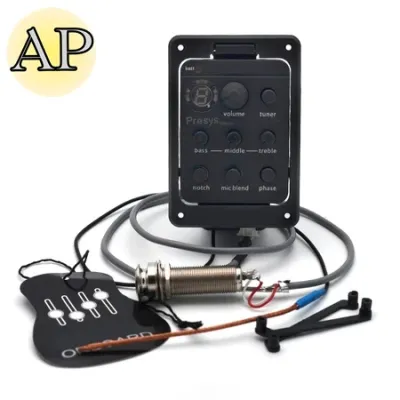
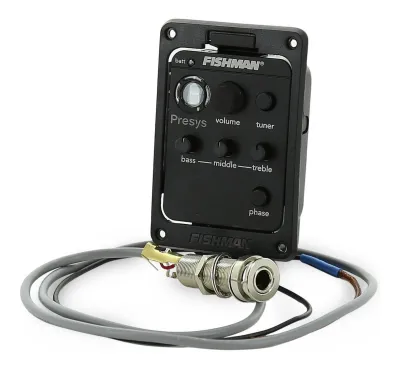
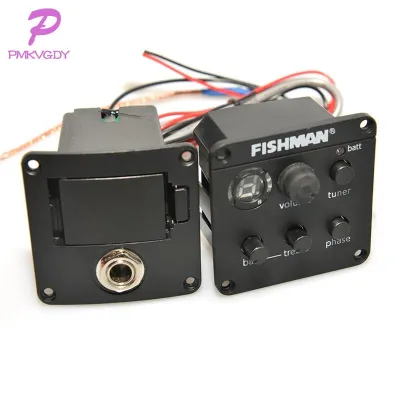
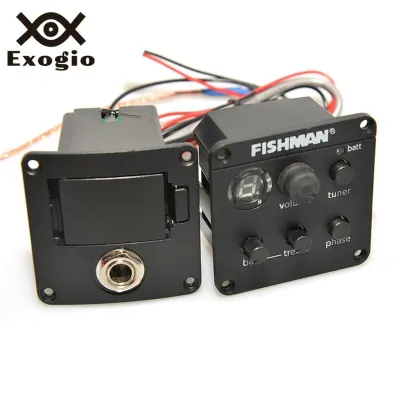
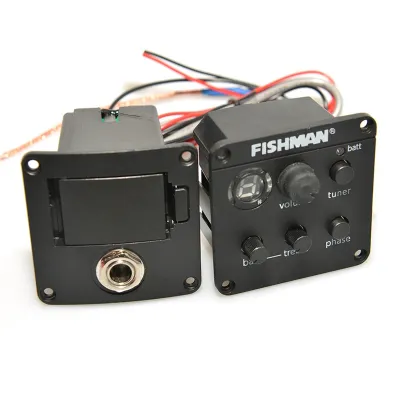
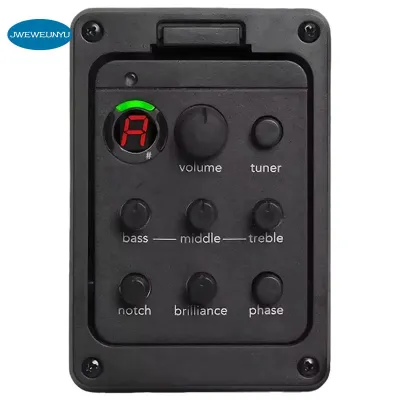
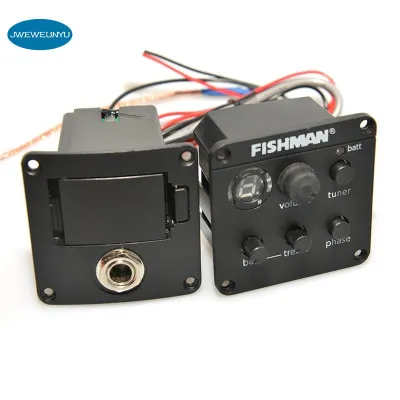
Prices are valid at publication and may change. Please refer to the product page for the latest price.
Active pickup systems require an onboard power source, usually a 9-volt battery. You must decide where this battery will reside. Some systems utilize an internal battery bag velcroed to the neck block, requiring you to loosen the strings during string changes to replace the battery. Other systems feature an integrated battery compartment near the endpin jack, which requires cutting a larger cavity into the guitar’s side bout. In highly humid environments, battery terminals are susceptible to corrosion, making easy access for regular inspection and replacement a key consideration. Finally, ensure your guitar’s existing endpin hole can be safely reamed to the standard 1/2-inch diameter required for an active endpin jack.
Match Sensor Technology to Your Playing Style
The way you strike the strings and express dynamics should dictate the sensor technology you choose. Under-saddle piezo pickups operate by detecting direct physical pressure from the strings through the saddle. This results in a highly immediate, bright attack with a fast transient response. If you are an aggressive rhythm guitarist who strums heavily or plays in a full band, the piezo’s sharp definition helps your guitar cut through a dense mix of drums, bass, and keyboards. However, some players find that pure piezo systems exhibit a harsh, synthetic “quack” during heavy picking, which may require external equalization to smooth out.

Magnetic soundhole pickups work similarly to electric guitar pickups, capturing the electromagnetic vibrations of the steel strings rather than the vibrations of the wood. This technology produces a warmer, rounder tone with excellent sustain, making it highly suitable for fingerstyle players and those who utilize percussive tapping techniques on the guitar body. Because magnetic pickups are less sensitive to body vibrations, they do not capture top-tapping percussion as effectively as soundboard transducers, but they excel at reproducing clean, articulate single-note lines. Note that magnetic pickups only work with bronze or steel strings and are incompatible with nylon-string classical guitars.
Blended systems combine the immediate attack of an under-saddle piezo or magnetic pickup with the airy, three-dimensional realism of an internal condenser microphone. These systems allow you to dial in the exact ratio of string definition to body resonance. If your playing style relies on subtle dynamic nuances, delicate fingerpicking, or percussive body hits, a blended system offers the most authentic acoustic reproduction. The internal microphone captures the air moving inside the guitar body, softening the harshness of the piezo and delivering a studio-quality tone directly to the sound system.
Evaluate Feedback Resistance for Your Performance Environment
Your performance environment plays a massive role in how your pickup behaves on stage. High-volume stages with loud floor monitors are notorious for causing acoustic guitar feedback. Under-saddle piezo pickups offer the highest gain-before-feedback because they are insulated inside the bridge slot and respond primarily to direct string pressure rather than airborne sound waves. This makes them the industry standard for touring musicians playing in large venues, outdoor festivals, or high-decibel band settings where stage volume cannot be easily controlled.
In contrast, internal microphones and soundboard transducers are highly susceptible to feedback. The hollow body of an acoustic guitar acts as a natural resonator; when stage monitors blast your guitar’s sound back at the instrument, the top vibrates sympathetically, creating a feedback loop. If you perform with a blended system in a loud environment, you will likely need to roll back the microphone volume and rely almost entirely on the piezo element. Magnetic soundhole pickups fall in the middle, offering moderate feedback resistance, though they can still squeal if positioned directly in front of a powerful amplifier.
To combat feedback on stage, many Fishman models feature onboard preamps equipped with phase switches and notch filters. A phase switch reverses the polarity of the pickup signal relative to the stage monitors, instantly canceling out low-end howling. A notch filter allows you to target and cut the specific frequency causing the resonance without altering your overall tone. If you regularly perform in unpredictable live venues, prioritizing a pickup system with these onboard tone-shaping tools will save you from feedback issues mid-performance.
Verify Compatibility and Finalize Your Selection
Before finalizing your purchase from an authorized dealer or online marketplace, compile a precise checklist of your guitar’s technical specifications. Measure your saddle’s thickness and string spacing at the bridge using a digital caliper. If your guitar features a split saddle or an unusually shallow saddle slot, a standard single-element under-saddle pickup may not function correctly, and you will need to seek specialized multi-element options.
Inspect the interior of your guitar using a small mirror or your smartphone camera. Check the condition of the bridge plate—the piece of hardwood directly beneath the bridge inside the guitar. If the bridge plate is worn, splintered, or crowded by bridge pins, installing an under-saddle wire or an internal sensor may require repair work first. Ensure there is sufficient flat surface area on the bridge plate if you are considering a system that mounts sensors internally to the wood.
If your instrument is a vintage piece, a high-end custom build, or possesses unique structural designs, consult a qualified luthier or guitar technician before proceeding with any installation. Professional installation ensures that the saddle slot is routed to the exact depth, the bottom is perfectly flat for even string balance, and the endpin jack is drilled without splintering the guitar’s finish or wood. Taking these precautionary steps guarantees that your chosen Fishman pickup performs at its absolute best while safeguarding your instrument’s long-term value.
Frequently Asked Questions (FAQ)
Can I install a Fishman under-saddle pickup myself?
While some experienced hobbyists attempt DIY installations, professional installation is highly recommended for under-saddle piezo pickups. Routing the saddle slot and drilling the hole for the transducer wire require specialized tools, such as a precision router guide and specific drill bits, to prevent wood splintering. If the bottom of the saddle slot is not perfectly flat, or if the saddle itself is loose or tilted, you will experience uneven string-to-string volume and poor tone. A professional luthier can ensure a flawless fit, preserve your guitar’s action, and prevent structural damage to the bridge plate.
Do I need an external preamp if the Fishman pickup has one onboard?
If your Fishman pickup features an active onboard preamp, it already handles the essential tasks of impedance matching, signal buffering, and basic tone shaping. However, an external preamp or Direct Input (DI) pedal remains highly beneficial for live performances. An external DI box converts your guitar’s high-impedance unbalanced signal to a low-impedance balanced signal, allowing you to run long cables to the mixing console without signal loss or noise interference. Additionally, external preamps offer advanced equalization, mute switches, boost functions, and ground-lift switches to eliminate hum caused by venue electrical issues.
Community discussion
Share your experience or ask a question. Comments are reviewed before publication.