
Quick Answer: How to Know Which Strings Your Guitar Needs
Selecting a new guitar strings full set is not a matter of personal preference or musical taste; it is a strict structural requirement dictated by your instrument’s design. Installing the wrong string type can permanently damage or even destroy your guitar. Classical and flamenco guitars are engineered exclusively for nylon strings, which exert relatively low tension. Conversely, standard acoustic guitars, electric guitars, and bass guitars are built to withstand the high tension of steel or metal-alloy strings.
Because the physical construction of these instruments differs fundamentally, you must identify your specific guitar model before making a purchase. If you put steel strings on a classical guitar, the immense tension can warp the neck, lift the bridge, or crack the soundboard. Placing nylon strings on a steel-string acoustic results in a dull, virtually unplayable instrument. Always match the string material to your guitar’s structural design.
How to Identify Your Guitar Type Before Buying a Full Set
Many beginners struggle to distinguish between a classical guitar and a steel-string acoustic guitar. Because they look similar from a distance, it is easy to make a mistake when shopping for a replacement guitar strings full set. Fortunately, a quick physical inspection of three key areas—the headstock, the bridge, and the neck—will reveal exactly what type of guitar you own. Even if you have a hybrid or crossover guitar, these physical markers will tell you which category of strings the manufacturer intended for the instrument.
Products mentioned in this guide
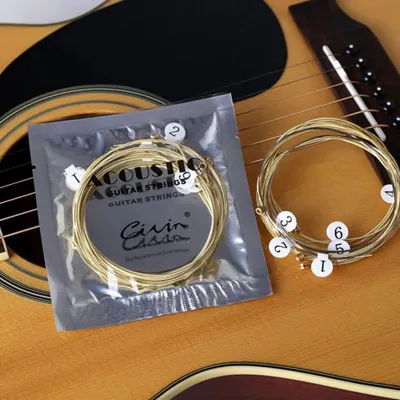



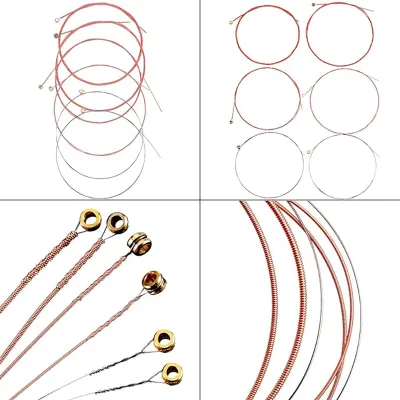

Prices are valid at publication and may change. Please refer to the product page for the latest price.

Inspect the Headstock and Tuning Pegs
The headstock, located at the very top of the guitar neck, provides the most immediate visual clue. Classical guitars almost always feature a slotted headstock. This design has two vertical channels cut completely through the wood, with horizontal plastic or thick metal rollers running across the slots. The strings wrap around these thick rollers, which are turned by tuning keys mounted on the sides of the headstock. Because nylon strings are thicker and more elastic, they require these wider rollers to wind properly without slipping or snapping.
In contrast, a standard steel-string acoustic guitar features a solid headstock. There are no slots cut through the wood. Instead, the tuning pegs are solid metal posts that project vertically through the front face of the headstock. The strings wind directly around these thin metal posts, and the tuning gears are typically enclosed or mounted on the back. If your guitar has vertical metal pegs, it is built for steel strings.
Check the Bridge and Tie-Block
Looking at the lower body of the instrument, the bridge is where the strings are anchored to the soundboard. On a classical guitar, you will find a flat tie-block bridge. This component does not have any holes going down into the body. Instead, the strings are threaded through horizontal holes in the block and secured by tying a specific loop knot around the back of the bridge. Nylon strings designed for these guitars typically have plain ends with no hardware attached. Tying this knot correctly is crucial, as the low friction of nylon can cause the string to slip under tension, unraveling the knot and detuning the instrument.
On a steel-string acoustic guitar, the bridge utilizes a completely different anchoring mechanism. You will see six individual plastic, wooden, or bone pegs called bridge pins inserted vertically into the bridge. The strings for these guitars feature a small brass or metal ball-end at one tip. To install them, you insert the ball-end into the pin hole and press the bridge pin down to lock the string in place. If your bridge has removable pins, you must purchase a steel-string set.
Look at the Neck and Fretboard
The physical dimensions of the guitar neck also reflect the tension and playing style of the intended string type. Classical guitar necks are noticeably wider, flatter, and thicker. The fretboard has no radius, meaning it is completely flat across its width to facilitate complex fingerstyle playing. Furthermore, the neck of a classical guitar almost always joins the body at the 12th fret, giving the player a shorter reaching distance to the body.
Steel-string acoustic guitars feature narrower, slimmer necks that are comfortable for wrapping your hand around to play chords. The fretboard is slightly curved (radiused) to match the natural arch of your fingers. Because steel-string guitars are built to withstand higher tension and offer access to higher registers, the neck typically joins the body at the 14th fret. Additionally, steel-string guitars contain an adjustable metal truss rod running inside the neck to counteract string tension, which is rarely found in traditional classical guitars.
Nylon vs Steel Strings: Tone, Feel, and Playability Compared
Once you have verified which string type your guitar requires, understanding how these materials perform will help you get the best experience from your instrument. Nylon and steel strings look, feel, and sound entirely different, shaping both your physical playing experience and the genres of music you can effectively play.
Tone and Musical Styles
The material of your strings dictates the acoustic signature of your guitar. Nylon strings produce a warm, mellow, and round tone with a soft attack. This intimate sound is highly expressive, making it the perfect match for classical compositions, traditional flamenco, Spanish folk, and Brazilian bossa nova. The lower frequencies are rich and resonant, while the high notes sound sweet rather than piercing.
Additionally, the way you play these strings affects their tonal output and longevity. Nylon strings are meant to be plucked with fingertips or fingernails, which coaxes out their characteristic warm, singing quality. Using a plastic plectrum (pick) on nylon strings is generally avoided, as the sharp edges of a pick can quickly gouge the soft nylon material and create a harsh, unbalanced sound.
Steel strings, on the other hand, deliver a bright, crisp, and highly projecting tone with a sharp attack and long sustain. They are designed to cut through a mix and project sound across a room. This bright, metallic chime is the foundational sound of modern folk, pop, rock, country, bluegrass, and blues. If you try to play driving pop rhythms on nylon strings, the sound may feel muddy and lacking in volume; conversely, playing delicate classical pieces on steel strings can sound overly harsh and metallic.
Conversely, steel strings are highly responsive to both flatpicking and fingerpicking. They can handle the heavy, percussive impact of a thick plastic pick, producing the driving rhythms necessary for rock and pop. This durability allows steel-string players to transition seamlessly from delicate fingerstyle melodies to aggressive strumming without worrying about shredding the string material.
Playability and Finger Comfort
For beginners, the physical sensation of pressing down on the strings is a major consideration. Nylon strings operate under significantly lower tension, typically around 75 to 90 pounds of total pull across the entire set. Because the material is soft and pliable, nylon is incredibly gentle on sensitive fingertips. Beginners playing classical guitars will experience much less finger pain and can practice for longer periods without immediate discomfort.
Steel strings require much higher tension to vibrate at the correct pitch, exerting roughly 150 to 200 pounds of pull on the guitar. This high tension makes the strings feel stiff and hard. Pressing thin, high-tension steel wires against the frets requires substantial finger strength and will cause noticeable discomfort initially. Over time, steel-string players develop thick calluses on their fingertips, which eventually eliminates the pain. If you are learning on a steel-string guitar, starting with lighter gauges can help ease this transition.
The spacing between the strings also plays a major role in playability. Because classical guitars have wider necks, the distance between each string is significantly larger than on a steel-string acoustic. This wide spacing is highly beneficial for classical fingerstyle playing, as it gives your fingers ample room to articulate individual notes without accidentally muting adjacent strings. However, it also requires your fretting hand to make wider stretches, which can be challenging for players with smaller hands.
Steel-string guitars feature much tighter string spacing on their narrow fretboards. This setup is ideal for wrapping your hand around the neck to play chords or executing fast, lead-guitar runs. The trade-off is that you must be highly precise with your finger placement to avoid touching neighboring strings, which can cause unwanted buzzing or dampening of the notes.
String Construction and Materials
The physical composition of a guitar strings full set varies significantly between the two types. In a standard nylon set, the three treble strings (E, B, and G) are made of solid, translucent, or black nylon monofilament, which looks and feels like heavy-duty fishing line. The three bass strings (D, A, and E) consist of a core made of hundreds of fine nylon filaments, wrapped tightly with a thin metal wire, typically silver-plated copper or bronze.
A steel-string set is entirely metallic. The high E and B strings (and sometimes the G string in lighter sets) are plain, high-carbon steel wires. The remaining bass strings feature a solid steel core wrapped with a copper-based alloy. The most common wrapping materials are 80/20 bronze (80% copper, 20% zinc), which offers a bright and chimey tone, and phosphor bronze (copper with tin and phosphorus), which provides a warmer, longer-lasting sound. Electric guitar strings differ further, utilizing nickel-plated steel or pure nickel wraps to interact efficiently with magnetic pickups.
Why You Must Never Mix Nylon and Steel Strings
The temptation to swap string types—such as putting steel strings on a classical guitar to make it sound louder, or putting nylon strings on an acoustic to make it easier on the fingers—is a common mistake that must be avoided. The mechanical designs of these instruments are highly specialized, and cross-installing strings can lead to catastrophic structural failure.
The primary hazard lies in the massive difference in physical tension. A standard classical guitar is constructed from lightweight, thin pieces of wood, reinforced internally with delicate fan bracing. It is engineered specifically to handle the low tension of nylon. If you install a steel guitar strings full set on a classical guitar, the instrument is subjected to more than double the tension it was designed to bear.
This excess force will quickly pull the guitar apart. Within days or even hours, the high-tension steel strings can warp the wooden neck, pulling it forward into a severe bow that makes the action unplayably high. Because classical guitars lack an adjustable metal truss rod, this neck warp is often irreversible. Furthermore, the immense upward pull can rip the glued-on wooden bridge clean off the soundboard, tearing away chunks of the delicate spruce or cedar top, and collapsing the internal bracing.
Conversely, putting nylon strings on a steel-string acoustic guitar will not damage the instrument, but it will result in a completely non-functional setup. Steel-string guitars are built with heavy, thick soundboards and robust X-bracing designed to withstand high tension. The low tension of nylon strings is simply not powerful enough to vibrate the heavy top wood, resulting in an extremely quiet, thin, and lifeless sound.
The core of this issue lies in the physics of acoustic sound projection. The soundboard, or top wood of the guitar, acts as a natural transducer that converts string vibrations into audible sound waves. To do this efficiently, the soundboard must be braced internally. Classical guitars use lightweight fan bracing that spreads outward like a hand, allowing the thin top wood to vibrate freely under the low energy of nylon strings.
Steel-string acoustics use a robust X-bracing pattern, which crosses directly under the bridge to reinforce the top wood against the massive tension of steel. If you place nylon strings on an X-braced guitar, the low tension cannot drive the stiff, heavily reinforced soundboard. The wood remains virtually stationary, resulting in a quiet, thin whisper of a sound with no sustain. Conversely, placing steel strings on a fan-braced classical guitar will quickly collapse the delicate internal braces, ruining the guitar’s structural integrity forever.
Additionally, nylon strings will not fit the physical hardware of a steel-string guitar. The thick nylon strings will not sit properly in the narrow slots of the nut, causing them to slip or buzz. Without ball-ends, you cannot secure them using standard bridge pins, and the strings will continuously slip out of the bridge holes. Always adhere to a strict structural rule: never cross-install string types, and always match the string material to the manufacturer’s original design.
How to Choose the Right Guitar Strings Full Set
Once you have established the correct string type for your guitar, you must select the specific specifications that match your playing level, maintenance preferences, and instrument scale.
Choosing the Right Gauge or Tension
For steel-string guitars, strings are categorized by “gauge,” which refers to the physical thickness of the high E string measured in thousandths of an inch. Common sets range from “extra light” (.010) to “medium” (.013). Beginners should start with light (.011) or custom light (.012) gauges, as thinner strings require less finger pressure to fret, reducing hand fatigue while you build strength.
Nylon strings do not use numerical gauges; instead, they are classified by “tension” levels, such as normal, hard, or extra-hard tension. Normal tension is the industry standard and is highly recommended for beginners because it offers a balanced, comfortable feel and is easy to play. Hard or high-tension strings provide a brighter, more punchy sound with greater volume, but they require more finger effort and put slightly more stress on the guitar’s bridge.
Coated vs Uncoated Strings
In the tropical climate of the Philippines, high humidity and sweat are constant challenges for guitarists. Moisture and oils from your fingers accelerate the oxidation of metal strings, leading to rust, a dull tone, and a rough texture. To combat this, many manufacturers offer coated strings. These feature an ultra-thin microscopic polymer coating that shields the metal winding from sweat and humidity, extending the life of the set by up to three to five times.
While coated strings are more expensive—typically ranging from ₱600 to ₱1,200 per set compared to ₱300 to ₱500 for uncoated sets—they save money and maintenance effort in the long run. Uncoated strings, however, remain popular among purists. They offer a brighter, more immediate acoustic response and a traditional, organic feel under the fingers, though they must be wiped down thoroughly after every session to prevent rapid corrosion.
Verifying Set Completeness and Scale Length
Before finalizing your purchase, always verify that the package is labeled as a “full set” containing all six strings. Some retailers sell individual replacement strings, which can be confusing if you are shopping quickly online. Additionally, ensure the set matches your guitar’s scale length. While most acoustic and classical guitars use standard scale lengths, smaller-bodied instruments like parlor guitars, travel guitars, or 3/4-size student models may require specific short-scale string sets to maintain proper tension and tuning stability.
Frequently Asked Questions (FAQ)
Can I use a standard guitar string winder for both nylon and steel strings?
Yes, you can use a standard peg winder for both string types, but you must exercise caution. Classical guitars feature larger, plastic rollers on their slotted headstocks, which are more fragile than the solid metal pegs found on steel-string guitars. When using a mechanical or plastic winder, ensure the tool fits securely over the tuning key without binding, and turn it slowly to avoid putting excessive lateral stress on the plastic rollers, which can crack under sudden pressure.
How do I know when it is time to replace my guitar strings full set?
Rather than relying on a strict calendar schedule, look for physical and auditory signs of wear. Your strings need replacing if they lose their bright, resonant tone and begin to sound dead or muddy. Visually inspect the strings for dark spots, rust, or corrosion, particularly on the underside where they contact the frets. Additionally, if the metal winding on the bass strings begins to fray or separate, or if the guitar suddenly struggles to stay in tune, it is time to install a fresh guitar strings full set.
Community discussion
Share your experience or ask a question. Comments are reviewed before publication.