
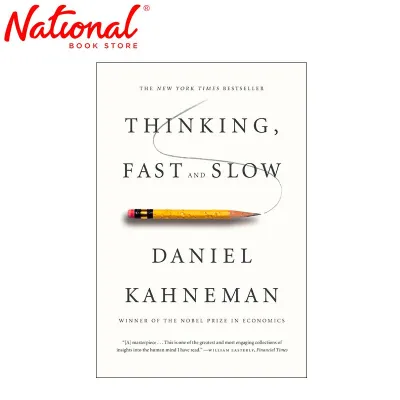
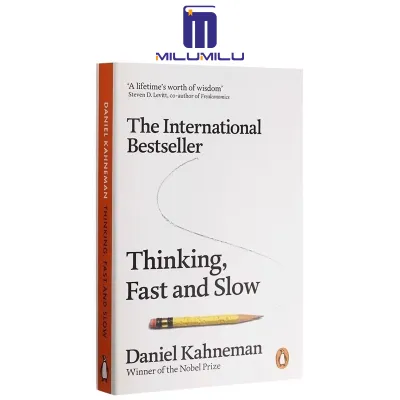
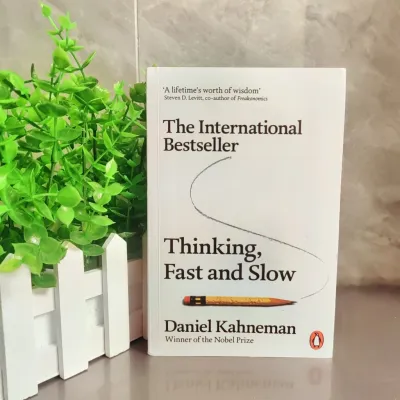
If you have ever spent time browsing the non-fiction shelves of a local bookstore in Manila or scrolling through popular online marketplaces, you have almost certainly encountered the distinctive cover of Daniel Kahneman’s masterpiece. The thinking fast and slow book is widely celebrated as a cornerstone of modern behavioral economics and cognitive psychology. Yet, many eager readers purchase it expecting a light, motivational self-help guide, only to find it gathering dust on their nightstands after a few chapters.
This book is not a typical, breezy personal development read. It is a dense, intellectually demanding exploration of how human beings make decisions. To help you decide whether this major reading investment matches your current reading level and personal goals, we will break down its style, difficulty, and structure, and provide a clear action plan for your reading journey.
Before making a purchase, it is highly recommended to verify the specific edition, language, and authorized source of the book. In the Philippines, paperback copies typically range from ₱600 to ₱1,100, while hardcover or special anniversary editions can cost significantly more. If you prefer digital reading, always check the file format, regional restrictions, and device compatibility for your e-reader or audiobook app to ensure a seamless experience. Do not rely solely on cover art, as publishers frequently update designs without changing the underlying text.
Products mentioned in this guide
Prices are valid at publication and may change. Please refer to the product page for the latest price.
Assess Your Reading Patience and Style Preferences
To determine if this book is right for you, you must first examine your personal reading style. Most popular self-help books rely heavily on narrative-driven chapters, relatable personal anecdotes, and highly simplified summaries of scientific studies. They are designed for rapid consumption, allowing you to breeze through fifty pages in a single sitting while feeling a quick surge of motivation.
Daniel Kahneman, a Nobel laureate in Economics, takes a radically different approach. His writing style is academic, precise, and research-heavy. Rather than telling a warm story to make a point, he presents the step-by-step methodology of psychological experiments, complete with control groups, statistical variances, and logical puzzles. He treats the reader as an intellectual partner, which requires a high degree of patience.
Ask yourself these self-check questions before committing to the text:
- Do you enjoy reading detailed breakdowns of scientific experiments, or do you prefer quick, actionable life hacks?
- Are you comfortable spending several pages understanding why a specific group of research participants answered a survey in a certain way, just to prove a single cognitive bias?
- Do you prefer books that you can easily digest in short, distracted intervals, or do you enjoy sitting down for an hour of focused, uninterrupted study?
The pacing of this book is deliberately slow. In Kahneman’s own terminology, reading this text forces you to engage your “System 2” thinking—the lazy, effortful, and highly analytical part of your brain. It is not a light bedtime read to enjoy when you are physically and mentally exhausted at the end of a long day. If you attempt to skim through his explanations, you will quickly lose the thread of the argument and find yourself needing to restart the chapter.
Furthermore, the attention span required for this book is substantial. You must be willing to follow multi-page experimental setups, analyze the subsequent data, and contemplate the broader implications on human behavior. If your reading habits are currently optimized for short-form articles or highly conversational books, the academic density of this work may feel like a steep uphill climb.
Align the Book with Your Self-Improvement Goals
Your satisfaction with this book depends entirely on what you hope to gain from it. It is crucial to distinguish between cognitive science and practical habit-building before spending your hard-earned pesos.

This book delivers a deep, theoretical understanding of human irrationality. You will gain profound insights into cognitive biases, heuristics, and the systemic flaws in human judgment. You will learn how the mind takes shortcuts, why we are consistently overconfident, and how our choices are shaped by the way information is framed. It is a masterclass in understanding the hidden mechanics of human thought.
However, this book is not a practical “how-to” manual. If your current self-improvement goals include building better morning routines, organizing your daily planner, boosting your immediate productivity, or finding career motivation, this book will not serve those needs. It does not contain step-by-step guides, worksheets, or daily habits that you can implement tomorrow morning.
Instead, the book is ideal for those who want to build long-term critical thinking skills. It is highly valuable for professionals in fields like marketing, finance, product design, management, and strategic planning in the Philippines, where understanding consumer behavior and avoiding costly decision-making errors is vital. It teaches you how the mind works, rather than telling you what to do.
Ultimately, you must decide if you are looking for a practical manual or a theoretical textbook. A manual tells you exactly where to turn the wrench to fix a specific problem. A textbook explains the physics of the entire engine so that you can diagnose and solve complex problems on your own. Kahneman has written the latter.
Evaluate the Reading Difficulty and Structure
Understanding the structural layout and vocabulary of the book will help you set realistic expectations before you begin reading.
The vocabulary is heavily rooted in cognitive psychology and statistics. While Kahneman does an excellent job of defining his terms, you will frequently encounter academic concepts such as:
- Heuristics: Mental shortcuts that ease the cognitive load of making decisions.
- Regression to the Mean: The statistical phenomenon where extreme academic or behavioral performance is naturally followed by more average results.
- Prospect Theory: A model describing how people choose between probabilistic alternatives that involve risk, demonstrating that we fear loss more than we value equivalent gain.
- Base Rates: The baseline probability of an event occurring, which human beings routinely ignore in favor of vivid anecdotes.
The book is structured into five distinct parts, containing a total of 38 chapters. Rather than building a singular, continuous narrative arc, each chapter reads like a standalone academic essay. This structure means you cannot rely on narrative momentum to carry you forward. You must re-engage your focus with each new chapter as Kahneman introduces a fresh psychological concept.
If you want to “test drive” the book before buying a copy, try this practical method: visit a local bookstore or preview a digital sample online. Read the entire introduction and Chapter 1 (“The Characters of the Story”). This section introduces System 1 and System 2. If you find this introductory material engaging and comprehensible, you are likely ready for the rest of the book. If you find yourself struggling to stay focused or constantly re-reading paragraphs to grasp the basic premise, the full text may prove too tedious for your current reading level.
Be prepared for occasional mathematical puzzles and simple statistical graphs. While you do not need an advanced math degree, Kahneman uses these visual and logical tools to demonstrate how poorly our intuitive minds handle probability. Engaging with these puzzles is essential to fully appreciating his conclusions.
Your Action Plan: Read, Adapt, or Find an Alternative
Based on your self-diagnosis of your reading patience, goals, and difficulty tolerance, you can choose one of three distinct paths to approach this material.
Path 1: The Full, Dedicated Read
Choose this path if you enjoy deep intellectual challenges, have ample reading time, and want the complete, unfiltered academic context. To succeed, treat this book like a university course. Read one short chapter per day, take notes in the margins, and give yourself time to digest the concepts.
Tip for Philippine Readers: High tropical humidity can cause physical book pages to warp or develop mold over time. If you invest in a physical copy, store it in a dry, well-ventilated space, or keep it in a sealed bag with a silica gel packet to preserve the paper quality.
Path 2: Strategic Skimming
Choose this path if you want to understand the core concepts without getting bogged down in dense statistical proofs. Focus your energy heavily on Part 1 (Two Systems) and Part 2 (Heuristics and Biases). These sections contain the most famous and widely cited concepts. You can then selectively skim or skip the highly technical economic modeling in Part 4 (Choices) and the theoretical discussions in Part 5 (Two Selves) without losing the practical value of the book.
Path 3: Seek Accessible Alternatives
If you decide that Kahneman’s academic style is too dry or demanding for your current reading level, there is no shame in seeking alternative books that cover similar behavioral science topics with a more engaging, narrative-driven approach. Consider these options:
- ***Predictably Irrational* by Dan Ariely**: Explores the same cognitive biases and irrational behaviors but uses highly entertaining, real-world anecdotes and a conversational tone.
- ***Nudge* by Richard H. Thaler and Cass R. Sunstein**: Focuses on how behavioral economics can be applied to improve daily decisions, public policy, and personal finance.
- ***Atomic Habits* by James Clear**: If you want direct, actionable habit-building advice and practical daily routines rather than deep cognitive science.
To make your final decision, match your personal profile to this quick decision matrix:
- High Patience + Theoretical Goals: Path 1 (Full Read)
- Medium Patience + Practical Goals: Path 2 (Strategic Skimming)
- Low Patience + Action-Oriented Goals: Path 3 (Seek Alternatives)
Frequently Asked Questions (FAQ)
How long does it typically take to read 'Thinking, Fast and Slow'?
Because of its academic density, this 400+ page book takes significantly longer to read than a standard novel or a typical self-help book. While an average reader might finish a standard book in 6 to 8 hours, this text often requires 15 to 20 hours of highly focused reading. It is best to plan for a multi-week reading schedule, such as reading one chapter a day over several weeks, rather than attempting to finish it in a single weekend. Comprehension and retention are far more important than speed when tackling this material.
Do I need a background in psychology or statistics to understand it?
No, you do not need a formal degree or prior background in psychology or statistics. Daniel Kahneman wrote this book for a general, educated audience. He explains every technical concept, bias, and statistical term from the ground up. However, you must bring a willingness to slow down, re-read complex paragraphs, and actively participate in the mental puzzles presented throughout the text. A basic comfort with percentages and simple probabilities will make the reading experience much smoother.
Community discussion
Share your experience or ask a question. Comments are reviewed before publication.