
Viktor Frankl’s Man’s Search for Meaning is not your typical self-help book. It does not offer quick productivity hacks, morning routine templates, or superficial promises of endless happiness. Instead, it is a profound, deeply moving exploration of human resilience, arguing that our primary drive in life is not pleasure or power, but the pursuit of what we find personally meaningful. If you are currently navigating a major life transition, processing a difficult loss, or feeling a persistent sense of emptiness, this book can offer a powerful framework for finding purpose. However, if you are looking for immediate, actionable daily habits or are currently dealing with an acute mental health crisis, this dense and emotionally heavy text might not be the right starting point for your journey.
Before purchasing a copy from a local bookstore or an online marketplace, it is helpful to understand what this classic text demands of its readers. Be sure to verify the edition, language, and format—whether you prefer a physical paperback or a digital ebook compatible with your reading device—to ensure you are getting an authorized, complete translation. By evaluating your current emotional state, reading goals, and practical needs, you can determine if this book is the right investment for your personal growth today.
What 'Man's Search for Meaning' Actually Teaches
To understand why this book remains a cornerstone of personal development, you must first understand its core philosophy, known as Logotherapy. Developed by Frankl, a Viennese psychiatrist, Logotherapy posits that human beings are driven by a “will to meaning.” This stands in stark contrast to traditional psychological theories of his era, which focused heavily on the pursuit of pleasure or the acquisition of power. Frankl argues that even in the most miserable, painful, and restrictive circumstances, we retain one ultimate freedom: the ability to choose our attitude toward our situation.
Products mentioned in this guide

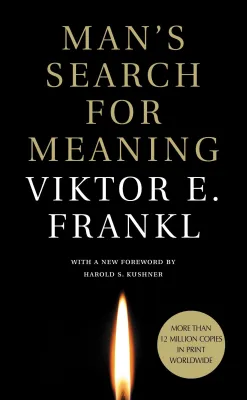



Prices are valid at publication and may change. Please refer to the product page for the latest price.
This book is entirely free of toxic positivity. It does not suggest that you can simply think your way out of suffering or that everything happens for a predetermined, positive reason. Instead, it teaches that suffering is an unavoidable part of the human condition, much like fate and death. The real challenge is not to avoid suffering, but to find a way to bear it with dignity and to find a purpose within or despite that pain.
Structurally, the book is divided into two distinct parts. The first half is a raw, autobiographical memoir of Frankl’s time surviving Nazi concentration camps, including Auschwitz. He uses his observations of himself and his fellow prisoners to analyze how people cope with extreme, prolonged trauma. The second half transitions into a more academic, yet accessible, explanation of Logotherapy, outlining how readers can apply these existential observations to their own lives.
Signs This Book Aligns With Your Current Mindset
This book is highly suitable for those who find themselves at a major crossroads or are experiencing a profound sense of uncertainty. If you are currently navigating a career transition, adjusting to a major lifestyle shift, or dealing with the quiet aftermath of a personal loss, Frankl’s reflections can provide a stabilizing perspective. It helps you reframe these challenging periods not as empty spaces of wasted time, but as opportunities to define who you want to be in the face of adversity.

You will benefit from this book if you are experiencing what Frankl calls an “existential vacuum”—a persistent feeling of emptiness, boredom, or a lack of direction. This is different from a temporary bad mood or a stressful week at work. It is a deeper, quieter questioning of your life’s overall “why.” If you find yourself looking at your daily routine and wondering what it all adds up to, the principles of Logotherapy can help you identify unique sources of meaning in your work, your relationships, and your creative pursuits.
Finally, this book is ideal if you are emotionally prepared to engage with heavy, challenging themes. It requires a level of maturity to read about historical atrocities and translate those extreme lessons into your own daily life. If you are ready to accept personal responsibility for your choices and your attitude, rather than looking for a book that blames external circumstances for your unhappiness, Frankl’s writing will resonate deeply.
When You Might Need a Different Self-Help Approach
There are times when Man’s Search for Meaning is not the right tool for your current struggles. If you are looking for immediate, highly practical coping mechanisms or step-by-step habit trackers, you will likely find this book frustrating. It does not contain worksheets, daily checklists, or scientific breakdowns of cognitive behavioral exercises. For readers who need immediate structure to organize their day or manage mild, everyday stress, spending a few hundred pesos (₱) on a modern, action-oriented productivity guide would be a more practical purchase.
It is also crucial to recognize that reading philosophy or existential psychology cannot replace professional mental health care. If you are currently experiencing acute trauma, severe anxiety, or clinical depression, the graphic and emotionally intense descriptions of concentration camp life in the first half of the book could be overwhelming or triggering. In these moments, seeking support from a qualified clinical psychologist or counselor is the safest and most effective path.
Additionally, if your current reading preference leans toward lightweight, easily digestible personal growth books, this text may feel too dense. The language, while beautifully translated, reflects its mid-20th-century academic origins. If you have limited reading time or prefer conversational, modern self-help that you can easily skim during a busy commute, you might want to set this book aside until you have the mental space for deep, uninterrupted reflection.
How to Approach the Reading Experience
If you decide that this book matches your current needs, approaching it with a deliberate strategy will help you get the most out of its pages. Start by reading the autobiographical section first, even if you are primarily interested in the psychological theory. The memoir is not just historical background; it is the empirical proof that validates Frankl’s entire psychological framework. Understanding the extreme conditions under which these ideas were tested makes the theoretical second half much more impactful.
Because of the book’s emotional weight, it is highly recommended to keep a journal nearby as you read. You will likely encounter passages that force you to pause and reflect on your own life choices, relationships, and attitude toward past hardships. Writing down your immediate reactions, questions, and personal insights allows you to process these heavy themes actively rather than just consuming them passively.
Lastly, pace your reading sessions. While the book is relatively short—often under 160 pages depending on the specific print edition—it is not a book to be rushed or speed-read. Give yourself permission to read just a few pages at a time, especially during the intense memoir portions. Allowing the concepts to settle in your mind over several days or weeks will prevent emotional fatigue and give you the space needed to integrate Frankl’s wisdom into your daily outlook.
Frequently Asked Questions (FAQ)
Is 'Man's Search for Meaning' a religious or spiritual book?
While the book deals deeply with the human spirit, inner freedom, and the search for ultimate purpose, it is not a religious text. Viktor Frankl writes from his perspective as a clinical psychiatrist and neurologist. The principles of Logotherapy are grounded in existential philosophy and empirical psychological observation rather than any specific religious doctrine or dogma. Readers of all faiths, as well as secular readers, can easily apply its teachings to their own lives.
How long does it take to read 'Man's Search for Meaning'?
Although the book is physically slim and can technically be read in a few hours, a meaningful reading experience usually takes longer. Because of the dense psychological concepts and the emotional intensity of the concentration camp memoir, most readers find it best to read it slowly over a week or two. Taking time to pause, reflect, and digest each chapter ensures you absorb the deeper philosophical lessons rather than just skimming the historical narrative.
Should I read it if I am currently feeling severely depressed?
If you are experiencing severe depression or an acute psychological crisis, you should consult a qualified mental health professional before reading this book. While Frankl’s ultimate message is one of profound hope and resilience, the first half of the book contains vivid, graphic descriptions of extreme suffering, starvation, and systemic cruelty. For someone in a highly vulnerable emotional state, these historical accounts can be deeply distressing and may exacerbate feelings of hopelessness if processed without professional guidance.

Community discussion
Share your experience or ask a question. Comments are reviewed before publication.