
Deciding whether to transition to an 8-string guitar is a pivotal moment for any guitarist looking to expand their musical horizons. You only need an 8-string guitar if your musical compositions require a sub-bass register below the low B of a 7-string, or if you need to play complex, piano-like chord voicings across a single, continuous fretboard. For most players, a standard 6-string or 7-string with down-tuning or pitch-shifting is more than sufficient.
In tropical environments like the Philippines, where high humidity and temperature fluctuations can affect wood stability, the massive neck of an 8-string is a significant maintenance consideration. The extra tension of eight heavy-gauge strings requires a stable neck construction, often utilizing multi-ply wood laminates or carbon fiber reinforcement rods. Understanding these physical and musical demands will help you make an informed decision before investing your hard-earned pesos (₱).
Identify Your Tuning and Range Requirements
The primary appeal of the 8-string guitar lies in its massive tonal range, which bridges the gap between a traditional electric guitar and a bass guitar. Standard tuning for an 8-string adds a low B and a low F# below the standard EADGBE strings. This configuration allows you to access deep, resonant sub-bass registers that are physically impossible to achieve on a standard instrument without losing all string tension.
Products mentioned in this guide
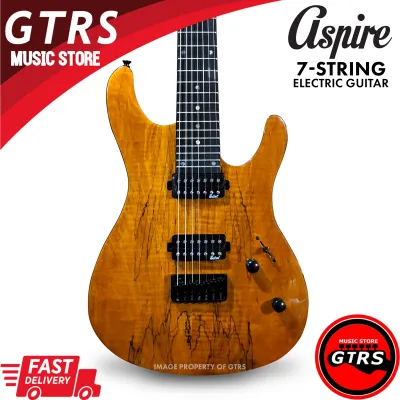
11 Lazada user ratings
Maganda sya maayos din nakarating right out of the box naka set up na amd maayos lahat walang ano man problema Thank you again seller and la…Read full reviewShow less
Maganda sya maayos din nakarating right out of the box naka set up na amd maayos lahat walang ano man problema Thank you again seller and lazada and kay kuya deliverer, panoodin nyo nalang sa vid solid talaga itong 8 string na ito kahit na napaka affordable, I upgrade ko nalang ng locking tuners at fishman pickups solid na
Parcel arrived safely with no dents/cracks. Thanks, GTRS! I can start my year right with this bad boy.
Quality Item! Fast Shipping! Item came in good condition ready to play. 😊🤘🤘
astig to..rakrakan na!!! 🤘🤘🤘
Thankyou po! Solid!!!
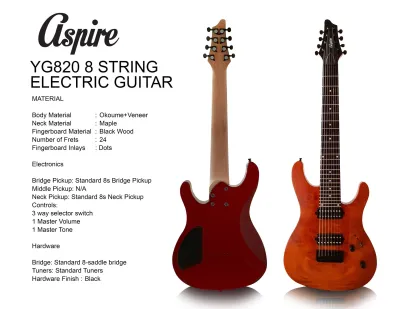
25 Lazada user ratings
So far super satisfied and happy po ako sa performance ng guitara in terms sa tunog, na meet nia ung preferred na hanap kong tunog. Gumagana…Read full reviewShow less
So far super satisfied and happy po ako sa performance ng guitara in terms sa tunog, na meet nia ung preferred na hanap kong tunog. Gumagana naman ung tatlong tune selector. Ung body for me is perfect, ung neck manipis which is preferred ko, strings sa fretboard set to low action, swabe talaga. Problema ko lang is yung selector nia, after 2 days na tanggal na agad. And then yung volume knob is mejo stiff pero hindi naman nkaka apekto sa performance. Sana ma improve pa Quality Check. Pero overall super happy and satisfied po ako sa product despite of the very affordable price of a 7-string guitar. Good job Aspire. More power! Hindi ko alam if local product po ang Aspire, pero if local man, lets support local products. Many thanks. Happy camper here. :)
It's already set up straight from the package, and only needed the strings to be tuned. Vendor also slipped in some free stuff. The action i…Read full reviewShow less
It's already set up straight from the package, and only needed the strings to be tuned. Vendor also slipped in some free stuff. The action is set up perfectly. Vendor = 10/10 For the guitar itself, quality is beyond the expected from the price point. There are no visual defects, but the bridge needs to be grounded though (nothing a bit of soldering can't fix). It's easier to play than my Jackson JS32, which is 3x the price of this one. Guitar = 9/10
Overall a good guitar for such a price can't say anything more, due to my needs I might be changing the electronics. Neck is fast playing an…Read full reviewShow less
Overall a good guitar for such a price can't say anything more, due to my needs I might be changing the electronics. Neck is fast playing and the fretboard has a large radius so you can set this up for lower action, the body isn't too thick just like an Ibanez. Out of the box: The Wood is very good 9.5/10 The Fretboard/Frets is unexpectedly well setup 10/10 The Electronics is decent 8/10 The Hardware is decent 8.5/10 (Tuning Keys are stiff)
perfect👌 *straight neck *low action *no fret buzz *saddles are same radius with the neck *ang kinis na dumating *napakabilis ng shipping, 1 …Read full reviewShow less
perfect👌 *straight neck *low action *no fret buzz *saddles are same radius with the neck *ang kinis na dumating *napakabilis ng shipping, 1 day shipping *no excessive hum from the electronics plug agad wala ng adjust2 timplahin nalang
very well packed.. excellent customer service.. 100% legit.. til next transaction Fermata✌️
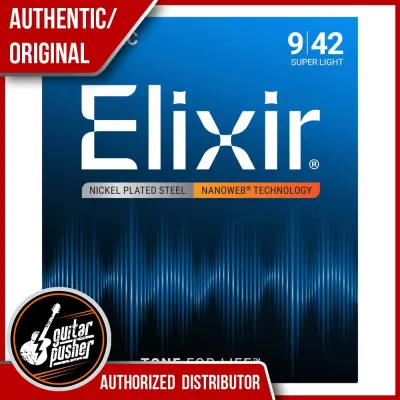
2,736 Lazada user ratings
The custom light gauge is just right., High-quality materials used., The nanoweb coating makes a difference., Smooth feel for easy playing.,…Read full reviewShow less
The custom light gauge is just right., High-quality materials used., The nanoweb coating makes a difference., Smooth feel for easy playing., Excellent balance of brightness and warmth., High-quality materials used.,
Idk kung pang ilang order ko na dito sa GP pero ang masasabi ko lang is sobrang bilis mag deliver and 100% makakasigurado ka na walang kalaw…Read full reviewShow less
Idk kung pang ilang order ko na dito sa GP pero ang masasabi ko lang is sobrang bilis mag deliver and 100% makakasigurado ka na walang kalawang ang strings mo The custom light gauge is just right.,
Grabi solid na strings pero sana tumagal sbai ng iba anti rust sya sana totoo muhkang legit pero alam kong inde maganda ung string kasi an s…Read full reviewShow less
Grabi solid na strings pero sana tumagal sbai ng iba anti rust sya sana totoo muhkang legit pero alam kong inde maganda ung string kasi an sarap makapa sna nalang tumagal lets see
High-quality materials used., Great tone and long-lasting., Super light strings for easy bending., Smooth feel for easy playing., The nanowe…Read full reviewShow less
High-quality materials used., Great tone and long-lasting., Super light strings for easy bending., Smooth feel for easy playing., The nanoweb coating makes a difference.,
Prices are valid at publication and may change. Please refer to the product page for the latest price.
If your primary musical genres demand these ultra-low frequencies, you might have already tried down-tuning your current 6-string or 7-string guitar. However, tuning a standard-scale guitar down to F# or low E requires incredibly thick string gauges. These heavy strings often do not fit through standard tuning pegs or bridge holes without physical modification to the instrument.
Furthermore, heavy strings on a short scale length suffer from poor intonation and a floppy feel. The lack of tension causes the pitch to sharp when you strike the string hard, resulting in a muddy and inconsistent tone. If you find that maintaining proper string tension and tuning stability is constantly compromising your performance, a dedicated 8-string instrument becomes a practical necessity.
Beyond heavy riffs, the 8-string guitar opens up unique harmonic possibilities. The extended range allows you to play wide-interval chord voicings that are physically impossible on fewer strings. You can hold down a deep bass pedal point while simultaneously playing intricate melodies or close-voiced jazz chords on the higher strings, making it an exceptional tool for solo arrangements and progressive compositions.
Evaluate Your Physical and Technical Readiness
Before committing to an 8-string, you must honestly assess your physical comfort with a significantly larger instrument. The neck of an 8-string guitar is exceptionally wide, often measuring around 55 millimeters at the nut compared to a standard 6-string’s 43 millimeters. This extra width requires your fretting hand to stretch much further, which can lead to wrist fatigue or strain if your technique is not correct.

To navigate this wide fretboard comfortably, you will need to adopt a classical hand position. This means keeping your thumb centered on the back of the neck rather than wrapping it over the top edge. If your playing style relies heavily on wrapping your thumb for blues-style bends or anchoring your hand, transitioning to an 8-string will require a fundamental rewrite of your physical habits.
Controlling unwanted noise is another major technical hurdle when playing an instrument with eight strings. The extra bass strings are highly sensitive to sympathetic resonance, meaning they will vibrate and hum even when you are not actively striking them. This creates a chaotic wash of noise, especially when playing with high-gain distortion.
To keep your playing clean, you must develop highly precise muting techniques. Your picking hand must constantly rest on the unused lower strings, while the fingers of your fretting hand must lightly touch the idle higher strings. Mastering this dual-handed muting technique requires a high level of physical discipline and focused practice.
Finally, consider the time investment required to rebuild your spatial awareness and muscle memory. Adding two extra strings shifts the visual and physical center of the fretboard. When you look down, your brain must recalibrate where the middle strings are located, which can lead to hitting the wrong strings during fast passages. You must be willing to dedicate months of practice to adapt your existing repertoire to this new layout.
Verify Your Gear and Signal Chain Compatibility
An 8-string guitar places unique demands on your amplification and signal processing gear. Standard guitar amplifiers and speaker cabinets are designed to project midrange frequencies, typically rolling off the extreme low end. The low F# of an 8-string sits at approximately 46 Hz, which is a frequency range usually reserved for bass amplifiers or subwoofers.
If you plug an 8-string directly into a standard open-back guitar cabinet, the speaker cones may struggle to reproduce the low-end transients. At high volumes, this can result in a loose, flubby sound that lacks definition, and in extreme cases, it can cause physical damage to the speaker driver. You must verify if your current amplifier has the headroom and frequency response to handle these deep tones.
To maintain clarity, you will likely need to optimize your signal chain with specialized utility pedals. A high-quality noise gate is essential for cutting out the hum from unmuted strings. Additionally, using an equalizer pedal or a high-pass filter to roll off the sub-bass frequencies before they reach your amplifier’s preamp stage can prevent your tone from turning into a muddy mess.
When shopping for an 8-string, pay close attention to the manufacturer’s specifications regarding scale length. A standard 25.5-inch scale length is generally too short to keep a low F# string tight and clear. Look for instruments with a longer scale length, such as 27 or 28 inches, which provide the necessary tension for low-end clarity.
Multi-scale, or fanned-fret, designs are highly recommended for 8-string guitars. These instruments feature angled frets that create a longer scale length for the bass strings and a shorter scale length for the treble strings. This design balances the tension across the entire fretboard, ensuring that your low strings remain tight and punchy while your high strings stay easy to bend.
Determine Your Action Plan: Upgrade or Adapt
If your musical goals consistently require sub-bass registers, wide-interval chord voicings, and you are prepared for the physical learning curve, purchasing an 8-string is a justifiable upgrade. It provides a seamless, integrated solution that allows you to explore new creative territories without compromising on tone or playability.
However, if your need for an extended range is only occasional, there are highly effective ways to adapt your current setup. You can use a digital pitch-shifting pedal to drop your tuning electronically at the press of a switch. While this does not replicate the physical feel of playing an 8-string, it allows you to perform low-tuned riffs on your familiar 6-string or 7-string instrument.
Another alternative is to set up a dedicated 7-string guitar with heavier strings tuned down to drop G or drop F#. This setup gives you the low-end punch you desire while keeping the neck profile relatively comfortable and familiar. It is often a more practical stepping stone before making the leap to a full 8-string neck.
If you decide to purchase, plan a practical testing strategy. Visit a local music store to physically hold and play different 8-string models. Pay close attention to how the neck profile feels in your hand, especially during long playing sessions. Testing both straight-scale and multi-scale models will help you determine which configuration offers the best balance of comfort and string tension for your specific playing style.
Frequently Asked Questions (FAQ)
Is an 8-string guitar harder to play than a standard guitar?
Yes, it presents unique physical and technical challenges. The wider neck requires a classical hand position with the thumb centered on the back of the neck. You must also master strict muting techniques to prevent the extra strings from ringing out. However, the core mechanics of fretting and picking remain identical; it is primarily an exercise in spatial adaptation and noise control.
Can I use my standard guitar amplifier with an 8-string guitar?
You can, but you must manage the low frequencies carefully. Standard guitar amplifiers and speakers are not designed to reproduce frequencies as low as 46 Hz cleanly. To avoid a muddy sound or potential speaker damage at high volumes, you should use an equalizer pedal to cut the lowest sub-bass frequencies, or route your signal through a digital modeler into a full-range, flat-response (FRFR) monitor or a high-quality audio interface.
What is the main difference between a 7-string and an 8-string guitar?
The primary difference is the addition of an extra low string (usually tuned to F# or E), which extends the instrument’s range deep into bass guitar territory. Physically, an 8-string requires a wider neck and typically a longer or multi-scale length to maintain proper string tension. While a 7-string is often used for heavier riffs in standard drop tunings, an 8-string is a specialized tool for complex progressive arrangements, ambient soundscapes, and wide-interval chord voicings.
Community discussion
Share your experience or ask a question. Comments are reviewed before publication.