
Selecting the right 88-key digital piano is a significant milestone for any musician. It is an investment that directly impacts your technical development, musical expression, and daily practicing habits. To make an informed choice, you must look beyond aesthetic appeal and evaluate the core technical specifications that define how an instrument feels, sounds, and integrates into your living space.
By understanding the differences in keybed mechanics, sound generation technologies, and connectivity options, you can bypass marketing hype and identify the exact features that match your playing level and goals. Whether you are a classical student building finger strength, a gigging musician performing across the Philippines, or a home studio producer looking for a reliable MIDI controller, comparing these essential dimensions ensures you select an instrument that will serve your creative journey for years to come.
Quick Guide: Core Specs That Define an 88-Key Digital Piano
When shopping for an 88 keys piano keyboard, your primary objective is typically to replicate the expressive range and tactile response of a traditional acoustic grand piano. At the center of this experience are two foundational specifications: keyboard action and sound engine quality. Keyboard action determines how realistically the keys resist and return under your fingers, while the sound engine dictates how dynamically the audio responds to subtle shifts in your playing velocity. If these two elements are compromised, even the most feature-rich instrument will quickly feel unsatisfying to play.
Products mentioned in this guide
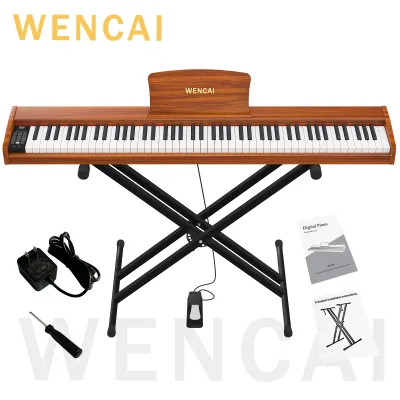
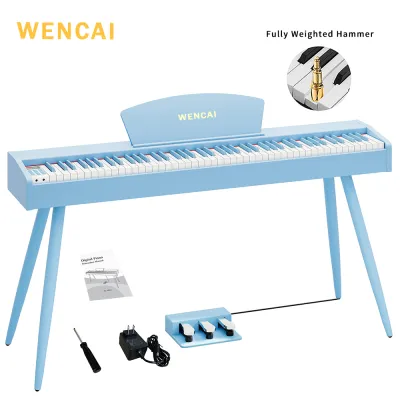
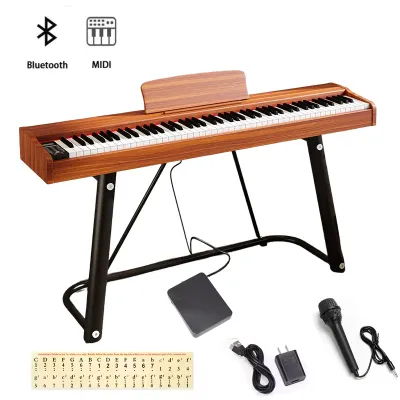
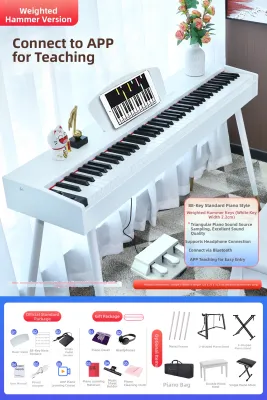
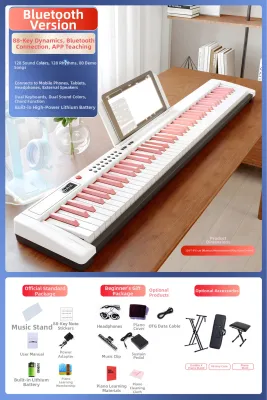
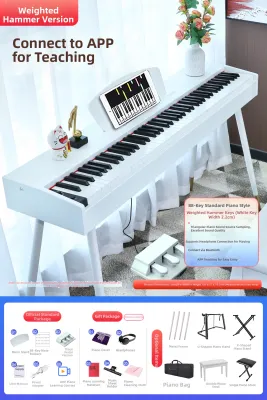
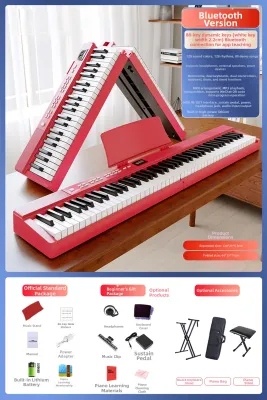
Prices are valid at publication and may change. Please refer to the product page for the latest price.
For gigging musicians, mobile music producers, or those living in compact spaces, secondary factors such as portability, speaker output, and connectivity become the ultimate deciding factors. A heavy console cabinet piano may sound spectacular in a spacious living room, but it is highly impractical for a performer who needs to transport their gear to different venues. Conversely, a lightweight slab-style piano offers excellent portability but may lack the high-wattage, multi-way speaker systems required to fill a room with rich, immersive sound without external amplification.
To streamline your comparison, it is best to view these specifications through a core decision matrix based on your primary use case. Classical students require heavy, graded hammer action to build proper finger technique, while studio producers prioritize robust MIDI-over-USB connectivity and a compact form factor. By identifying your primary playing goals, you can quickly narrow down the specifications that deserve your focus and avoid paying for premium features that do not serve your daily workflow.
Keyboard Action: Evaluating Touch and Realism on an 88 Keys Piano Keyboard
The physical feel of the keys is the single most important differentiator when comparing digital pianos. Acoustic pianos use a complex system of wooden keys, felt hammers, and gravity to produce sound, creating a distinct resistance that players must master. Digital instruments attempt to replicate this behavior using three main types of keybeds: fully weighted (hammer action), semi-weighted, and synth-action. Fully weighted keybeds use physical weights or miniature hammer mechanisms to simulate the true resistance of an acoustic piano, making them indispensable for students who need to develop finger strength, hand posture, and dynamic control.

Semi-weighted keys use springs combined with light weights to offer some resistance, making them a common middle ground for portable instruments. While they are easier to play for fast synthesizer lines or organ glissandos, they do not provide the physical feedback necessary to execute delicate pianissimo passages or powerful fortissimos on a piano voice. Synth-action keys, on the other hand, rely entirely on spring tension and offer virtually no resistance. These are excellent for electronic music production or playing fast lead lines, but they are highly discouraged for anyone serious about learning traditional piano technique.
When comparing weighted keybeds, look for advanced mechanical simulations that elevate the realism of the instrument. Graded hammer action is a crucial feature where the keys on the lower register feel heavier than those in the treble register, mimicking the varying hammer sizes of an acoustic grand. Premium models often include an “escapement” or “let-off” simulation, which replicates the subtle click or notch felt when gently pressing an acoustic key halfway down. Additionally, look for textured key surfaces, such as synthetic ivory and ebony keytops. In tropical climates like the Philippines, where high humidity and warm temperatures can lead to slippery fingers during long practice sessions, these textured surfaces are highly beneficial for absorbing moisture and maintaining proper grip.
Beyond the mechanical components, the electronic sensors beneath the keys play a vital role in how your touch translates into sound. Most entry-level digital pianos use dual-sensor systems, which detect when a key is pressed and how fast it travels. However, intermediate and professional models utilize triple-sensor keybeds. The third sensor allows the instrument to register a key repetition before the key has fully returned to its resting position, enabling rapid note repetitions and smooth legato playing.
Finally, evaluate the instrument’s touch sensitivity levels and velocity curves. Most digital pianos allow you to adjust the touch response to be light, medium, heavy, or fixed. A heavy touch curve requires you to strike the keys harder to produce a loud sound, which is excellent for players with strong fingers who want maximum dynamic expression. A light touch curve is ideal for younger children or beginners who have not yet developed full hand strength. When comparing models, check the manufacturer’s technical specifications for the precise name of the keybed mechanism (such as PHA-4, RH3, or GHC) and research user feedback regarding its physical weight and bounce-back speed, rather than relying on generic marketing claims of a “natural touch.”
Sound Engine and Polyphony: Assessing Audio Quality
A digital piano’s sound engine is responsible for transforming your physical keystrokes into rich, expressive audio. Manufacturers primarily use two distinct technologies to achieve this: multi-layer acoustic sampling and physical modeling. Acoustic sampling involves recording individual notes of a world-class grand piano at multiple volume levels (velocity layers) and playing back those recordings when you press a key. High-quality sampled sound engines use long, unlooped samples with minimal compression to preserve the natural decay and tonal character of the acoustic instrument.
Physical modeling takes a fundamentally different approach. Instead of playing back pre-recorded audio files, a modeled sound engine uses powerful digital signal processors to calculate the physical behavior of a piano in real-time. It simulates the interaction of the strings, the soundboard, the cabinet, and even the surrounding room acoustics. While sampling can sound incredibly realistic for individual notes, physical modeling excels at capturing the organic, infinitely variable tonal transitions that occur when you play complex chords or use the sustain pedal. Some premium instruments combine both technologies, using high-resolution samples for the initial attack of the note and physical modeling for the complex resonance that follows.
Another critical technical specification to compare is polyphony, which refers to the maximum number of individual notes or voices the piano can produce simultaneously. Entry-level models may offer 64-note polyphony, while intermediate and advanced instruments typically feature 128, 256, or even unlimited polyphony on their primary piano sounds. It is easy to assume that 64 notes are more than enough for a ten-fingered player, but polyphony is consumed rapidly when you use the sustain pedal. Each sustained note, along with its stereo channels, layered sounds (such as piano combined with strings), and internal resonance effects, counts toward the polyphony limit. If you exceed this limit, the oldest active notes will abruptly cut off, ruining the smoothness of your performance. For classical repertoire or advanced pedaling, a minimum of 128-note polyphony is highly recommended.
To truly replicate an acoustic grand, look for sound engines that simulate natural acoustic behaviors. Damper resonance simulates the rich, sympathetic vibration of all strings when the sustain pedal is pressed down. String resonance replicates the subtle harmonic vibrations of un-damped strings when other notes are struck. Key-off samples capture the quiet sound of the damper falling back onto the string when a key is released. These microscopic details might seem minor individually, but together they create a three-dimensional, living sound that feels responsive to your touch.
The way this sound is projected into your room is equally important. Compare the built-in speaker systems of each model by looking at the amplifier wattage, the number of speakers, and their physical placement. Entry-level portable pianos often feature dual 6-watt or 8-watt speakers, which are sufficient for quiet home practice but can sound thin or distort at higher volumes. Premium console models may feature multi-channel amplification systems exceeding 40 watts, utilizing dedicated woofers for deep bass and tweeters for crisp highs. If you plan to practice primarily with headphones or connect your instrument to external studio monitors, high-wattage internal speakers are less critical. However, if the piano will stand alone in a spacious living room, robust internal amplification is essential for a satisfying, full-bodied sound.
Connectivity and Build: Practical Features for Your Setup
The physical design and connectivity options of an 88-key digital piano determine how easily it integrates into your daily routine, recording studio, or live performance setup. Modern digital pianos offer a variety of digital interfaces designed to simplify music production and learning. A USB-to-Host port is standard on almost all modern models, allowing you to send MIDI data to a computer, tablet, or smartphone. Some advanced models support USB Audio over this same connection, meaning the piano can send its internal high-quality audio directly to your recording software without requiring a separate external audio interface.
Wireless connectivity has also become increasingly popular. Bluetooth MIDI allows you to connect the piano wirelessly to interactive learning apps, sheet music readers, or digital audio workstations (DAWs) on your mobile devices. Bluetooth Audio, on the other hand, lets you stream music from your phone directly through the piano’s built-in speakers, allowing you to play along with your favorite backing tracks or instructional videos. For musicians working with older hardware synthesizers or vintage studio gear, traditional 5-pin MIDI ports remain a valuable inclusion, though they are increasingly rare on consumer-focused digital pianos.
When it comes to analog audio connections, pay close attention to the available outputs. If you intend to perform live or record in a studio, dedicated line outputs (typically left and right 1/4-inch jacks) are essential. These outputs send a clean, line-level signal to PA systems, mixing consoles, or audio interfaces. Pianos that lack dedicated line outs force you to use the headphone jack for external amplification, which often results in weak signals, unwanted background hiss, and automatic muting of the internal speakers. Conversely, ensure the headphone jacks themselves are easily accessible (ideally mounted on the front of the instrument) and offer both 1/4-inch and 3.5mm options to accommodate different headphone styles without needing adapters.
The physical build of the piano represents a major fork in your decision-making process. Portable slab-style pianos are lightweight, compact, and easy to store. They are designed to sit on a folding stand and typically ship with a basic, plastic sustain switch. While highly practical for gigging or small apartments, they require you to purchase a sturdy stand and a high-quality sustain pedal separately to prevent the keyboard from wobbling during passionate play. Console or cabinet-style digital pianos are designed as permanent pieces of furniture. They feature integrated wooden stands, sliding key covers to protect against dust, and a built-in triple-pedal board (damper, soft, and sostenuto). Console models offer superior stability and a more traditional aesthetic, but they are heavy, difficult to move, and occupy a fixed footprint in your home.
Additionally, consider secondary features that enhance your daily practice. Built-in metronomes, dual headphone jacks (for silent student-teacher practice), and onboard MIDI or audio recording are highly practical tools for self-evaluation. Some premium cabinet models also feature physical design elements like lid simulators or physical soundboards that naturally disperse sound, though these are luxury additions rather than absolute necessities for most players. Before connecting any external hardware, mobile apps, or power supplies, always refer to the manufacturer’s instruction manual to ensure device compatibility and prevent accidental damage to the internal circuitry.
Decision Framework: Matching Specs to Your Playing Goals
To finalize your comparison and choose the right instrument, you must align the technical specifications of each model with your specific musical goals, space constraints, and budget.
Choose a basic hammer-action model with 128 polyphony if:
- You are a beginner or intermediate student focused on learning classical piano technique.
- Your primary goal is to build finger strength and muscle memory that translates directly to an acoustic piano.
- You plan to practice mostly at home and do not require advanced recording interfaces or extensive built-in instrument voices.
- You want a reliable, budget-friendly instrument that prioritizes physical touch realism over secondary digital features. Entry-level models in this category typically range from ₱20,000 to ₱35,000.
Choose a portable slab model with extensive USB/Bluetooth connectivity if:
- You are a gigging musician, live performer, or mobile music producer who needs to transport their instrument frequently.
- You work extensively with digital audio workstations, virtual instruments, or interactive learning software.
- You have limited living space and need an instrument that can be easily stored in a closet or under a bed when not in use.
- You plan to connect the piano to external PA systems, mixers, or studio monitors for performances and recording sessions. Mid-range portable models generally fall between ₱35,000 and ₱75,000.
Choose a premium console model with physical modeling and high-wattage speakers if:
- You want a permanent, elegant instrument for your living room or dedicated music studio that replicates the physical presence of an acoustic upright or grand piano.
- You are an advanced player who demands the highest level of expression, including sympathetic resonance, key-off samples, and physical escapement simulation.
- You prefer to play without headphones and want a powerful, multi-channel internal speaker system that fills the room with rich, natural sound.
- You want an all-in-one package that includes a stable wooden stand, a sliding key cover, and a fully integrated triple-pedal system. Premium console models typically start at around ₱80,000 and can exceed ₱150,000.
Verify first if:
- You require specific software compatibility or dedicated mobile app integration to access advanced settings or lesson plans.
- The keyboard layout supports specialized functions like split mode (playing different instruments on the left and right hands) or duet mode (splitting the keyboard into two identical pitch ranges for lessons).
- The physical dimensions of the instrument—especially when accounting for a stand or cabinet—will fit comfortably within your designated room space.
- The local electrical standards and voltage requirements are compatible with your home setup. In the Philippines, digital pianos must support 220V at 60Hz; if you are purchasing an imported model, verify whether you need a dedicated step-down transformer or a compatible local power adapter to prevent damaging the sensitive internal electronics.
Frequently Asked Questions (FAQ)
Do I really need 88 keys for learning piano?
Yes, a full 88-key range is highly recommended if your goal is to learn traditional piano, study classical repertoire, or take formal music lessons. Standard acoustic pianos feature 88 keys, and most sheet music—even for intermediate players—is written with this full range in mind. While smaller keyboards with 61 or 73 keys are perfectly suitable for playing basic synthesizer leads, pop chord progressions, or electronic music production, they will quickly limit your progress as you advance to complex classical pieces that utilize the extreme bass and treble registers of the instrument.
Is a digital piano the same as a digital keyboard?
No, digital pianos and digital keyboards serve fundamentally different purposes and feature distinct designs. A digital piano is engineered specifically to replicate the touch, weight, and acoustic sound of a traditional piano, almost always featuring 88 fully weighted keys and a focus on high-quality piano samples. A digital keyboard, often referred to as an arranger or synthesizer, focuses on portability and sonic variety. Keyboards typically feature unweighted or semi-weighted keys, fewer than 88 notes, and hundreds of built-in instrument voices, drum rhythms, and automatic accompaniment features designed for casual playing or electronic music production.
Community discussion
Share your experience or ask a question. Comments are reviewed before publication.