
Selecting the correct drum rug size is a balance between the physical footprint of your drum kit and the actual floor space available in your home. When you play, the forward energy of your bass drum pedal strikes and the lateral force of your hi-hat footwork naturally push your hardware away from you—a frustrating phenomenon known as “drum creep.” A dedicated drum rug provides the necessary friction to lock your stands in place, protects your underlying flooring from scratches caused by sharp metal spurs, and dampens unwanted vibrations. Choosing the correct size requires balancing the physical footprint of your specific drum kit configuration with the available dimensions of your practice space. This guide walks you through measuring your gear, assessing your room, and selecting a rug that ensures stability and comfort.
Measure Your Drum Kit Footprint
To find the correct rug size, determine the absolute floor space your drum kit occupies when fully assembled. Set up your drum kit exactly how you prefer to play it, adjusting the throne height, pedal angles, and cymbal placements to your anatomical comfort. Once your kit is configured, take a tape measure and map out the extreme outer boundaries of your setup.
Begin by measuring the maximum width of your layout. Locate the outermost point on the left side of your kit—typically the leg of your hi-hat stand or the edge of a crash cymbal—and measure in a straight line to the outermost point on the right side, which is often the leg of a ride cymbal stand or the edge of your floor tom. Next, measure the total depth of your setup. This measurement must run from the very back of your drum throne (accounting for where your body weight shifts when you lean back) to the absolute front of your bass drum hoop or the front legs of your kick drum.
Products mentioned in this guide


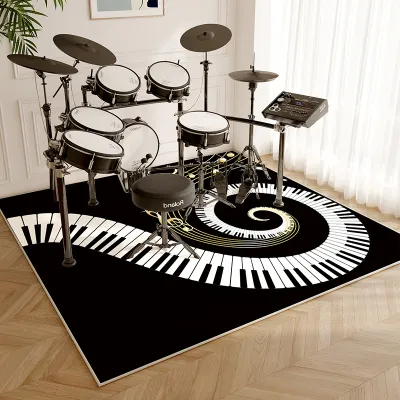

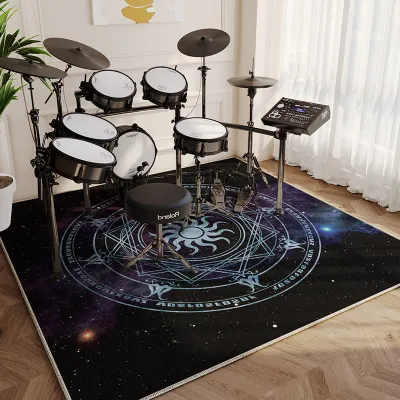


Prices are valid at publication and may change. Please refer to the product page for the latest price.
It is vital to account for any auxiliary hardware that might expand this footprint. If you use a double bass drum pedal, the slave pedal and its connecting drive shaft will push your hi-hat stand further to the left. If you incorporate floor-standing music stands, laptop mounts, auxiliary percussion tables, or floor-monitoring wedges, these items must also sit entirely on the rug. If any single stand leg spills off the edge of the rug, the height imbalance will cause that stand to wobble during play.
The type of kit you play also dictates your footprint dynamics. Electronic drum kits typically utilize a unified rack system that organizes the pads within a relatively compact, rectangular boundary. While electronic kits generally require less depth than acoustic kits, their rack legs still require a flat, uniform surface to prevent the entire structure from swaying. Acoustic kits, on the other hand, rely on independent, double-braced tripod stands that sprawl outward to support heavy cymbals and drums, demanding a significantly wider and more irregular footprint.
Assess Your Available Practice Space
Once you have mapped out the physical dimensions of your drum kit, you must evaluate the room where the kit will live. In many residential settings, particularly compact apartments, townhouses, or condominiums, floor space is a premium commodity. You cannot simply match the rug to the kit; you must also ensure the rug fits harmoniously within the room without disrupting daily household traffic.

Start by measuring the dedicated floor area where you plan to place the rug. When doing this, add a safety buffer of at least 30 to 50 centimeters around the perimeter of your measured kit footprint. This buffer is essential for several reasons: it allows your drum throne to slide back slightly when you stand up, prevents your drumsticks from striking nearby walls or glass windows during energetic fills, and ensures you have enough room to mount and dismount the throne safely.
Next, carefully analyze the room’s architectural features and furniture layout. Check the swing radius of nearby doors, closet doors, and cabinet drawers. A drum rug that extends even a few centimeters into a doorway can prevent the door from closing properly or create a constant tripping hazard. If your practice space doubles as a guest bedroom or a home office, you must plan for a layout that does not obstruct walkways or block access to power outlets and light switches.
For drummers living in shared spaces where the kit cannot remain permanently assembled, portability is key. If you use a foldable electronic kit or a compact cocktail kit, you will want a drum rug that can be easily rolled up, secured with a strap, and tucked away in a closet or behind a door when not in use. In these scenarios, choosing a rug that is slightly smaller and lighter—while still accommodating the pedals and throne—makes the setup and teardown process far less tedious.
Match Standard Rug Sizes to Kit Configurations
Drum rugs generally fall into three standard size categories, each suited to different kit configurations and spatial limitations. While these categories serve as an excellent starting point, always prioritize your actual physical measurements over generic recommendations.
Small-format drum rugs typically measure around 4×6 feet (approximately 1.2×1.8 meters). This compact size is highly suited for small electronic drum kits, portable cocktail kits, or minimalist 3-piece acoustic setups (consisting of a bass drum, snare, and hi-hat). If you are setting up in a highly restricted bedroom corner or a small study, a 4×6 rug provides just enough surface area to anchor your bass drum pedal, hi-hat stand, and the front legs of your drum throne. However, keep in mind that larger acoustic kits with multiple cymbal stands will easily spill over the edges of a small rug.
Medium-format drum rugs, usually measuring between 5×7 and 6×8 feet (approximately 1.5×2.1 to 1.8×2.4 meters), represent the industry standard and are the most versatile option for most drummers. This size comfortably accommodates standard 4-piece and 5-piece acoustic drum kits, including the bass drum, snare, rack toms, floor tom, hi-hat, and two or three cymbal stands. Crucially, a medium rug is long enough to ensure your drum throne sits entirely on the carpet. Keeping your throne on the rug is essential because your body weight acts as the primary anchor, pressing the rug down and preventing the bass drum from sliding forward.
Large-format drum rugs, measuring 8×10 feet (approximately 2.4×3.0 meters) or larger, are designed for expansive setups. If you play a double-bass drum kit, a multi-piece fusion setup with numerous rack toms and side-snares, or if you use extensive cymbal arrays with heavy boom stands, a large rug is a necessity. This size is also ideal for professional rehearsal studios or stage environments where you need extra space to accommodate floor monitors, external mixers, and accessory tables alongside the drum kit.
Ultimately, your final selection must rely on the physical measurements of your specific hardware layout rather than the mere number of drums in your kit. A minimalist player who uses wide-sprawling, heavy-duty boom stands may require a medium or large rug, whereas a player with a compact 5-piece kit mounted entirely on a single rack might easily fit on a smaller footprint.
Evaluate Rug Material and Thickness for Stability
The material composition and physical construction of your drum rug are just as important as its dimensions. In tropical climates where high humidity is common, selecting the right materials ensures both the longevity of the rug and the safety of your floors.
First and foremost, a drum rug must feature a high-quality, non-slip backing. On hard, smooth surfaces such as polished ceramic tiles, marble, or hardwood, a plain fabric rug will slide effortlessly under the impact of your playing. Look for rugs with a dedicated rubberized, latex, or textured thermoplastic elastomer (TPE) backing. This backing grips the floor surface, preventing the rug from shifting even during intense double-bass drumming.
The thickness and pile of the rug also directly affect your playing stability. While a thick, plush shag carpet might feel comfortable underfoot, it is highly unsuitable for a drum kit. Extremely thick piles allow heavy hardware stands and pedal boards to sink unevenly, causing your bass drum pedal and hi-hat stand to wobble or tilt. For maximum stability, choose a low-pile, tightly woven carpet, a needle-punch utility rug, or a specialized tight-loop nylon drum mat. These materials provide a firm, level surface that keeps your pedals flat and responsive.
Additionally, pay close attention to the edge finishing of the rug. Look for rugs with heavily bound, stitched, or beveled edges. Unfinished edges will quickly fray under the constant friction of heavy metal stands, transport, and foot traffic. Furthermore, a rug with curled or frayed edges presents a serious tripping hazard in tight practice spaces and can easily catch on your shoes or hardware bags during setup.
Secure and Maintain Your Drum Rug
To maximize the lifespan of your drum rug and maintain a clean, safe practice environment, proper installation and routine maintenance are essential. Even a high-quality rug requires occasional care to perform at its best.
When setting up your rug on highly polished or slippery floors, you can enhance its stability by using a thin, non-slip mesh underlay—the same type used to keep household area rugs from sliding. If you have a permanent practice space, you can secure the corners of the rug using heavy-duty, double-sided carpet tape that is rated safe for your specific flooring type. However, the most effective way to anchor the rug is simply to ensure that your heaviest hardware—specifically your drum throne with your body weight on it—is fully positioned on the rug, creating a natural anchor point.
Routine cleaning is vital for preserving the rug’s fibers and backing, especially in humid environments where dust and moisture can combine to create grime. Regularly vacuum the rug to remove dust, wood shavings from your drumsticks, and tiny metal filings that naturally wear off cymbal stands and tension rods over time. If left uncleaned, these sharp metal and wood particles can grind into the rug fibers, causing premature wear and tearing.
Finally, establish a regular schedule to inspect the condition of your rug. Periodically flip the rug over to check the non-slip backing for signs of wear, cracking, or dry rot, which can be accelerated by tropical heat and humidity. If the rubberized backing begins to flake off, lose its grip, or leave a powdery residue on your floor, it is time to replace the rug or add a separate, high-quality grip pad underneath to protect your flooring and maintain a stable playing foundation.
Frequently Asked Questions (FAQ)
Can I use a regular household carpet instead of a dedicated drum rug?
Yes, you can use a regular household carpet or area rug, but you must evaluate its construction carefully before doing so. Many standard household carpets lack a non-slip rubber backing, meaning they will slide easily on smooth tile or wooden floors unless they are anchored by heavy furniture. Additionally, household rugs often feature thick, plush piles that cause drum pedals and tripod stands to sink and wobble, compromising your playing stability. If you choose to repurpose a household rug, ensure it has a very low, dense pile, and always place a dedicated non-slip rubber underlay beneath it to prevent sliding.
How do I prevent my drum rug from sliding on smooth tiles?
Smooth ceramic or marble tiles are notoriously slippery surfaces for drum setups. To prevent your rug from sliding, the most effective solution is to place a high-quality, non-slip rubberized mesh underlay mat directly beneath the drum rug. Additionally, ensure that your drum throne is positioned entirely on the rug; your body weight provides the necessary downward force to pin the rug to the floor. For permanent setups, you can also use specialized double-sided carpet tape on the corners, making sure to choose an adhesive that will not damage or leave a sticky residue on your tiles.
Community discussion
Share your experience or ask a question. Comments are reviewed before publication.