
Choosing the right acoustic guitar string set is one of the most direct ways to transform your instrument’s playability and tone. The ideal strings bridge the gap between your physical technique and the natural resonance of your guitar’s wood. Because acoustic guitars rely entirely on physical vibration to project sound, your choice of string gauge and material dictates how hard you must press, how loudly your instrument speaks, and how long your notes sustain.
In tropical climates like the Philippines, where high humidity and warm temperatures accelerate metal oxidation, selecting the right strings also involves balancing tone with durability. Sweat and moisture can quickly deaden a fresh set of strings, making material choice and protective coatings key factors in your decision. By understanding how your playing style, comfort preferences, and instrument hardware interact with different string specifications, you can confidently select a set that feels comfortable under your fingers and delivers your desired sound.
Identify Your Playing Style and Technique Needs
Your primary playing technique determines the physical demands you place on your guitar strings. Fingerstyle players, who pluck the strings directly with their fingertips or nails, generally require highly responsive strings that vibrate easily under light pressure. Because fingerstyle relies on subtle nuances and individual note definition, strings with lower tension allow for expressive bending and intricate fretting without causing hand fatigue.
Products mentioned in this guide


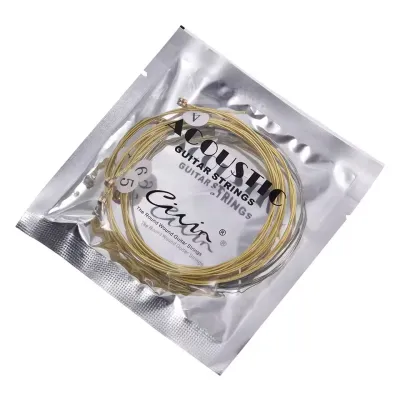





Prices are valid at publication and may change. Please refer to the product page for the latest price.
Conversely, players who focus on aggressive strumming or flatpicking need strings that can withstand heavy pick attacks. Heavy strumming transfers significant kinetic energy to the strings, which can cause lighter strings to buzz against the frets or quickly lose their tuning stability. Rigid, higher-tension strings resist this intense downward force, maintaining their pitch and delivering a clean, powerful chord projection even under a heavy hand.
If you frequently switch between delicate fingerpicking and energetic strumming, finding a middle ground is essential. Hybrid playing styles benefit from mixed-gauge sets or balanced-tension strings, which feature lighter treble strings for easy fretting and heavier bass strings to handle robust rhythm work. Evaluating your daily playing habits helps you identify whether you need the flexibility of a light set, the resilience of a heavy set, or a versatile compromise.
Match String Gauge to Your Comfort and Volume Goals
String gauge refers to the physical thickness of the strings, measured in thousandths of an inch. The gauge you choose directly impacts both the physical effort required to play and the acoustic volume your guitar can produce. Extra-light (typically .010 to .047) and light (.012 to .053) gauges are highly popular among beginners and fingerstyle players because they require less finger pressure to press down against the fretboard. However, thinner strings exert less physical force on the guitar’s soundboard, resulting in a quieter overall volume, less sustain, and a thinner bass response.

Medium (.013 to .056) and heavy (.014 to .059) gauges offer the opposite trade-off. These thicker strings require substantial finger strength and well-developed calluses to play comfortably, especially when executing string bends. In return, they drive the guitar’s top wood much harder, producing a louder, richer sound with deep bass and prolonged sustain. For large-bodied guitars like dreadnoughts or jumbos, heavier strings are often necessary to fully activate the instrument’s internal air volume and wood resonance.
Before moving to a heavier gauge, you must check your guitar’s structural limits. Smaller instruments, such as parlor guitars or travel models, are built with lighter internal bracing. Installing medium or heavy strings on these delicate instruments can exert excessive tension on the bridge and neck, potentially warping the wood or lifting the bridge over time. Always verify the manufacturer’s recommended string gauges for your specific guitar body size to ensure you do not cause structural damage.
Select Winding Materials for Your Target Tone
The metal alloy wrapped around the lower four strings of an acoustic set defines its tonal character and longevity. The two most common options are 80/20 bronze and phosphor bronze. 80/20 bronze strings, made of 80 percent copper and 20 percent zinc, deliver a bright, crisp, and highly projecting tone when first installed. They are excellent for darkening guitars or for players who want their chords to cut through a mix, though they tend to lose their brightness relatively quickly as they oxidize.
Phosphor bronze strings introduce a small amount of phosphorus to the copper-tin alloy. This addition creates a warmer, richer, and more balanced tone with a longer acoustic lifespan. The copper-heavy composition resists corrosion slightly better than 80/20 bronze, making phosphor bronze a reliable standard for players who prefer a mellow, woody sound that ages gracefully over weeks of play.
For players seeking a softer feel and a vintage, intimate sound, silk and steel strings are an excellent alternative. These strings feature nylon or silk fibers wrapped around a steel core before being wound with copper wire. The resulting strings have significantly lower tension, making them incredibly gentle on sensitive fingers while producing a quiet, sweet tone reminiscent of a classical guitar.
In humid environments, coated strings are highly practical. These strings feature an ultra-thin polymer barrier that prevents sweat, skin oils, and atmospheric moisture from reaching the metal core and windings. While coated strings generally carry a higher initial price tag, they can last several times longer than uncoated strings before showing signs of rust or tonal decay. Some players note a slight reduction in high-end brightness and a different physical texture, but the trade-off is often worthwhile for those living in tropical climates.
Verify Guitar Compatibility and Hardware Limits
Before purchasing a new string set, you must confirm that the physical design of the strings matches your guitar’s hardware. Most steel-string acoustic guitars use ball-end strings, which are secured inside the bridge using bridge pins. However, some vintage models, classical guitars, or crossover instruments require loop-end strings or tie-on nylon strings. Attempting to force the wrong end type into your bridge can damage the bridge plate or prevent the strings from holding tension.
Specialized instruments also require dedicated string configurations. For example, a 12-string guitar requires a specific set containing octave and unison pairs, which are wound to much thinner gauges to prevent excessive total tension on the neck. Similarly, short-scale travel guitars or baritone acoustics require specialized lengths and gauges to maintain proper playability and pitch stability. Always read the packaging labels carefully to ensure the set matches your instrument’s scale length and string count.
Switching to a significantly different string gauge alters the physical pull on your guitar’s neck. If you move from extra-light to medium strings, the increased tension will pull the neck forward, increasing the action (the distance between the strings and the fretboard) and making the guitar harder to play. This change typically requires a truss rod adjustment to restore the correct neck relief, and potentially a saddle adjustment to maintain accurate intonation. If you are uncomfortable performing these adjustments yourself, consult a local luthier or guitar technician to set up your instrument safely.
Plan for String Longevity and Maintenance
The lifespan of your acoustic guitar strings depends heavily on your playing environment and post-session care. In tropical regions, high relative humidity combined with the natural acidity of sweat creates a highly corrosive environment for bare steel and bronze. If left uncleaned, moisture trapped between the string windings will rapidly cause rust, leading to a dull, dead tone and rough physical texture that can wear down your frets.
You can easily identify when your strings need replacement by observing a few key signals. Visually, look for dark spots, rust, or discoloration along the length of the strings, particularly over the frets where your fingers make contact. Tonally, worn-out strings lose their sustain and high-end clarity, sounding muddy and unresponsive. If your guitar suddenly struggles to stay in tune or if the strings feel stiff and brittle, it is time to install a fresh set.
When budgeting for accessories, focus on finding a reliable baseline set that fits your routine rather than relying on extravagant packaging promises. For casual players, a standard uncoated set changed every few weeks offers a fresh, bright tone at a modest price point. If you play daily or live in a highly humid area, investing in a coated set can save you time and money in the long run by reducing the frequency of string changes. Keeping a clean microfiber cloth in your gig bag to wipe down the strings after every session is a simple, zero-cost habit that dramatically extends the life of any set you choose.
Frequently Asked Questions (FAQ)
Can I use electric guitar strings on an acoustic guitar?
While you can physically install electric guitar strings on an acoustic guitar, it is not recommended for optimal performance. Electric strings are typically made of nickel or nickel-plated steel, which are designed to interact efficiently with magnetic pickups rather than project sound acoustically. When installed on an acoustic guitar, these materials produce a very quiet, thin, and tinny tone because they lack the bronze winding needed to drive the acoustic soundboard. Additionally, electric sets are generally much thinner, which may cause significant fret buzz due to insufficient tension on the acoustic neck.
How often should I change my acoustic guitar strings?
There is no fixed calendar schedule for changing strings, as replacement frequency depends on how often you play and your local climate. Casual players who practice a few times a week may only need to change their strings every two to three months. However, if you play daily, sweat heavily, or live in a highly humid environment, you may need to replace them every three to four weeks to maintain a bright tone and smooth playability. Always rely on physical cues—such as visible rust, tuning instability, or a dull, lifeless sound—to decide when to change your set.
Do I need to adjust my guitar when switching string gauges?
Yes, changing your string gauge usually requires minor adjustments to your guitar’s setup. Moving to a heavier gauge increases the physical tension on the neck, which can bow the neck forward and raise the action, making the strings harder to press down. Moving to a lighter gauge has the opposite effect, reducing tension and potentially causing the strings to buzz against the frets. To keep your guitar playing comfortably and in tune, a technician may need to adjust the truss rod inside the neck, file the nut slots, or adjust the saddle height to accommodate the new string thickness.

Community discussion
Share your experience or ask a question. Comments are reviewed before publication.