
Finding a consistent rhythm in your spiritual life can be challenging when balancing professional demands, family duties, and the daily grind. Short-format Catholic daily devotionals, such as One Minute with God, offer an accessible pathway to daily prayer. These books provide structured, bite-sized reflections that fit seamlessly into a busy schedule, helping you ground your day in Scripture without requiring hours of study. To choose the right devotional, you should look for books that combine solid Catholic doctrine, practical daily challenges, and a format that matches your lifestyle.
Why Short-Format Devotionals Work for Men
Men often face unique spiritual hurdles, particularly when trying to balance the call to spiritual leadership with a packed schedule. Between long commutes, demanding work hours, and family commitments, finding a quiet hour for deep theological study can feel nearly impossible. This is where short-format devotionals excel. By condensing profound spiritual truths into actionable, bite-sized insights, these books make daily reflection achievable. Instead of feeling overwhelmed by the sheer volume of a text, you can focus on a single, powerful thought for the day.
An effective men’s devotional relies on a clear daily structure. It typically begins with a short Scripture passage, followed by a brief reflection that connects the biblical text to real-world scenarios. These scenarios often address common masculine experiences, such as professional integrity, fatherhood, self-discipline, and personal sacrifice. By framing spiritual growth around practical application, these books help you see how faith operates in your daily decisions, rather than keeping theology abstract.
Products mentioned in this guide
![[COD] SAjeNH SPORT One Minute With God For Men: 365 Daily Devotional Book Daily Bible Reading & Prayer Planner With 365 Prompts Gift](https://img.lazcdn.com/g/p/557bce22d179a26672905a65c5d6140e.jpg_400x400q80.jpg_.webp)
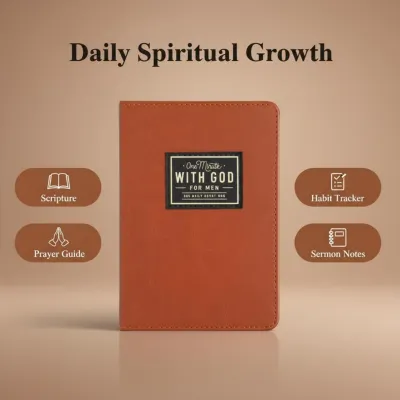



Prices are valid at publication and may change. Please refer to the product page for the latest price.
Furthermore, brief formats help lower the barrier to entry for spiritual reading. Thick theological volumes or complex spiritual treatises can be intimidating, especially for those who are just beginning to develop a prayer routine. A devotional that requires only a few minutes of your morning removes this friction. It builds momentum, proving that consistency is far more valuable than sporadic, lengthy study sessions. Over time, these small daily habits accumulate, leading to a deeper, more resilient faith.
Essential Criteria for Evaluating Catholic Spiritual Books
When selecting a daily devotional, ensuring theological soundness is paramount. Because these books shape your daily thoughts and moral outlook, they must align with the authentic teachings of the Catholic Church. The most reliable way to verify this is by looking for official ecclesiastical approvals: the Nihil Obstat and the Imprimatur. The Nihil Obstat is a declaration by a church censor that the book contains nothing contrary to faith and morals, while the Imprimatur is the official permission granted by a bishop to publish the work. These declarations are typically found on the copyright page and serve as a safeguard for your spiritual formation.

Beyond official approvals, it is wise to evaluate the author’s background and spiritual tradition. Catholic spirituality is rich and diverse, encompassing various schools of thought such as Ignatian, Dominican, Franciscan, or Carmelite traditions. Understanding the author’s background—whether they are a priest, a religious brother, or a lay theologian with a history of faithful service—can give you insight into the book’s tone and focus. An author deeply rooted in Church tradition is more likely to provide reflections that are both spiritually rich and doctrinally sound.
A high-quality devotional must also maintain a healthy balance between Scripture, reflection, and action. A book that relies solely on emotional encouragement without grounding its words in the Word of God may lack spiritual depth. Look for a structure where Sacred Scripture is the foundation, followed by a reflection that unpacks the text, and concluding with a concrete daily challenge. This challenge, often called a resolution, translates the spiritual insight into a physical action, such as performing a specific act of charity, practicing patience in traffic, or offering up a small sacrifice.
Matching Devotional Themes to Your Current Life Stage
Your spiritual needs change as you move through different seasons of life, and your devotional should reflect your current reality. If you are a beginner or a returning Catholic, you may benefit most from a book that focuses on the basics of prayer, the sacraments, and core Catholic doctrines. These devotionals help rebuild a foundation of faith without assuming prior theological knowledge. Conversely, if you have a well-established prayer life, you might seek a devotional that incorporates deeper theological reflections, classical spiritual writings, or the writings of the Church Fathers.
For busy professionals and fathers, the themes of daily readings should speak directly to the challenges of leadership, provision, and protection. A devotional tailored for fathers often emphasizes patience, sacrificial love, and leading by example in the home. For professionals, the focus may shift to ethical decision-making, humility in leadership, and sanctifying daily work. Additionally, men who participate in parish groups or brotherhoods might look for devotionals that emphasize accountability, communal prayer, and the shared journey of Christian discipleship.
It is also helpful to identify whether a devotional focuses primarily on virtue building, apologetics, or contemplative prayer. A virtue-focused book will guide you through the systematic cultivation of habits like temperance, fortitude, and justice. An apologetics-based devotional might help you understand and defend Catholic teachings, which is highly valuable in secular environments. Meanwhile, a contemplative devotional will guide you toward silent prayer, helping you quiet your mind and listen to the promptings of the Holy Spirit amidst a noisy world.
Formats, Editions, and Pre-Purchase Checks
The physical or digital format of your devotional plays a significant role in how easily you can integrate it into your daily routine. Standard print editions are excellent for keeping on a bedside table or a desk, providing a tactile, distraction-free reading experience. However, if you travel frequently or have a long daily commute, a pocket-sized leatherette edition might be more practical. These compact books are durable enough to withstand being tossed into a backpack and are easy to read while riding public transit.
In tropical climates like the Philippines, high humidity can take a toll on paper books. When purchasing a physical copy, look for high-quality bindings, such as sewn bindings rather than glued ones, and consider using a protective book cover to prevent warping. If physical storage or climate damage is a concern, digital editions or audiobooks are excellent alternatives. E-readers allow you to carry your entire spiritual library with you, while audio devotionals can be listened to during your morning drive or workout, turning otherwise unproductive time into a period of prayer.
Before making a purchase, always verify the specific edition, language, and Scripture translation used in the book. Catholic devotionals should ideally use approved Catholic Bible translations, such as the Revised Standard Version Catholic Edition (RSV-CE) or the New American Bible Revised Edition (NABRE). If you are buying online through ecommerce platforms or local Catholic bookshop websites, check the product specifications carefully. Look for supplementary features like built-in ribbon markers, dedicated space for journaling, or discussion questions at the end of each week, which can greatly enhance your study and reflection.
Strategies for Building a Consistent Daily Prayer Habit
Owning a great devotional is only the first step; the real benefit comes from consistent daily engagement. One of the most effective ways to build this habit is through “habit stacking.” This technique involves anchoring your new reading habit to an established part of your daily routine. For example, you can place your devotional next to your coffee maker, committing to reading the daily entry while your morning brew is preparing. Alternatively, you can make it the very first thing you do when you sit down at your office desk, before opening your email.
It is crucial to approach this habit with a mindset of grace rather than legalism. There will inevitably be days when you miss a reading due to illness, travel, or unexpected disruptions. When this happens, avoid the “all-or-nothing” trap of giving up entirely or trying to read ten chapters at once to catch up. Simply pick up where you left off on the current day. The goal is to cultivate a relationship with God, not to check off a box on a checklist.
Finally, remember that a daily devotional is meant to be a springboard, not the destination. The brief reflection should lead you into personal conversation with God. Use the daily Scripture passage as a starting point for mental prayer, allowing a few minutes of silence to listen to how God is speaking to your heart. Let the devotional inspire you to participate more fully in the sacramental life of the Church, drawing you closer to regular Confession and the reception of the Holy Eucharist, which are the ultimate sources of spiritual strength.
Frequently Asked Questions (FAQ)
Do I need to read the devotional in the exact order printed?
No, you do not have to read a daily devotional in chronological order. While many devotionals are structured around the liturgical calendar or a specific 365-day progression, others are organized topically. If you are facing a specific challenge, such as anxiety, career decisions, or family difficulties, it is entirely appropriate to skip ahead to a section that addresses those themes. The primary goal is spiritual growth and connection with God, so feel free to navigate the book in the way that best serves your current spiritual needs.
What should I look for if a devotional lacks an Imprimatur?
If a devotional does not have an official Imprimatur, it does not automatically mean the book is unsafe or unorthodox. Many excellent spiritual books written by reputable Catholic authors or published by smaller presses may not have gone through the formal diocesan review process. In these cases, you should carefully evaluate the author’s background, check if the publisher specializes in faithful Catholic literature, and read the book with a discerning eye. Ensure that the reflections align with the Catechism of the Catholic Church and do not contradict established Church teachings.
How can I use a daily devotional to lead my family in prayer?
A short daily devotional can be an excellent tool for family prayer, especially during meals or before bedtime. To adapt a men’s devotional for the family, read the Scripture passage aloud first, as the Word of God is universal. When reading the reflection, you can simplify complex terms or adjust the examples to make them relatable to your spouse and children. Conclude by asking a simple question based on the daily challenge, encouraging each family member to share how they can practice that virtue during the day.
Community discussion
Share your experience or ask a question. Comments are reviewed before publication.