
Finding a reliable phone clip for your guitar in the Philippines requires balancing device security, instrument safety, and local environmental factors. Whether you are practicing chords in a humid room, recording a cover for social media, or reading digital sheet music during a live gig, the right mount keeps your smartphone stable and accessible. Because guitars vary wildly in headstock thickness, body shape, and finish sensitivity, there is no single universal clip that works for every musician. To make an informed purchase on local e-commerce platforms, you must evaluate how different mounting styles interact with your specific instrument, verify your phone’s physical dimensions against clamp specifications, and choose materials that will not degrade under tropical conditions.
Determine the Right Mounting Style for Your Guitar
The physical design of your guitar is the primary factor that dictates which phone clip style you should choose. Headstock mounts are the most common variety, clamping directly onto the guitar’s peghead. These are excellent for reading lyrics or chord charts because they position the phone screen close to your natural line of sight. However, they work best on guitars with flat, accessible headstocks, such as standard electric guitars or steel-string acoustics. If you play a classical guitar, the wider, slotted headstock and thicker wood profile may prevent standard headstock clips from gripping securely. In such cases, forcing a small clip onto a thick classical headstock can cause the clamp to slip or crack the wood.
Soundhole mounts offer an alternative by positioning the phone directly over or inside the guitar’s soundhole. This placement is highly favored by fingerstyle players and those who record close-up videos of their strumming hand. However, soundhole mounts are strictly limited to acoustic guitars with standard round soundholes. They cannot be used on solid-body electric guitars, archtops with f-holes, or acoustics with non-traditional soundhole shapes. Additionally, because these mounts sit directly over the sound chamber, they can slightly alter the acoustic projection of your instrument, which is a critical consideration if you are performing unplugged.
Products mentioned in this guide
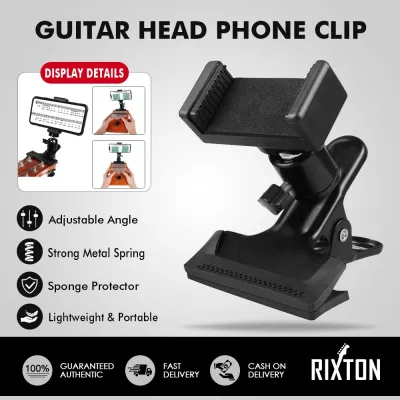
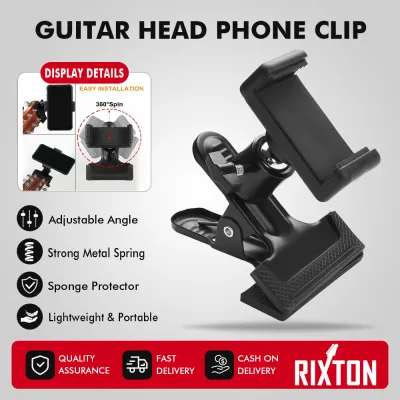
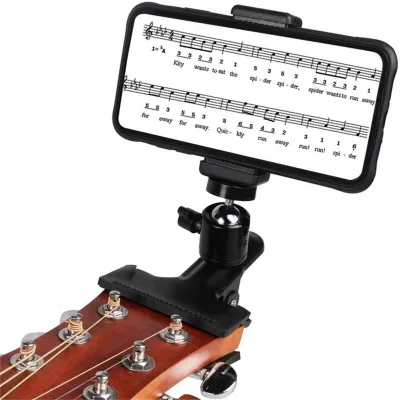
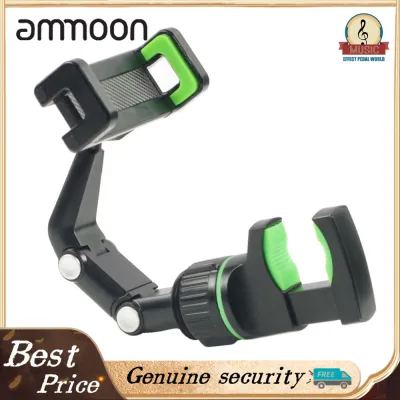
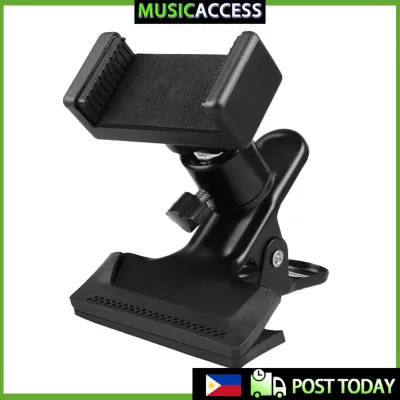
Prices are valid at publication and may change. Please refer to the product page for the latest price.
For players who prefer to keep their guitar’s neck and body completely free of obstructions, body or strap clips are a viable third option. These mounts typically attach to the guitar strap button or clamp onto the edge of the guitar body using suction cups or padded brackets. While they keep the phone out of your immediate field of view, they are highly stable and reduce the risk of neck-heavy imbalance. Before purchasing any mount, it is essential to measure your guitar’s headstock thickness or soundhole diameter using a ruler or caliper. Compare these measurements directly with the maximum opening dimensions listed on the product detail page to ensure a secure, slip-free fit.
Verify Phone Dimensions and Weight Capacity
A phone clip is only as useful as its ability to hold your specific smartphone securely. Before browsing online listings, measure the exact width and thickness of your phone. It is a common mistake to rely on the manufacturer’s official phone specifications, which only account for the bare device. In reality, most players use protective cases, ranging from slim silicone sleeves to bulky, rugged, shockproof cases. Measure your phone while it is inside its daily-use case to get an accurate reading of the total thickness and width.

When reviewing product descriptions on local e-commerce platforms, look closely at the clamp’s maximum extension range. A high-quality phone clip should have a spring-loaded or screw-tightened mechanism that comfortably accommodates your phone’s total width with at least a few millimeters of clearance to spare. If you have to stretch a spring-loaded clamp to its absolute limit to insert your phone, the excessive tension can strain the plastic housing of the mount, leading to premature cracking or sudden failure during a performance.
Weight capacity is another critical specification that is frequently overlooked. Modern smartphones, especially larger models with multi-camera arrays and heavy glass backs, can weigh upwards of 200 grams. When combined with a heavy-duty protective case, this weight can easily overwhelm a weak ball joint or a flexible gooseneck arm. If the mount’s load capacity is insufficient, the phone will gradually droop, tilt downward, or wobble every time you move or strum vigorously. Look for product listings that explicitly state the maximum supported weight, and choose a mount with a robust locking screw rather than a simple friction-based joint if you use a larger device.
Check Materials and Surface Protection
The materials used in a phone clip directly impact both the longevity of the accessory and the safety of your guitar’s finish. High-quality mounts feature thick, dense silicone or soft rubber padding on every surface that comes into contact with the instrument. This padding serves two purposes: it provides the necessary friction to prevent the clip from sliding around, and it acts as a protective barrier between the hard structure of the clamp and the delicate wood of your guitar.
Cheaply manufactured clips often use thin, low-density foam or, worse, leave hard plastic and metal screws exposed. Using a clip with inadequate padding can result in permanent cosmetic damage. Hard plastics can easily scratch polyurethane finishes, while exposed metal components can gouge the wood or dent the binding of your guitar. This risk is amplified in the Philippines, where high tropical humidity can make wood softer and more susceptible to pressure marks. Furthermore, some low-grade rubber or adhesive backings can chemically react with sensitive nitrocellulose finishes, which are commonly found on high-end acoustic and vintage electric guitars. This reaction can leave sticky, permanent blemishes on the headstock or neck.
To protect your investment, carefully read the product specifications and user feedback regarding material quality. Look for terms like “non-reactive silicone” or “high-density rubber padding.” If a product description does not clearly state what materials touch your guitar, or if buyer photos show exposed metal springs or screws near the clamping area, it is best to look for an alternative option.
Align Features With Your Playing and Recording Needs
Your choice of phone clip should align with how you intend to use your phone while playing. If your primary goal is to read digital sheet music, chord charts, or guitar tabs, you will need a mount that offers high adjustability. Look for clips featuring a 360-degree rotating ball joint or a flexible gooseneck arm. These features allow you to position the screen at the perfect viewing angle, minimizing neck strain and glare from overhead lights.
For musicians who use their phones to record audio or video, stability and vibration dampening are paramount. Strumming a guitar creates natural vibrations that travel up the neck to the headstock. If your phone clip lacks proper dampening, these vibrations will transfer directly to your phone’s internal microphone and camera sensor, resulting in distracting handling noise, rattling sounds, or shaky video footage. If you plan to record high-quality audio directly from your phone, look for rigid, low-profile mounts that sit close to the guitar’s body or headstock, as these tend to transfer fewer vibrations than long, flexible gooseneck designs.
Additionally, consider the ease of switching between landscape and portrait orientations. Landscape mode is ideal for reading wide sheet music or viewing multi-track recording interfaces, while portrait mode is necessary for vertical video platforms, live streaming, and video calls. A mount with a quick-release swivel mechanism allows you to change orientations on the fly without having to remove the phone from the clamp, saving time and reducing the risk of dropping your device during a transition.
Search and Verify Options on Online Retail Platforms
When shopping for a phone clip on local e-commerce platforms in the Philippines, using precise search terms will help you bypass irrelevant listings. Instead of searching for generic terms like “phone holder,” use specific queries such as “guitar phone holder,” “guitar headstock phone clip,” “guitar soundhole phone mount,” or “musical instrument phone clamp.” This narrows down the results to accessories specifically engineered for instruments rather than cars or desks.
Once you find a few promising options, do not rely solely on the seller’s promotional images, which are often highly edited or generic. Instead, scroll down to the user reviews and pay close attention to buyer-uploaded photos and videos. Look for reviews from local guitarists who have posted pictures of the clip attached to their actual guitars. This provides invaluable real-world evidence of how the clip fits different headstock shapes and whether it sags under the weight of a standard smartphone.
Finally, verify the seller’s overall rating and read their return and refund policies carefully. Because physical compatibility can be difficult to guarantee 100% online, buying from a reputable local seller with a clear return policy ensures you can exchange or return the mount if it does not fit your guitar’s headstock or soundhole upon arrival. Check if the seller packages the item securely, as delicate plastic components can easily crack during transit through local courier networks.
Frequently Asked Questions (FAQ)
Can I use a standard desk phone mount on my guitar?
Using a standard desk phone mount on a guitar is highly discouraged due to fundamental differences in design and clamping mechanics. Desk mounts are engineered for flat, rigid, and uniform surfaces like table edges, which do not match the contoured, tapered, and delicate profiles of guitar headstocks or necks. A desk clamp often lacks the specialized grip and soft, non-reactive padding required to hold onto an uneven wooden surface securely. Attempting to force a desk mount onto your guitar can result in uneven pressure distribution, which can easily slip, causing your phone to fall. Furthermore, the high clamping force of a desk mount can crush delicate wood fibers or leave deep, permanent indentations on your instrument’s neck.
Will a phone clip damage my guitar's finish?
A phone clip can potentially damage your guitar’s finish if it is poorly designed, made of low-quality materials, or left on the instrument for extended periods. To prevent scratches and cosmetic wear, always ensure the clip features clean, intact, and thick silicone or rubber padding on all contact points. Dust and grit can accumulate on the padding over time, acting like sandpaper when clamped down, so wipe both the clip and your guitar clean before attaching it. Additionally, never leave a phone clip clamped to your guitar when you are not playing. Prolonged pressure, combined with tropical humidity and heat, can cause the padding to stick to the finish or trigger a chemical reaction that softens and blemishes polyurethane or nitrocellulose lacquers.

Community discussion
Share your experience or ask a question. Comments are reviewed before publication.