
Finding a reliable, compact Catholic Bible for daily carry in the Philippines requires balancing physical durability with spiritual utility. Whether you are navigating a crowded MRT or LRT commute, sitting in a jeepney, or finding a quiet moment for personal prayer in a parish adoration chapel, your Bible must withstand the rigors of daily travel. A standard study Bible is often too heavy and bulky to carry in a daily bag, while an overly fragile pocket edition might deteriorate quickly under tropical humidity and frequent handling. To choose the right compact edition, you must evaluate physical dimensions, cover materials, binding durability, and translation accuracy, ensuring the text is both highly readable and fully approved by the Catholic Church.
Key Criteria for Selecting a Portable Catholic Bible
When selecting a compact Bible for daily carry, physical dimensions and weight are the first practical considerations. A true compact Bible typically measures around 4 by 6 inches (approximately 10 by 15 centimeters) and is less than 1.5 inches thick. This size fits comfortably in most backpacks, tote bags, or even larger jacket pockets. If an edition is too thick or heavy, you are less likely to carry it consistently. Weight should ideally remain under 500 grams so that it does not add noticeable strain during long commutes or walks between transit stations.
The binding method is a critical factor for long-term durability, especially in the humid climate of the Philippines. Many budget-friendly compact Bibles use glued bindings, where the pages are held together by adhesive along the spine. Over time, high humidity and frequent opening can cause the glue to dry out, crack, and lose its grip, leading to loose pages. A highly durable option is a Smyth-sewn binding, where groups of pages (signatures) are folded and stitched together with thread before being secured to the spine. Sewn bindings allow the Bible to lay flat when open, reducing stress on the spine and ensuring the pages remain securely attached for years of daily use.
Products mentioned in this guide
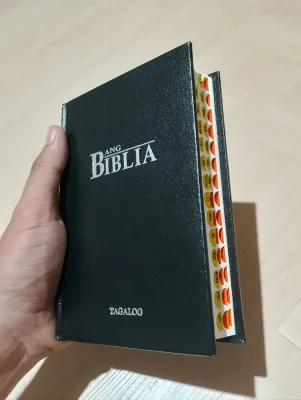
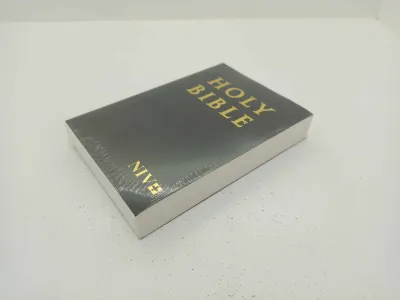
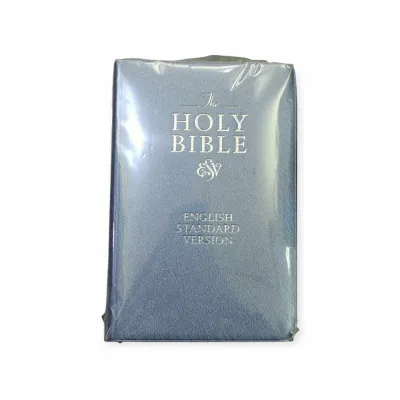
Prices are valid at publication and may change. Please refer to the product page for the latest price.
Paper quality and opacity directly affect readability in varied lighting conditions. Compact Bibles must use thin paper to keep the overall volume portable, but extremely thin paper can suffer from “ghosting,” where the text on the reverse side of the page shines through and makes reading difficult. When evaluating an edition, look for high-opacity Bible paper, often referred to as “indicia” or “scuff-resistant” paper. Some publishers use a printing technique called line-matching, where the lines of text on both sides of a page are aligned precisely on top of each other. This significantly reduces visual clutter and makes small fonts—typically 6-point to 8-point in compact editions—much easier to read under dim chapel lights or bright transit station bulbs.
Cover materials also dictate how well your Bible survives daily wear. Paperback covers are lightweight and inexpensive but crease easily and offer minimal protection against moisture. Genuine leather is highly durable and ages beautifully, but it requires regular care to prevent mold in humid environments and can be quite expensive. Synthetic leather, often labeled as imitation leather, TruTone, or polyurethane (PU) leather, offers an excellent middle ground. It is highly resistant to moisture, easy to wipe clean after a humid commute, and provides a supple, leather-like feel at a fraction of the cost.
Understanding Approved Catholic Translations
A Catholic Bible must contain the complete canon of Scripture and feature an approved translation. Unlike Protestant Bibles, which contain 66 books, a Catholic Bible includes 73 books, incorporating the seven Deuterocanonical books in the Old Testament. To ensure the translation is accurate and doctrinally sound, look for the official ecclesiastical approvals on the copyright page: the Nihil Obstat (certified by a church censor as free from doctrinal or moral error) and the Imprimatur (the official permission to publish granted by a bishop).

Different translations employ different translation philosophies, ranging from formal equivalence to dynamic equivalence. Formal equivalence, or “word-for-word” translation, prioritizes literal accuracy and matches the original Hebrew, Aramaic, and Greek structures as closely as possible. The Revised Standard Version Catholic Edition (RSV-CE) and its subsequent revision, the Second Catholic Edition (RSV-2CE), are prominent examples of formal equivalence. These translations are highly regarded for personal study, theological depth, and liturgical familiarity, making them excellent choices for readers who want to analyze the precise wording of Scripture during their daily reflections.
Dynamic equivalence, or “thought-for-thought” translation, focuses on conveying the original meaning in modern, easily understandable English. The New American Bible Revised Edition (NABRE) is a widely recognized translation that balances literal accuracy with contemporary readability. Because the NABRE is the basis for the Liturgy of the Word in many English-language Masses, carrying a compact NABRE allows you to follow along closely with the readings proclaimed from the ambo. Another popular dynamic translation is the Jerusalem Bible (JB) or the New Jerusalem Bible (NJB), known for its literary quality and poetic flow, which can enhance personal prayer and meditation.
When choosing a translation, consider your primary use case. If you intend to use your compact Bible primarily for deep personal study and memorization, a formal equivalence translation like the RSV-2CE is highly suitable. If your goal is quick devotional reading during a short commute or following along during Mass, a highly readable dynamic translation like the NABRE or the Good News Translation (GNT) Catholic Edition may be more practical.
Balancing Portability with Readability and Features
Opting for a smaller physical footprint inevitably requires some trade-offs regarding layout and extra features. In a compact Bible, margin space is minimal, leaving virtually no room for personal note-taking or extensive journaling. If you prefer to write down reflections, you will need to carry a separate small notebook or rely on digital note-taking apps. The font size in compact editions is also scaled down, usually ranging from 6 to 8 points. If you have difficulty reading small print, you may need to search specifically for a “compact large print” edition, which balances a smaller overall cover size with a slightly larger, bolder typeface, though this will result in a thicker book.
Despite their small size, quality compact Catholic Bibles do not compromise on canonical completeness. They contain all 73 books, including Tobit, Judith, 1 and 2 Maccabees, Wisdom, Sirach, and Baruch, integrated into the Old Testament rather than grouped in a separate section at the back. Additionally, look for essential study aids that can fit into a compact format, such as brief book introductions, a basic concordance, maps of the biblical world, and cross-references. Cross-references are particularly valuable for daily reading, as they allow you to connect Old Testament prophecies with New Testament fulfillments without needing a bulky commentary volume.
The style of the cover closure is another critical decision for a daily carry Bible. An open-cover Bible is quick to access but leaves the edges of the pages exposed to the contents of your bag, where keys, pens, or loose coins can easily tear or bend the delicate paper. A zippered cover provides maximum protection, sealing the entire text block away from dust, dirt, and accidental spills. This is especially useful during the rainy season in the Philippines, where sudden downpours can easily soak the contents of a bag. Alternatively, some compact Bibles feature a snap-flap closure, which protects the page edges while offering a classic, elegant appearance.
Where and How to Verify Authentic Catholic Editions
Before purchasing a compact Bible, especially from online marketplaces or ecommerce platforms, it is essential to verify that you are buying an authentic Catholic edition. Many search results for “compact bible” will display Protestant editions, which lack the Deuterocanonical books. Always check the product description or the table of contents for books like Sirach, Wisdom, and Maccabees. If these books are missing, or if they are listed in an appendix labeled “Apocrypha,” the edition is not a standard Catholic Bible.
To guarantee authenticity, consider purchasing from established Catholic retail outlets and diocesan bookstores in the Philippines. Physical stores operated by religious congregations, such as St. Pauls, Word & Life, or the Daughters of St. Paul (Paulines), offer a reliable selection of approved Catholic Bibles. Visiting a physical store allows you to hold the Bible, test the font size under realistic lighting, and check the flexibility of the binding before making a decision.
If you prefer the convenience of shopping online, look for the official digital storefronts of these reputable Catholic publishers on major ecommerce platforms. Avoid buying from unverified third-party sellers who cannot provide clear photos of the copyright page or the table of contents. When browsing online listings, read customer reviews to check the physical condition of the book upon arrival, ensuring the pages are not bent and the cover is intact.
Set a realistic budget for your purchase. In the Philippines, a basic paperback compact Catholic Bible can cost anywhere from ₱300 to ₱600. These are highly affordable but may require a protective cover to survive daily commuting. Mid-range editions with durable synthetic leather covers and sewn bindings typically range from ₱800 to ₱1,800. Premium editions featuring genuine leather, gilded page edges, and multiple ribbon markers can cost ₱2,500 or more. Investing in a mid-range synthetic leather edition with a sewn binding often provides the best value, offering long-term durability and excellent portability without a premium price tag.
Frequently Asked Questions (FAQ)
What is the difference between a Catholic and a Protestant compact Bible?
The primary difference lies in the biblical canon, or the list of books included in the Old Testament. A Catholic compact Bible contains 73 books, which includes the 46 books of the Old Testament and the 27 books of the New Testament. A Protestant compact Bible contains only 66 books, omitting seven books from the Old Testament: Tobit, Judith, 1 and 2 Maccabees, Wisdom, Sirach, and Baruch, along with portions of Esther and Daniel. In Catholic theology, these seven books are recognized as inspired Scripture and are referred to as the Deuterocanonical books. In Protestant editions, if they are included at all, they are placed in a separate section called the Apocrypha, but most standard Protestant compact Bibles omit them entirely. Additionally, Catholic Bibles will feature the Nihil Obstat and Imprimatur on the copyright page, indicating official church approval.
Can I use a compact Bible for daily Mass readings?
Yes, you can use a compact Bible to follow along with the daily Mass readings, but there are a few practical details to keep in mind. The Catholic Church uses an official book called the Lectionary for Mass readings, which is compiled from specific scripture translations. In the Philippines, English-language Masses frequently use readings based on the New American Bible (NAB) or the Jerusalem Bible. If your compact Bible uses one of these translations, the text you read will closely match what is proclaimed from the ambo. However, if your Bible uses a different approved translation, such as the RSV-2CE, you may notice minor differences in wording, though the theological meaning remains identical. To follow the liturgical calendar accurately, you can use your compact Bible in conjunction with a daily missalette or a liturgical calendar guide, which lists the specific chapter and verse citations for each day’s Mass.
Community discussion
Share your experience or ask a question. Comments are reviewed before publication.