
Choosing the right guitar tuning pegs—often called machine heads or tuner keys—for your acoustic or electric guitar in the Philippines requires a careful balance of mechanical specifications, playing style, and environmental resilience. Because the local climate is characterized by high relative humidity and coastal salt air, selecting hardware with the appropriate enclosure and materials is just as important as finding the correct physical fit. To make a confident purchase, you must prioritize precise physical measurements of your guitar’s headstock and understand how different tuner designs interact with your instrument’s wood and string tension.
Upgrading your tuning pegs can dramatically improve tuning stability, make string changes faster, and even alter the physical balance of your instrument. However, because there is no universal standard for tuner dimensions, buying a set without verifying your guitar’s specific requirements often leads to costly installation mistakes or permanent headstock damage. By understanding the mechanical differences between acoustic and electric setups, measuring your hardware accurately, and selecting the right gear type for your playing conditions, you can ensure a seamless upgrade that keeps your guitar in tune through long practice sessions and humid live gigs.
Acoustic vs. Electric: Understanding the Structural Differences
The physical layout of your guitar’s headstock is the first major factor that limits your tuning peg options. Most acoustic guitars utilize a 3+3 configuration, where three tuners are mounted on the bass side and three on the treble side of the headstock. Electric guitars, conversely, exhibit a wider variety of layouts, including classic 6-in-line configurations where all six tuners sit on a single side, asymmetrical layouts like 4+2, or traditional 3+3 designs. Because the mounting tabs, gear directions, and post alignments are engineered specifically for either the left or right side of the headstock, you must purchase a set that matches your guitar’s exact layout.
Products mentioned in this guide
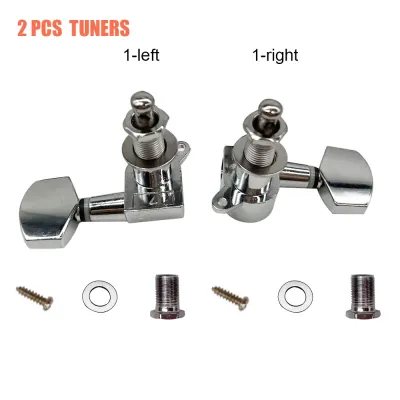
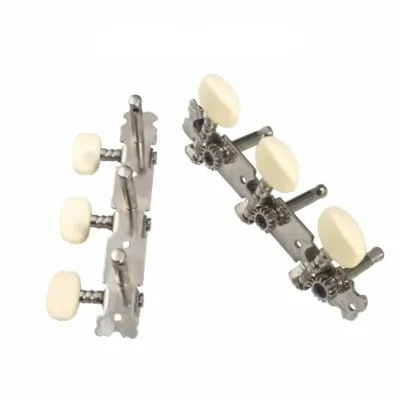

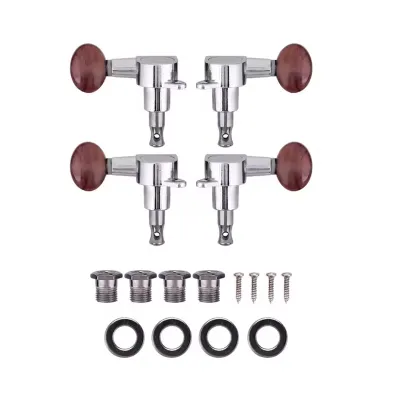
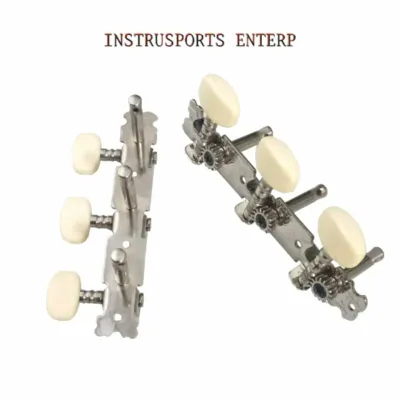
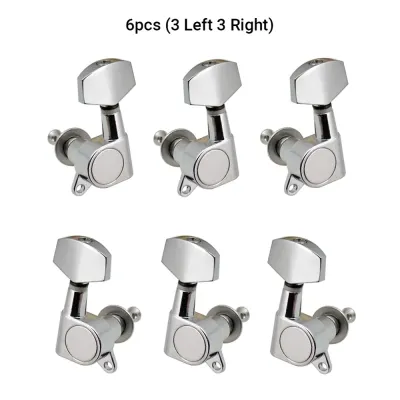
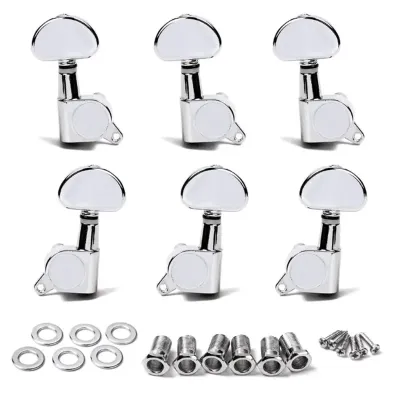
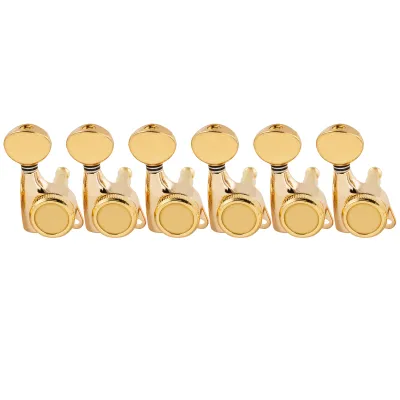
Prices are valid at publication and may change. Please refer to the product page for the latest price.
Mechanically, tuning pegs are divided into two primary categories: open-gear and sealed-gear. Open-gear tuners leave the worm and spur gears exposed to the elements, a design highly common on vintage-style acoustic guitars, classical guitars, and some vintage electric reissues. While lightweight and aesthetically classic, open-gear tuners require regular maintenance in tropical environments. The high humidity and airborne dust common in the Philippines can quickly degrade the exposed lubricants, leading to grit accumulation, stiff turning, and accelerated gear wear. Sealed-gear tuners enclose the gears in an airtight, permanently lubricated cast housing, protecting the mechanism from moisture, sweat, and dirt. This makes sealed tuners highly durable and virtually maintenance-free, making them the standard choice for modern electric and acoustic guitars.
Headstock angles and string tension also dictate tuner selection. Acoustic guitars generally use high-tension bronze strings, which exert significant pulling force on the tuner shafts. This requires robust tuner housings and thick posts that will not bend or lean over time. Electric guitars often use lighter-gauge steel strings but frequently feature flatter, non-angled headstocks. On these electric models, the strings require a sufficient downward angle (break angle) over the nut to prevent string buzz and maintain sustain. This is often achieved using staggered-height tuner posts, a feature rarely found or needed on acoustic guitars with angled headstocks.
Essential Specifications to Verify Before Purchasing
Before purchasing replacement tuning pegs from an online marketplace or local music store, you must take precise measurements of your guitar’s headstock. The most critical dimension is the peg hole diameter. Modern guitars typically feature peg holes drilled to 10mm (approximately 13/32 inches) to accommodate modern sealed-gear tuners, which are secured from the front using a threaded hex bushing and washer. Vintage guitars and vintage-style reissues often feature smaller peg holes, usually measuring around 8.5mm to 8.8mm (11/32 inches), designed for push-in bushings that rely purely on friction to stay in place. Attempting to force a modern 10mm tuner into a vintage-sized hole will split the headstock wood, while installing a vintage tuner into a modern 10mm hole without conversion adapters will cause the tuner shaft to lean, ruining your tuning stability.

Another vital specification is the alignment of the mounting screw holes on the back of the headstock. Most tuning pegs are secured against rotation by a small wood screw. The positioning of this screw tab varies by manufacturer and model, with common configurations including 90-degree (straight down), 45-degree (angled), and vertical alignments. If you want a direct, drop-in replacement that does not require drilling new holes into your headstock, you must find a tuner set with a screw tab that perfectly matches your existing holes. Some modern tuners bypass mounting screws entirely, utilizing one or two small indexing pins on the back of the tuner housing that press into matching guide holes in the wood.
Finally, you must verify the shaft length and string post height. Standard tuner posts are of uniform height, which works well on angled headstocks. However, if you are upgrading a 6-in-line electric guitar with a flat headstock, you should look for a staggered tuner set. In a staggered set, the posts gradually decrease in height from the low E string to the high E string. This design increases the downward string angle over the nut for the higher strings, eliminating the need for front-mounted string trees and reducing friction points that can cause the guitar to go out of tune during string bends.
Locking vs. Non-Locking Tuners: Evaluating Your Needs
Locking tuners feature an internal mechanism—usually controlled by a thumbwheel on the back of the tuner housing or an auto-locking pin inside the post—that clamps the guitar string tightly inside the post hole. This design eliminates the need to wind the string around the post multiple times during a string change. Instead, you simply pull the string taut through the hole, tighten the locking mechanism, and tune the string to pitch, usually requiring less than one full turn of the peg. This dramatically increases string-changing speed, making locking tuners highly popular for gigging musicians who need to replace a broken string quickly on stage.
Beyond convenience, locking tuners offer superior tuning stability by removing the primary source of string slippage. On traditional non-locking tuners, the multiple wraps of wire around the post can slacken, stretch, and shift as you play, especially during aggressive string bending or vibrato. Because locking tuners require almost no wraps around the post, there is no excess string slack to stretch out, resulting in an instrument that stays in tune much longer. However, non-locking tuners remain highly reliable if the strings are wound neatly and locked manually using traditional wrapping techniques, such as the “luthier’s knot.”
Despite their advantages, locking tuners have a few trade-offs to consider. Because of the internal locking pins and heavy thumbwheels, locking tuners are physically heavier than their non-locking counterparts. On lightweight electric guitars or instruments with thin, resonant necks, installing a heavy set of locking tuners can alter the center of gravity, causing “neck dive” where the headstock pulls the neck downward when you play with a strap. Additionally, locking tuners are more mechanically complex and generally carry a higher price tag than standard sealed tuners, making high-quality non-locking tuners a more budget-friendly and lightweight option for casual players.
Condition-Based Selection Matrix for Your Guitar
To help you determine the best type of tuning pegs for your specific instrument and playing style, consider how your guitar setup and environment align with the following scenarios:
- For Tremolo and Heavy Bending Setups: If you play an electric guitar equipped with a non-locking tremolo system (such as a synchronized tremolo or a Bigsby tailpiece) and frequently perform wide string bends, locking tuners are highly recommended. By eliminating string wraps on the post, they prevent the slack that typically occurs when the tremolo bridge tension relaxes. For maximum stability, combine locking tuners with a well-slotted, lubricated nut made of synthetic bone or graphite.
- For Vintage Restorations and Classical Guitars: If you are restoring an older acoustic guitar, a vintage-reissue electric, or upgrading a classical guitar, maintaining historical accuracy and a lightweight headstock is essential. In these cases, high-quality open-gear tuners with press-in bushings and plastic or pearloid buttons are the ideal choice. Because these gears are exposed to the humid Philippine climate, you must commit to routine maintenance, using a soft brush to clear away dust and applying a tiny drop of dry, non-attracting lubricant to the gears every few months to prevent corrosion.
- For Everyday Practice and Budget-Conscious Upgrades: If you own a standard steel-string acoustic or a hardtail electric guitar used for daily practice, church services, or casual jamming, standard sealed-gear tuners with a 14:1 or 18:1 gear ratio offer the best balance of performance and value. The sealed housing protects the gears from humidity and sweat, requiring zero maintenance over their lifespan, while providing smooth, reliable tuning adjustments without the added weight and cost of locking mechanisms.
Pre-Installation Checks and When to Seek Professional Help
Before attempting a DIY installation of your new tuning pegs, perform a thorough dry fit. Remove one of your old tuners and attempt to insert the new tuner shaft through the peg hole from the back of the headstock. If the tuner housing does not sit flush against the wood, or if the shaft is too tight to pass through easily, do not force it. If you are transitioning from vintage press-in bushings to modern threaded hex bushings, you will likely find that the peg holes are too small. Conversely, if you are putting vintage tuners into modern 10mm holes, you will need to purchase specialized conversion bushings to fill the gap and support the tuner shaft.
If your headstock holes need to be enlarged, never use a standard twist drill bit. A standard drill bit can easily catch on the wood grain of a mahogany or maple headstock, tearing out large chunks of wood, cracking the delicate face veneer, or fracturing the lacquer finish. Instead, use a tapered hand reamer. A hand reamer allows you to slowly and smoothly shave away micro-layers of wood from the inside of the hole, maintaining a perfectly circular shape and giving you complete control over the final diameter.
There are several clear stop conditions where you should put down your tools and take your guitar to a professional luthier. If the new tuners require drilling new mounting screw holes that partially overlap with your old, unfilled screw holes, the drill bit will naturally drift into the old hole, resulting in a crooked installation. A professional luthier can properly plug the old holes with hardwood dowels and wood glue, sand them flush, and drill precise new pilot holes. Additionally, if your guitar is a valuable vintage instrument, or if you feel uncomfortable reaming the headstock wood, seeking professional help will prevent costly, irreversible structural damage to your beloved instrument.
Frequently Asked Questions (FAQ)
Can I use electric guitar tuning pegs on an acoustic guitar?
While the internal gear mechanisms of acoustic and electric tuners function similarly, they are rarely directly interchangeable due to physical dimensions. Acoustic guitar headstocks, particularly on classical or vintage steel-string models, are often thicker than electric guitar headstocks, meaning electric tuner shafts may not protrude far enough to allow proper string wrapping. Additionally, acoustic guitars almost always require a 3+3 mounting configuration with specific screw tab angles, whereas many electric tuner sets are sold as 6-in-line configurations with mounting tabs designed specifically for thin, flat headstocks.
Do higher gear ratios always mean better tuning stability?
No, a higher gear ratio does not inherently prevent your guitar from going out of tune. The gear ratio (such as 18:1 or 21:1) simply dictates how many times you must turn the tuner button to rotate the string post once. Higher ratios allow for incredibly precise micro-adjustments, which is highly beneficial for fine-tuning and drop tunings. However, actual tuning stability is determined by the quality of the gear teeth engagement, the friction at the nut slots and bridge saddles, and how securely the strings are wound or locked onto the post.
How do I measure my current tuning peg hole diameter?
To measure your peg hole diameter accurately, you must remove one of your existing tuning pegs and its bushing entirely from the headstock. Use a digital caliper to measure the inner diameter of the bare wooden hole. Measuring the outer diameter of the tuner shaft or the top of the bushing while they are still installed on the guitar often yields inaccurate measurements, which can lead to purchasing the wrong replacement size.
Community discussion
Share your experience or ask a question. Comments are reviewed before publication.