
Selecting the right guitar pick holder depends entirely on where you play, how you access your gear, and the specific instruments in your collection. For electric guitarists who rely on a structured signal chain, an adhesive pedalboard mount keeps spare picks exactly where their feet and hands already transition during a set. Acoustic players often benefit more from soundhole clips, which position replacement picks directly on the instrument’s body for immediate recovery during a performance. Meanwhile, players who travel frequently between rehearsals, gigs, and home studios find that a dedicated leather wallet offers the best balance of high-capacity storage, organization, and protection for premium picks.
To make an informed choice, you must evaluate several key decision factors: mid-song accessibility, storage capacity, instrument compatibility, and overall portability. A holder that excels in a climate-controlled studio might fail during a humid outdoor gig, just as a high-capacity storage system might prove too slow when you drop a pick mid-solo. By comparing the mechanical designs, surface requirements, and practical limitations of adhesive mounts, soundhole clips, and leather wallets, you can identify the ideal storage solution for your specific playing environment.
Adhesive Pedalboard Mounts: Workflow and Surface Compatibility
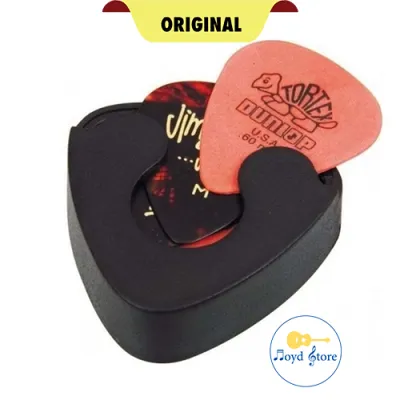
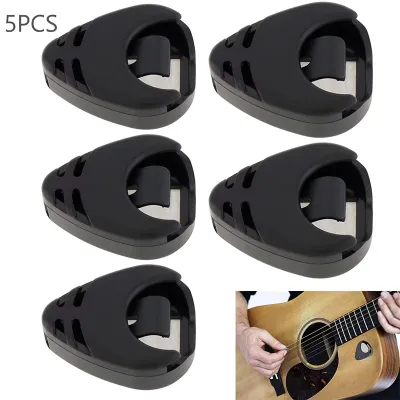
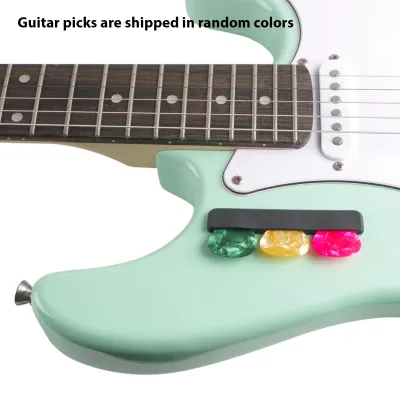
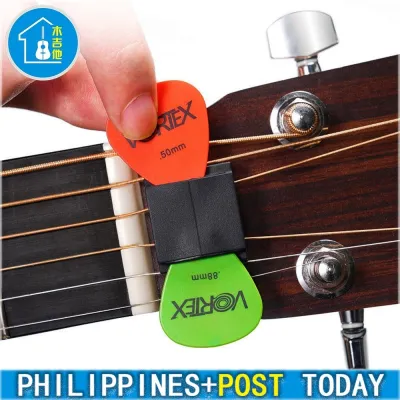
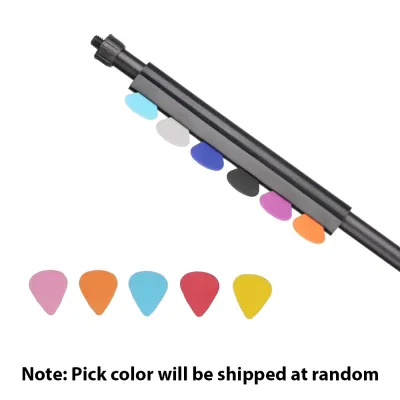
Adhesive pedalboard mounts are designed for electric guitarists who need a reliable, stationary repository for their picks. These holders typically feature a spring-loaded plastic chamber or a flexible rubber slot backed by a double-sided adhesive strip. By mounting the holder directly to a pedalboard frame, an effects switcher, or even the side of a patch bay, you integrate pick retrieval into your existing footwork and pedal-switching routine. This setup is highly efficient during live performances, allowing you to grab a fresh pick with a quick downward reach without looking away from your fretboard.
Products mentioned in this guide
479 Lazada user ratings
Lahat ng guitar ko meron neto hehe pinaka dabest na pick holder design for me! Spring-loaded for quick access,
Keeps picks within reach, Convenient pick storage, No more losing picks, Stick it anywhere with adhesive,
Great for on-the-go musicians, Durable plastic holder, Keeps picks within reach, Convenient pick storage,
Securely holds picks, Stick it anywhere with adhesive, Durable plastic holder, Keeps picks within reach,
No more losing pick. Durable plastic holder, Keeps picks within reach, Stick it anywhere with adhesive,
135 Lazada user ratings
🔌Compatibility:👏 🔨Durability:👏👏👏👏 💰Price: ganda
Simple and practical design,
erm u get what u pay for?
Ok nice & quality
8 Lazada user ratings
sticks well, so decide where to put it. holds 3 regular picks or 2 large picks
thank you seller
12 Lazada user ratings
G hejdjfjej jaha krkr nfkeogmgk hchdjdjsjsnv nfndjdjcjf jejdj kkejfjv hfjfjfjvjfj jds
Durable rubber material, Fast shipping service,
very good and very nice
10 Lazada user ratings
Quality: 10/10Very high quality, Impressive quality,
hindi pwede yung mga jazz 3 size na guitar pick
Nice Product
2 Lazada user ratings
Ang ganda pang display.. 😁👌
161 Lazada user ratings
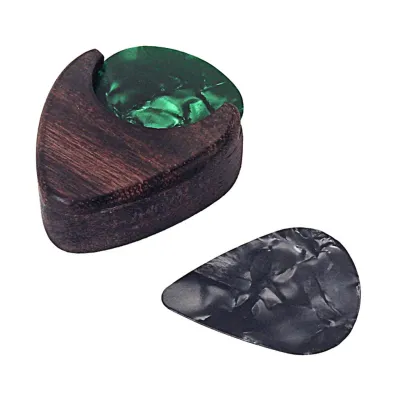
Took time on delivery; great wooden look - same as advertised; fits four 0.70-mm picks at a time; came with 2 free picks
Goods! Pero nakakainis lang yung hindi pantay na kulay. Mas okay sana kung all darkbrown/rosewood
item is damage when arrived, i also think the price is so high for the quality of this item..
High-quality rosewood material, Keeps picks easily accessible, looks really really good.
Prices are valid at publication and may change. Please refer to the product page for the latest price.
However, the performance of an adhesive mount depends heavily on the surface material of your pedalboard and the local climate. In tropical environments with high humidity and ambient heat, standard pressure-sensitive adhesives can degrade, soften, or slide under tension. Before applying a mount, you must verify whether your pedalboard surface is bare aluminum, powder-coated metal, painted wood, or covered in hook-and-loop tape. While smooth, non-porous metal surfaces provide the strongest bond, they are also the most susceptible to leaving behind stubborn, sticky residue when the mount is eventually removed. Applying adhesive directly to hook-and-loop tape or textured wood often results in a weak bond that can fail mid-performance.
Capacity is another critical limitation of adhesive chamber mounts. Most standard spring-loaded models are optimized for classic teardrop shapes and medium-to-heavy gauge picks. If you use oversized triangle picks, extra-thick jazz-style picks, or highly textured grip surfaces, they may jam inside the spring mechanism or fail to slide out smoothly. For players who regularly switch between different pick thicknesses or materials during a single set, a single adhesive mount may not offer the versatility required for a diverse performance workflow.
Soundhole Clips: Acoustic Access and Finish Safety
Soundhole clips offer acoustic and classical guitarists a highly accessible, on-instrument storage solution that requires no permanent modifications. These compact holders clip directly onto the edge of the soundhole, positioning one or two spare picks within inches of your strumming hand. This proximity is unmatched for acoustic performers who do not use pedalboards or microphone stand wraps, ensuring that a dropped pick can be replaced almost instantly without interrupting the rhythm of a song.

Despite their convenience, soundhole clips introduce physical risks to the instrument that require careful evaluation. The clip mechanism relies on tension to stay secure, which can compress the delicate wood around the soundhole. If the clip lacks adequate protective padding, such as soft silicone or felt lining, it can easily scratch or dent the guitar’s top wood and rosette inlays. Furthermore, placing a foreign object directly on the soundboard can subtly alter the instrument’s acoustic properties. A heavy or poorly positioned clip can dampen soundboard vibrations, slightly reducing projection and sustain, or even buzz against the top plate during heavy strumming.
Compatibility is also a key concern, as acoustic guitars vary widely in construction. You must check the thickness of your guitar’s top wood, the width of the decorative rosette, and the placement of the internal bracing near the soundhole edge. Some traditional classical guitars or vintage acoustic models feature thicker tops or delicate bracing patterns that prevent a standard clip from seating securely. Additionally, if the clip extends too far into the soundhole, it can interfere with your low E string or accidentally fall inside the guitar body during a high-energy performance, creating an annoying rattle that is difficult to retrieve quickly.
Leather Wallets: Portability and Collection Organization
Leather wallets serve as the ultimate off-instrument storage and organization system for guitarists who carry a diverse selection of picks. Unlike mounted or clipped options, a pick wallet is designed to hold dozens of picks in dedicated slots, clear plastic sleeves, or secure pockets. This high capacity makes them indispensable for studio musicians, music teachers, and collectors who need immediate access to various gauges, materials, and shapes to suit different tonal requirements. The thick, structured cover of a leather wallet provides excellent physical protection, preventing custom, fragile, or expensive picks from getting lost, bent, or scratched in a gig bag.
Portability is a major strength of the leather wallet, allowing you to transport your entire pick collection safely between home, rehearsals, and gigs. In humid tropical climates, genuine leather requires mindful maintenance to prevent mold and mildew growth. Storing your pick wallet in a well-ventilated gig bag compartment alongside a small silica gel packet can help preserve both the leather and the picks inside. Many wallets also feature keychains or carabiner loops, making it easy to secure them to your instrument case or belt loop so they are never left behind.
The primary trade-off of a leather wallet is mid-song retrieval speed. Because the wallet remains off your instrument—usually resting on an amp, a music stand, or inside your pocket—you cannot easily retrieve a replacement pick with one hand while playing. If you drop a pick during a live performance, reaching into a zippered or buttoned wallet is impractical. Consequently, while leather wallets excel at organizing, protecting, and transporting your collection, they are best paired with a secondary on-stage solution if your performance style demands instant, hands-free recovery.
How to Choose the Right Pick Holder for Your Setup
To select the right guitar pick holder, you must analyze your primary playing environment, your instrument type, and your performance workflow.
Choose adhesive pedalboard mounts if you primarily play electric guitar, rely on a pedalboard setup, and need a hands-free, stationary location to grab spare picks during live sets. This option is ideal for high-energy performances where speed is critical, provided you have a clean, non-porous surface on your board to secure the adhesive.
Choose soundhole clips if you play acoustic or classical guitar, do not use a pedalboard, and want your spare picks positioned as close to your strumming hand as possible. This setup ensures you can recover from a dropped pick without breaking your performance posture, though you must verify that the clip’s padding is safe for your guitar’s specific finish.
Choose leather wallets if you prioritize organization, carry a large and diverse collection of picks, and need a secure way to transport your gear between different locations. This is the best choice for studio sessions, rehearsals, and daily carry, where protecting your picks from loss or environmental damage is more important than split-second retrieval.
Before making a purchase, perform a few essential verification steps to ensure compatibility. For adhesive mounts, inspect your pedalboard’s surface material and clean it thoroughly to ensure a strong bond. For soundhole clips, measure the thickness of your guitar’s soundboard and check the clearance around the soundhole to avoid string interference. For leather wallets, confirm that the internal slot dimensions can accommodate your preferred pick shapes and thicknesses, especially if you use non-standard or extra-thick models.
Frequently Asked Questions (FAQ)
Can I safely remove an adhesive pick mount without damaging my pedalboard?
Yes, but the safety of the removal process depends entirely on your pedalboard’s surface material and finish. Before applying any heat or solvents, inspect the surface to ensure it is not prone to peeling or discoloration. You can use a hair dryer on a low, gentle heat setting to soften the adhesive backing, then slowly peel the mount away. If sticky residue remains, apply a mild, manufacturer-approved adhesive remover or isopropyl alcohol using a soft microfiber cloth, testing a small, hidden area first. If your pedalboard features a delicate painted or custom-lacquered finish, stop immediately and consult the manufacturer to avoid voiding your warranty or stripping the coating.
Will a soundhole clip scratch my acoustic guitar's finish?
A soundhole clip can scratch your guitar’s finish if it lacks proper protective padding or is installed incorrectly. When selecting a clip, ensure it features soft silicone, rubber, or felt lining on all contact points to cushion the wood. You must also identify your guitar’s finish type; delicate nitrocellulose finishes are highly sensitive to chemical reactions with certain plastics and rubbers, which can cause softening or clouding over time. Polyurethane finishes are generally more resilient but still require padded protection. Always slide the clip on gently without forcing it, and position it away from the rosette inlays and strings to prevent physical wear during play.
Community discussion
Share your experience or ask a question. Comments are reviewed before publication.