
Quick Answer: Which Guitar Case Do You Actually Need?
Choosing between a soft gig bag and a hard case depends entirely on how you transport your acoustic guitar and the level of environmental risk it faces. If your routine consists of local commutes, walking to lessons, or traveling by private car where the instrument remains in your hands, a padded soft gig bag is the most practical choice. It offers lightweight portability, convenient backpack straps, and ample pocket space for your accessories.
Conversely, if you travel by air, ship your instrument, or load gear into shared transport vehicles where heavy items might stack on top of it, a rigid hard case is non-negotiable. Hard cases provide the structural defense needed to survive heavy impacts and crush forces that would easily destroy a soft bag. While hybrid cases offer a middle ground by blending rigid foam with lightweight fabrics, your final decision should balance physical carrying comfort against the actual risk of physical damage.
Core Differences: Protection, Portability, and Storage
Protection Levels and Structural Integrity
The primary difference between these two formats lies in how they handle physical force. A soft gig bag relies on layers of foam padding to absorb shock from minor bumps and prevent surface scratches. However, because the outer fabric is flexible, it offers virtually no resistance to crushing weight or sharp impacts. If a heavy object falls onto a gig bag, the force is transmitted directly to the guitar’s delicate wooden soundboard.
Products mentioned in this guide
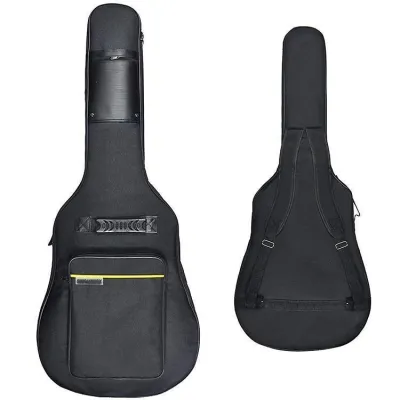
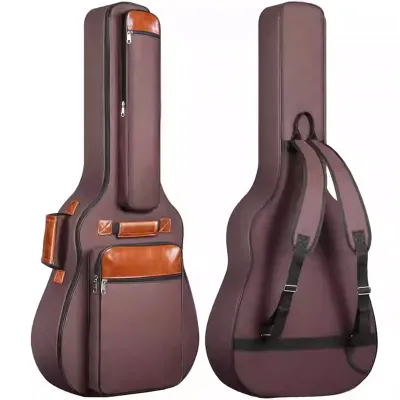
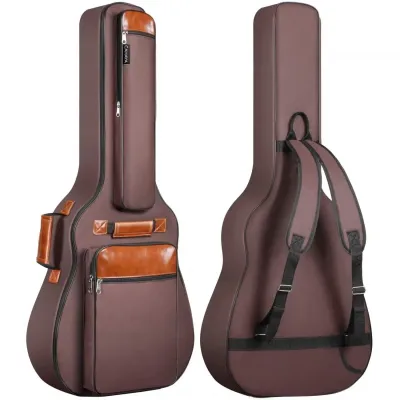

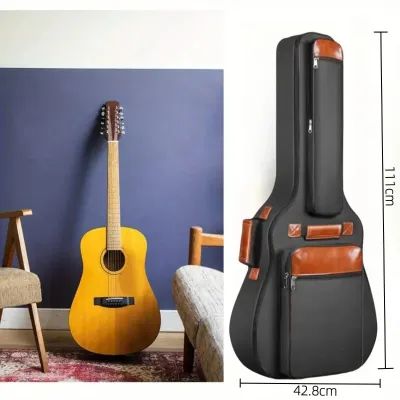
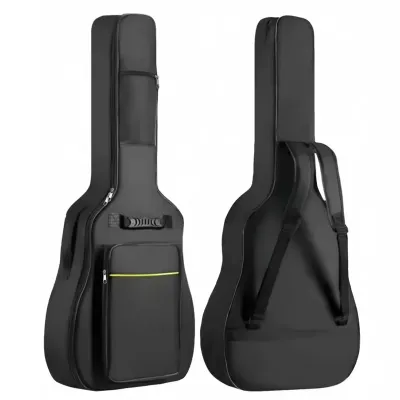

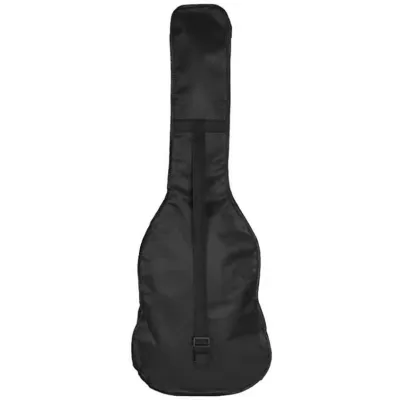
Prices are valid at publication and may change. Please refer to the product page for the latest price.

A hard case utilizes a rigid outer shell made of plywood, molded ABS plastic, or fiberglass. This rigid structure is designed to deflect impact energy away from the instrument, distributing the force across the outer frame. Furthermore, hard cases feature dedicated internal neck cradles that keep the guitar’s neck and headstock completely suspended and immobile, preventing the devastating headstock snaps that occur when a guitar falls flat.
Portability, Weight, and Carrying Comfort
When it comes to daily mobility, soft gig bags are vastly superior. They are constructed from lightweight materials and almost always feature adjustable, padded backpack straps. This design allows you to carry your acoustic guitar hands-free, which is incredibly helpful when navigating busy streets, boarding public transit, or carrying other gear.
Hard cases are inherently heavy and bulky. They lack backpack straps, requiring you to carry them by a single side handle. Walking long distances with a heavy hard case can quickly cause hand and shoulder fatigue. Additionally, their rigid, wide profiles make them awkward to maneuver through tight spaces, crowded walkways, or packed commuter vehicles.
Storage and Accessory Management
Acoustic guitarists often need to carry a variety of accessories, including tuners, capos, spare strings, cables, and sheet music. Soft gig bags excel in this area, typically featuring multiple large, zippered external pockets. These compartments allow you to organize all your gear in one place, eliminating the need for an extra backpack.
Hard cases offer very limited storage. Because the interior is molded tightly to the shape of the guitar to prevent movement, there is no room for external pockets. Most hard cases only feature a small, lidded compartment directly beneath the neck support. This space is usually only large enough for a tuner, a capo, and a spare set of strings, forcing you to carry larger items elsewhere.
When to Choose a Soft Gig Bag
A padded soft gig bag is the ideal companion for the active, everyday guitarist whose primary concern is convenience and quick mobility. If your musical activities are limited to local music lessons, casual jam sessions at a friend’s house, or traveling to a nearby recording studio, a gig bag provides more than enough protection. In these scenarios, the guitar rarely leaves your sight or your physical control, minimizing the risk of accidental crushing.
Environmental factors also play a major role in this choice. In tropical climates like the Philippines, sudden downpours and high humidity are constant challenges. When selecting a gig bag for these conditions, it is crucial to verify that the outer fabric is made of high-denier, water-resistant nylon or polyester, and that the zippers are tightly sealed. A breathable interior lining is also beneficial to prevent moisture from trapping against the wood, which can cause warping or finish damage over time.
However, you must recognize the strict limits of a soft bag. It should never be used if your guitar will be placed in a luggage compartment, stacked under heavy gear in a vehicle, or checked on a flight. The lack of structural support means even a minor squeeze in a crowded space can lead to costly structural cracks in your acoustic guitar.
When to Choose a Hard Case
A rigid hard case is an absolute necessity when your acoustic guitar is exposed to unpredictable environments or third-party handling. If you are a touring musician, frequently travel by air, or need to ship your instrument, a hard case is the only option that guarantees your guitar arrives in one piece. Baggage handlers and cargo holds are notoriously rough, and a soft bag offers zero protection against the heavy impacts and shifting cargo encountered during transit.
The structural benefits of a hard case extend beyond simple impact resistance. High-quality acoustic guitars are constructed from thin, resonant tonewoods that are highly susceptible to cracking under pressure. A hard case acts as a protective vault, sealing the instrument away from external physical forces. The tight seal of a hard case also makes it much easier to control the internal climate, protecting the wood from extreme humidity fluctuations that can cause the glue joints to fail or the wood to swell and split.
The obvious trade-offs are physical strain and daily inconvenience. A hard case is heavy, difficult to store in small apartments, and cumbersome to carry on foot. However, if you own a high-value or vintage acoustic guitar, the peace of mind and structural security provided by a hard case far outweigh the added weight and bulk.
How to Verify Fit and Features Before Buying
Body Shape and Size Compatibility
Acoustic guitars are not uniform in size; they come in a wide variety of body shapes, each requiring a specific fit. A case designed for a standard dreadnought will be far too large for a parlor or concert guitar, allowing the instrument to slide around inside and sustain damage. Conversely, a jumbo or grand auditorium acoustic will not fit into a case tailored for a classical guitar. Always check the manufacturer’s compatibility list to ensure the case is designed for your specific body style.
Essential Interior Measurements
To guarantee a perfect fit, do not rely solely on generic size labels. Grab a tape measure and record your guitar’s exact physical dimensions, then compare them against the interior measurements of the case:
- Overall Length: Measure from the very tip of the headstock to the bottom edge of the lower bout.
- Body Depth: Measure the thickness of the guitar body at its deepest point near the tail block.
- Lower Bout Width: Measure the widest part of the lower half of the guitar body.
- Upper Bout Width: Measure the widest part of the upper half of the body.
- Waist Width: Measure the narrowest part of the middle body.
Hardware, Latches, and Lining Quality
Before finalizing your purchase, closely inspect the build quality of the case’s hardware and interior. For hard cases, look for heavy-duty metal latches that close securely without resistance; if you plan to travel by air, consider cases with TSA-approved locks. The hinges should be sturdy and aligned perfectly to prevent the lid from twisting.
For both soft and hard options, examine the interior lining. The lining should consist of a thick, plush material that cushions the guitar and prevents scratches. Ensure there is a solid neck support block that cradles the neck securely, keeping the headstock elevated so it does not make contact with the bottom of the case. Finally, verify that the interior materials are safe for your guitar’s specific finish, as certain synthetic linings can chemically react with and damage delicate nitrocellulose lacquer finishes.
Frequently Asked Questions (FAQ)
Can I use a classical guitar case for a steel-string acoustic?
Generally, no. Classical guitars have distinct body proportions, including wider necks, flatter fingerboards, and shallower, more rounded bodies compared to standard steel-string acoustics. A steel-string guitar, such as a dreadnought or orchestra model, will typically be too deep or too long to fit into a classical guitar case. Even if you manage to squeeze it in, the lack of proper neck support and the tight pressure on the bridge can damage the instrument. Always verify the interior dimensions of the case against your specific guitar model rather than relying on generic acoustic labels.
Do I need a humidifier inside my hard case?
Yes, especially if you live in an area with extreme climate shifts or rely heavily on air conditioning. While tropical environments like the Philippines are generally humid, air-conditioned rooms dry out the air significantly. When wood loses moisture rapidly, it shrinks, leading to fret sprout, bridge separation, or cracks in the soundboard. Conversely, excessive humidity can cause the wood to swell. Storing your guitar in a sealed hard case with a specialized two-way humidity control packet helps maintain the ideal relative humidity range of 45% to 55%, protecting the wood from structural damage.
Are hybrid cases a better alternative to gig bags and hard cases?
Hybrid cases are an excellent middle-ground alternative for musicians who want the best of both worlds. These cases typically feature a tough, weather-resistant fabric exterior and backpack straps like a gig bag, but utilize a dense, rigid EPS foam core inside to provide structural crush resistance similar to a hard case. While they do not offer the absolute puncture resistance of a heavy-duty flight case, they are significantly lighter and much easier to carry on daily commutes while providing far superior drop protection compared to a standard padded soft bag.
Community discussion
Share your experience or ask a question. Comments are reviewed before publication.