
Quick Answer: Starting Your Rosary Journey
Starting to pray the rosary can feel overwhelming for beginners, especially when trying to memorize the sequence of prayers while meditating on the mysteries. A dedicated rosary guide book serves as a practical companion, offering step-by-step instructions, visual bead maps, and structured reflections to ease this transition.
The ideal guide depends on your personal learning style, whether you prefer highly visual layouts with illustrations or text-heavy books featuring deep theological meditations. Additionally, choosing between English, Tagalog, or bilingual editions ensures you can comfortably pray individually or participate in community devotions.
By understanding what to look for in terms of layout, language, and physical durability, you can select a guide that supports your spiritual routine. This article outlines the essential features of beginner-friendly rosary books, categorizes the main types available, and provides a practical checklist to help you verify book details before making a purchase.
Products mentioned in this guide

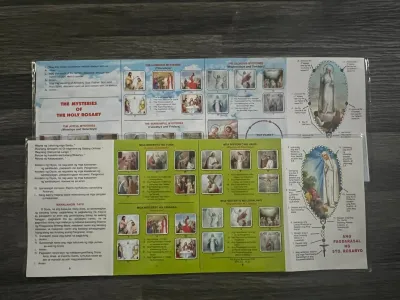
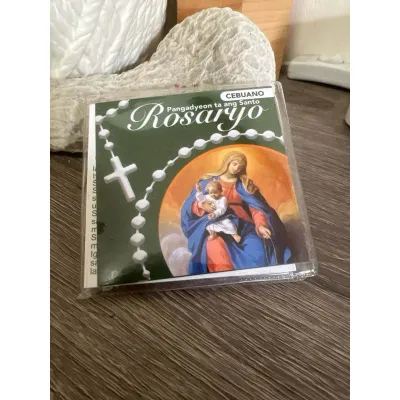
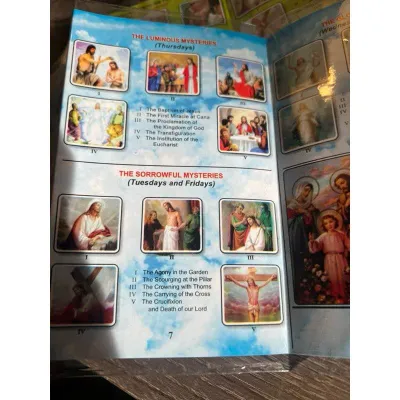


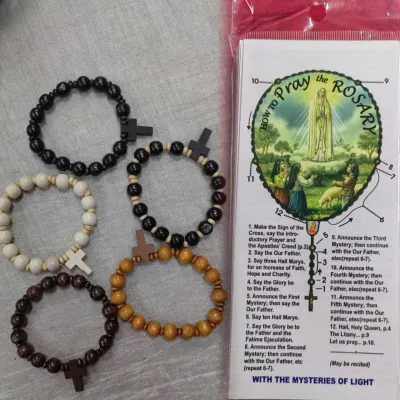
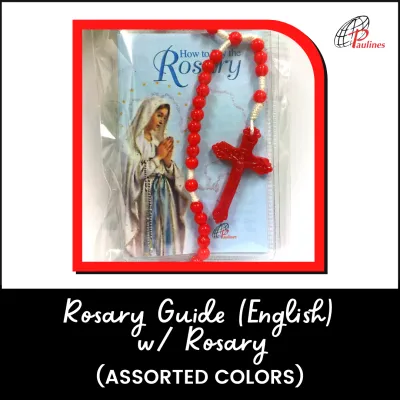
Prices are valid at publication and may change. Please refer to the product page for the latest price.
What to Look for in a Beginner Rosary Guide
When selecting a rosary guide, the primary goal is to find a resource that reduces cognitive load during prayer. For a beginner, the physical act of moving fingers along the beads while reciting prayers and contemplating spiritual events requires a clear, intuitive layout. A well-designed guide acts as a roadmap, allowing you to focus your mind on meditation rather than wondering which prayer comes next.

Step-by-Step Clarity
An effective beginner’s guide must clearly explain the mechanics of the rosary. It should start with the introductory prayers at the crucifix, move systematically through the first set of beads, and explain how to navigate the decades.
Look for books that explicitly label each bead with its corresponding prayer, such as the Apostles’ Creed, the Our Father, the Hail Mary, and the Glory Be. The transition between decades—including the Fatima Prayer and the announcement of the next mystery—should be clearly demarcated. A guide that assumes zero prior liturgical knowledge is highly valuable, as it prevents confusion during the initial stages of learning.
Explanation of the Mysteries
The heart of the rosary lies in meditating on the mysteries, which are key events in the lives of Jesus Christ and the Virgin Mary. A beginner guide must not only list these mysteries but also explain their spiritual significance in simple terms.
The book should organize the mysteries into their four traditional groups: the Joyful, Sorrowful, Glorious, and Luminous mysteries. Crucially, the guide should indicate the specific days of the week traditionally assigned to each set of mysteries. This helps you establish a consistent daily prayer rhythm aligned with the wider church calendar.
Language and Translation Options
In the Philippines, the rosary is prayed in English, Tagalog, and various regional languages. When choosing a guide, consider your primary prayer environment.
If you plan to pray mostly alone or with English-speaking groups, an English guide is suitable. However, if you intend to join parish communities, block rosary crusades, or family prayers, a bilingual English-Tagalog guide is highly practical. It is important to verify that the translations used in the book align with standard local liturgical texts approved by local church authorities to ensure consistency with community recitations.
Visual Aids and Formatting
Visual elements are incredibly helpful for beginners who are still building muscle memory. Look for guides that feature a complete visual map of the rosary, showing the entire loop of beads with clear arrows indicating the direction of prayer.
Some books use color-coded sections or distinct icons to represent different prayers. Additionally, illustrations or classical artwork depicting each mystery can serve as powerful focal points for visual meditation, helping to keep your mind from wandering during the repetitive recitations.
Types of Rosary Guides to Consider
Rosary guides come in various formats, each tailored to different lifestyles, reading preferences, and prayer settings. Understanding these categories allows you to select a book that fits seamlessly into your daily routine.
Pocket and Travel Editions
Pocket-sized guides are designed for portability and durability. These compact booklets are ideal for daily commuters, students, or professionals who want to pray during their transit or lunch breaks.
Because they must fit into small bags or pockets, they typically focus on the essentials: basic step-by-step instructions, the text of the prayers, and brief titles for each mystery. While they lack extensive commentary, their lightweight nature and simple layouts make them highly practical for quick reference on the go.
Comprehensive Devotional Guides
For those who prefer a deeper, more reflective prayer experience at home, comprehensive devotional guides are an excellent choice. These larger volumes go beyond the basic mechanics of the prayer, offering detailed historical context, theological explanations of each mystery, and extended scriptural passages for reading before each decade.
They often include additional prayers, novenas, and litanies. These guides are best suited for individuals who wish to dedicate quiet, uninterrupted time to spiritual study and deeper meditation.
Visual and Illustrated Books
Visual guides leverage the power of sacred art to aid contemplation. These books feature high-quality illustrations, photographs of stained glass windows, or classical paintings depicting the biblical scenes associated with each mystery.
For beginners who find it difficult to meditate on abstract concepts, having a concrete visual cue to look at while praying the Hail Marys can significantly improve focus. The formatting in these books is often spacious, with large fonts and clear diagrams that make reading comfortable under various lighting conditions.
Family and Children's Introductions
If you are looking to introduce the rosary to younger family members or establish a family prayer routine, specialized family guides are highly effective.
These books use simplified language, engaging illustrations, and interactive elements to explain the prayers and mysteries. They often include discussion prompts or short, relatable stories that help children connect the mysteries of the rosary to their daily lives. These guides are designed to be read aloud, making them excellent tools for parents and catechists alike.
How to Verify Book Details Before Buying
Purchasing a religious book, especially through online marketplaces or digital catalogs, requires careful verification to ensure you receive an accurate, complete, and durable edition. Because the rosary is a structured liturgical devotion, minor omissions or poor print quality can hinder your prayer experience.
Ecclesiastical Approvals and Editions
Before finalizing a purchase, check the book’s copyright page or product description for ecclesiastical approvals. Look for terms like Imprimatur (permission to print) and Nihil Obstat (nothing stands in the way), which indicate that a Catholic bishop or censor has reviewed the book and found it free of doctrinal or moral error.
This verification is crucial for ensuring that the prayers, reflections, and theological explanations are accurate and aligned with official Church teachings. Avoid self-published or unverified editions that may contain non-standard prayer formulas.
Physical Specifications and Durability
Consider the physical environment where you will use the book. In the tropical climate of the Philippines, high humidity can cause thin paper to warp or cheap glue bindings to deteriorate quickly.
If you plan to carry the book in your bag daily, look for guides with laminated covers, sturdy saddle-stitch (stapled) binding, or durable paperback covers. For home use, a slightly larger book with thicker, non-glare paper and a lay-flat binding is preferable, as it allows you to keep the book open on a table or desk while keeping your hands free to hold your rosary beads.
Table of Contents and Content Completeness
Always inspect the table of contents or the publisher’s detailed description to confirm that the guide is complete. A standard, modern rosary guide must include all four sets of mysteries: Joyful, Sorrowful, Glorious, and Luminous.
Some older editions or reprints of classic texts may omit the Luminous Mysteries, which were introduced in 2002. Additionally, verify that the book contains the specific prayers you wish to learn, such as the Hail Holy Queen, the Litany of the Blessed Virgin Mary, or local devotional prayers unique to regional parishes.
Reader Feedback and Print Quality
When buying online, read customer reviews carefully to assess the practical usability of the book. Look for comments regarding font size and readability; text that is too small can be difficult to read in dimly lit chapels or during evening family prayers.
Pay attention to feedback about translation quality, especially for bilingual editions, to ensure the Tagalog or regional phrasing is natural and matches the prayers commonly recited in local parishes. Reviews can also alert you to potential printing defects, such as missing pages or blurry illustrations.
Where to Buy Religious Books Safely
To ensure you are purchasing authentic, high-quality editions that support local Catholic publishers, it is important to choose reliable retail channels. Avoiding unauthorized reproductions guarantees that the text is complete and accurate.
Local Catholic Bookshops and Shrines
The most reliable places to purchase rosary guides are physical bookstores operated by religious congregations or located within parish grounds and national shrines.
Visiting these shops allows you to physically handle the books, check the font size, and assess the paper quality before buying. Furthermore, the staff in these stores are often knowledgeable catechists or religious sisters who can offer personalized recommendations based on your specific learning goals or language preferences.
Official Online Bookstores and Publisher Storefronts
If you prefer the convenience of online shopping, look for the official storefronts of established Catholic publishers on major ecommerce platforms.
Many local Catholic publishing houses and diocesan media centers maintain verified online shops. Purchasing directly from these official channels ensures that you receive genuine copies rather than low-quality, unauthorized photocopies. It also directly supports the local Church’s media apostolate and publishing efforts in the Philippines.
Secondhand and Community Exchanges
For budget-conscious beginners, secondhand bookstores and parish community exchanges are excellent alternatives.
Many parishes host book fairs or have sharing shelves where parishioners donate gently used spiritual books. When evaluating a secondhand rosary guide, check for missing pages, excessive highlighting that might distract you during prayer, and the physical integrity of the binding. Participating in these community exchanges not only saves money but also fosters a sense of shared spiritual journey within your local parish.
Frequently Asked Questions (FAQ)
Do I need a bilingual rosary guide if I already know the English prayers?
While knowing the English prayers is entirely sufficient for personal devotion, a bilingual guide offers significant practical advantages in the Philippines. Local parish communities, block rosary groups, and family gatherings frequently alternate between English and Tagalog during prayer meetings.
Having a bilingual guide allows you to participate seamlessly in these communal settings without feeling left out. Furthermore, reading the traditional Tagalog translations can deepen your spiritual reflection, as certain Filipino devotional terms carry unique cultural and emotional resonance that may not translate directly into English.
Can I use a digital rosary app instead of a physical book?
Digital rosary apps offer undeniable convenience, especially when traveling, and many include helpful audio features. However, for beginners, a physical book is often highly recommended.
Praying with a physical guide eliminates the constant risk of digital distractions, such as notifications, messages, or the temptation to browse other apps. The tactile experience of holding a book, turning its pages, and moving your fingers along physical beads helps build muscle memory and fosters a more focused, screen-free environment conducive to deep meditation and quiet contemplation.
What if the book I bought is missing the Luminous Mysteries?
If you purchase an older devotional book or a reprint of a classic spiritual text, you may find that it only contains the Joyful, Sorrowful, and Glorious mysteries. This is because the Luminous Mysteries (Mysteries of Light) were introduced relatively recently, in 2002, by Pope John Paul II.
If your book lacks these mysteries, you do not need to discard it. You can easily supplement your guide by printing out the Luminous Mysteries from a reliable Catholic website or writing them down on a small card to keep as a bookmark inside your physical guide.
Community discussion
Share your experience or ask a question. Comments are reviewed before publication.