
Keeping a guitar safe yet easily accessible is a balancing act that every musician faces. In many homes, space is at a premium, and the environment can be demanding. Leaving your instrument inside its hard case protects it from dust and humidity, but it often discourages spontaneous practice sessions. Conversely, leaning a guitar against a bed, sofa, or wall invites accidental falls, neck warps, and costly repairs. A reliable guitar stand solves this dilemma by keeping your instrument secure, upright, and ready to play at a moment’s notice. Selecting the right stand requires looking beyond basic aesthetics; you must evaluate your specific living space, understand your instrument’s physical profile, and verify that the materials in contact with your guitar will not cause chemical damage over time.
Assessing Your Room Layout and Instrument Profile
Before browsing online marketplaces or visiting a local music store, you must carefully evaluate the physical environment where your guitar will reside. Many homes in the Philippines feature tiled, polished concrete, or smooth wooden floors, which can be slippery if a stand lacks proper grip. Measure the available floor footprint in your designated music corner or bedroom. It is vital to identify high-traffic areas where family members, guests, or active household movement could accidentally bump into the stand. Placing a stand in a narrow hallway or right next to a frequently used doorway significantly increases the risk of a costly tip-over.
Your instrument’s physical profile also dictates the type of support it requires. Acoustic guitars have deep, hollow bodies but are relatively lightweight, making them susceptible to being knocked over by sudden drafts or light physical contact. Electric guitars and basses are much thinner but considerably heavier, requiring a robust frame that will not flex or sag under concentrated weight. Furthermore, asymmetrical body shapes, such as offset electric guitars or unique acoustic designs, will not sit securely in standard symmetrical bottom cradles. You must ensure the stand’s lower support arms can adjust or pivot to accommodate these uneven shapes.
Products mentioned in this guide
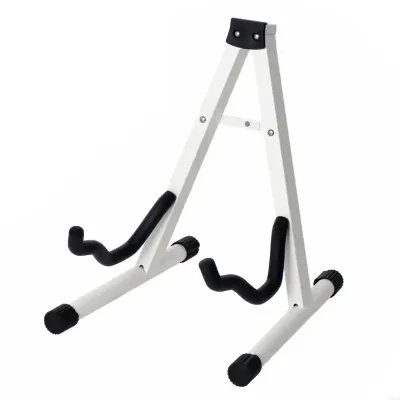
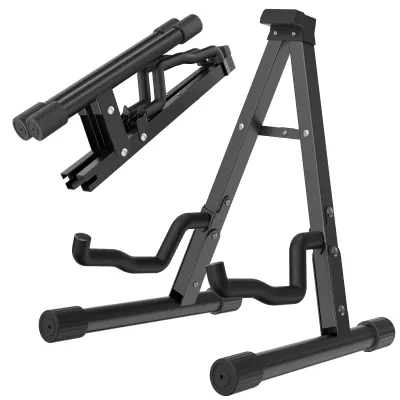

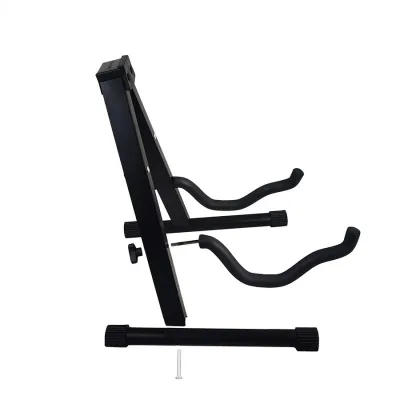
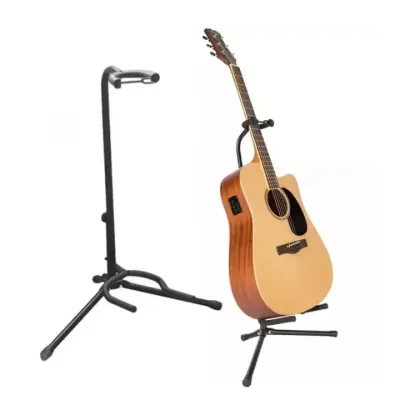
Prices are valid at publication and may change. Please refer to the product page for the latest price.
Household variables play a massive role in determining the stability your stand must provide. If you share your home with young children or active pets, a lightweight floor stand can easily be overturned during play. Additionally, daily household chores like sweeping or wet mopping mean the base of your stand will be exposed to occasional bumps from brooms or mops, as well as ambient moisture. Choosing a stand with a heavy, low-profile base or opting for a wall-mounted solution can help mitigate these daily hazards and keep your instrument out of harm’s way.
Choosing the Right Stand Type for Your Routine
Matching a guitar stand to your daily playing routine and storage habits ensures both convenience and safety. Different designs offer distinct advantages depending on how often you play and where you prefer to keep your instrument.

Evaluating A-frame and folding stands is highly recommended if portability and temporary use are your primary concerns. These stands are compact, lightweight, and can be folded flat in seconds, making them easy to tuck away under a bed or inside a closet when not in use. They are excellent for quick practice sessions or for taking to rehearsals. However, because A-frame stands lack neck support, they offer less protection against forward or backward tipping. If your home has high foot traffic, pets, or children, an A-frame stand may not provide sufficient security for long-term, unsupervised storage.
Standard tubular single stands are the traditional choice for daily accessibility and stable floor placement. These stands feature a tripod base, a lower body cradle, and an extended neck support column. The neck cradle typically includes a security strap or a gravity-activated gate that prevents the guitar from falling forward if bumped. This design offers excellent overall stability and keeps the instrument at a comfortable height for quick grabbing. The trade-off is that the tripod legs require a larger floor footprint than a folding A-frame stand, so you must ensure you have adequate floor space to accommodate the base.
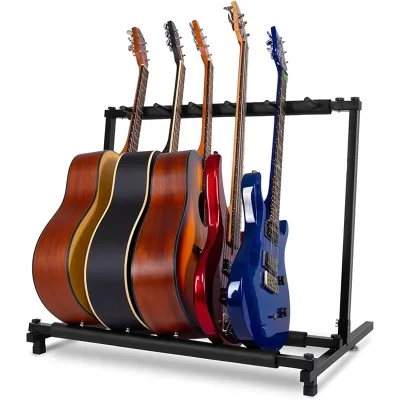
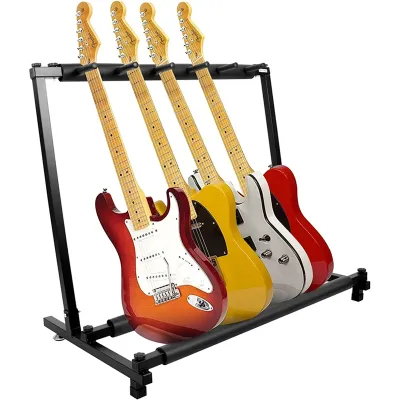
For players with growing collections, multi-stand racks offer a highly efficient and organized solution. These racks hold three, five, or seven guitars side-by-side in a neat, row-like fashion. By keeping the instruments close together on a single, rigid frame, multi-stands distribute the weight evenly and are incredibly difficult to tip over. While they require a permanent, rectangular floor footprint, they are far more space-efficient than using multiple individual tripod stands. This setup is ideal for dedicated music rooms or home studios where multiple instruments need to be accessed quickly during recording or practice.
Wall-mounted hangers are an excellent alternative that utilizes vertical space, lifting your instrument completely off the floor. This keeps the guitar safe from pets, children, and floor-level accidents while turning your instrument into a beautiful piece of wall art. However, wall mounting requires careful structural planning and proper installation. In many local homes, walls are constructed from concrete hollow blocks or plasterboard partitions. You must ensure you use the correct mounting hardware, such as heavy-duty plastic wall anchors for concrete or toggle bolts for drywall, to prevent the hanger from pulling out of the wall under the weight of the guitar.
Checking for Finish-Safe Materials and Stability
One of the most critical yet overlooked aspects of choosing a guitar stand is verifying that the materials in contact with your instrument will not cause physical or chemical damage over time.
Many vintage, high-end, or custom-built guitars feature a nitrocellulose lacquer finish. This material is highly sensitive and can react chemically with certain plastics, synthetic rubbers, and low-grade foams. If a nitrocellulose-finished guitar is left on a stand with incompatible padding, the chemicals can migrate into the lacquer, causing it to soften, discolor, or permanently melt. Always check product labels and manufacturer specifications to ensure the padding is explicitly rated as finish-safe or nitro-safe. Modern polyurethane or polyester finishes are much more resilient, but using high-quality, inert padding is still recommended to prevent minor surface scratches.
Inspect the physical design of the stand’s base to ensure maximum stability. A reliable stand should feature a wide stance and a low center of gravity to resist tipping from side or front impacts. Look for stands equipped with thick, non-slip rubber or silicone feet. On smooth tiled or polished wooden floors, cheap, hard plastic feet can easily slide or spin when bumped, which can lead to a catastrophic fall. The feet should grip the floor securely, providing a solid foundation that dampens vibrations and resists sliding.
Verify that the neck support mechanism securely holds the headstock without applying excessive pressure to the tuning machines. The yoke or cradle that holds the neck should be wide enough to accommodate your guitar’s neck profile without pinching. If the stand uses a gravity-activated locking gate, test the mechanism to ensure it operates smoothly and does not catch on the strings or tuning pegs. The weight of the guitar should be supported by the body cradle or the designated headstock hanger, never by the delicate tuning keys or the truss rod cover.
Implementing Space-Saving Storage in Compact Homes
Living in a compact apartment or a shared family home requires smart storage strategies to keep your instruments safe without cluttering your living space.
When space is limited, you must carefully weigh the trade-offs between a minimal floor footprint and physical stability. It can be tempting to choose the smallest, most minimalist stand available to save space, but these designs often have narrow bases that are easily tipped over. If you must use a floor stand in a small room, look for models that combine a compact base with a high-quality neck lock, or choose a folding model that you can easily store away when you are finished playing for the day.
Utilizing vertical space is one of the most effective ways to store guitars safely in smaller homes. When installing wall hangers, identify load-bearing concrete walls or structural wooden studs behind drywall. Avoid mounting hangers on thin plywood partitions or hollow drywall without proper anchors, as these materials can fail under the continuous weight of a heavy instrument. Additionally, avoid placing wall hangers near air conditioning units, open windows, or direct sunlight. Rapid temperature changes and high humidity levels can cause the wood of your guitar to warp, dry out, or crack.
Strategic placement of your floor stands can prevent accidental damage in tight quarters. Avoid placing stands in narrow walkways, behind swinging doors, or in areas where household chores are frequently performed. A sudden draft from an open door or an accidental brush from a passing shoulder can easily send a guitar crashing down. Instead, position your stand in a dedicated, low-traffic corner of the room, ideally next to a heavy piece of furniture like a desk or a bookshelf, which acts as a natural physical barrier against accidental bumps.
Evaluating Options Before You Buy
Before making a final purchasing decision, it is essential to run through a practical checklist to ensure the stand you choose is perfectly compatible with your instrument and living space.
First, cross-reference the manufacturer’s stated weight and dimension limits with your specific guitar model. This is especially important if you play a heavy seven-string electric guitar, a deep-bodied acoustic, or a long-scale bass. Ensure the bottom cradle is deep enough to hold your guitar’s body securely without letting it lean too far forward or backward. If you are buying online, look for detailed measurements of the cradle width and neck yoke to confirm a proper fit.
Next, review user feedback specifically looking for long-term durability issues. Pay close attention to comments regarding foam or rubber degradation, especially in warm, humid tropical climates where cheap materials tend to break down, become sticky, or crumble over time. Look for reports of loose joints, stripped adjustment screws, or base wobbling after several months of continuous use. Investing in a stand with durable, high-quality hardware will save you from having to replace it prematurely.
Finally, confirm the retailer’s return or exchange policy before finalizing your purchase. Because every guitar body shape and neck profile is unique, there is always a small chance that your instrument won’t sit perfectly on a particular stand. Having a flexible return policy ensures you can exchange the stand if the physical geometry does not properly accommodate your guitar. This is particularly crucial when purchasing specialized stands for asymmetrical instruments or multi-guitar setups.
Frequently Asked Questions (FAQ)
Is it safe to leave a guitar on a stand long-term?
Leaving a guitar on a stand long-term is generally safe if the room’s environment is stable, but it does expose the instrument to dust, ambient humidity fluctuations, and accidental bumps. In tropical climates, high humidity can cause the wood to swell, while air conditioning can dry it out rapidly. For long-term storage of several weeks or months without playing, keeping the guitar in a high-quality hard case with a dedicated humidity control pack is the safest option. If you do use a stand long-term, ensure the neck support does not apply constant, uneven pressure to the neck joint.
Do I need a different stand for acoustic and electric guitars?
Acoustic and electric guitars have vastly different body depths and weight distributions. Acoustic guitars have deep bodies and are relatively light, requiring a wider lower cradle to sit securely. Electric guitars are much thinner but significantly heavier, requiring a sturdy frame that can handle the concentrated weight without bending. While some specialized stands are designed exclusively for one type, many modern stands feature adjustable cradles or universal designs that can safely accommodate both acoustic and electric instruments.
How do I clean the rubber padding on my guitar stand?
Over time, the rubber or foam padding on a guitar stand can accumulate dust, sweat, and oils from your hands and the instrument. To clean it safely, use a soft microfiber cloth slightly dampened with warm water and a tiny drop of mild dish soap. Gently wipe down the padded surfaces to remove residue. Never use harsh chemical solvents, rubbing alcohol, or acetone, as these substances can chemically dissolve the rubber or foam, leaving a sticky residue that will ruin your guitar’s finish. Allow the padding to dry completely before placing your guitar back on the stand.
Community discussion
Share your experience or ask a question. Comments are reviewed before publication.