
Finding a reliable UHF wireless transmitter for your guitar or bass in the Philippines requires balancing signal stability, audio fidelity, and local environmental factors. In a country where high humidity, crowded radio frequencies, and concrete venue walls are the norm, a generic wireless system can easily lead to dropped signals, interference, or compromised tone. To secure a seamless performance, you must look beyond basic marketing promises and evaluate technical specifications like frequency bands, latency, dynamic range, and physical compatibility with your instrument.
Whether you are playing a crowded bar gig in Metro Manila, performing at an outdoor festival, or practicing in a humid home studio, your wireless setup must deliver your instrument’s true sound to the amplifier without interruption. By understanding how Ultra High Frequency (UHF) systems operate and knowing exactly what features to verify before purchasing, you can confidently transition from restrictive cables to wireless freedom. This comprehensive guide provides the practical frameworks, technical benchmarks, and local buying strategies needed to select the ideal UHF wireless transmitter for your musical gear.
Why UHF is the Standard for Wireless Guitar and Bass Systems
When shopping for wireless instrument systems, you will generally encounter two main frequency categories: 2.4 GHz digital systems and UHF (Ultra High Frequency) systems. While 2.4 GHz systems are popular for home practice due to their plug-and-play simplicity, they operate on the same crowded frequency band as home Wi-Fi networks, Bluetooth devices, and smart home appliances. In a live venue packed with audience smartphones and local wireless routers, a 2.4 GHz system is highly susceptible to signal dropouts, interference, and increased latency as it fights for bandwidth.
Products mentioned in this guide
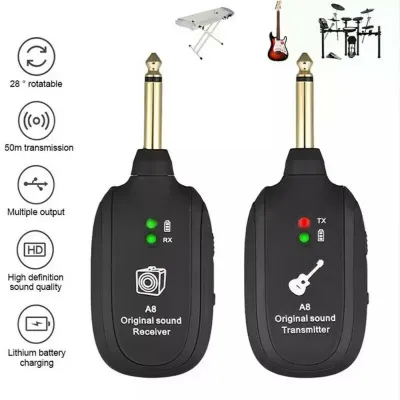
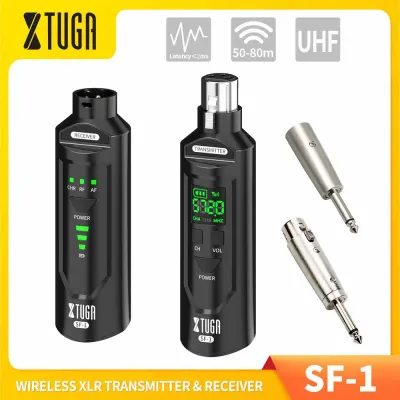
Prices are valid at publication and may change. Please refer to the product page for the latest price.
UHF wireless systems, which typically operate in the 470 MHz to 698 MHz range, offer a far more stable environment for live performances. Because this spectrum is less congested than the unlicensed 2.4 GHz band, UHF signals experience significantly fewer interruptions. The longer wavelengths of UHF radio waves also provide superior obstacle penetration, allowing the signal to travel easily through walls, stage gear, and even human bodies without losing connection. For a touring musician or a gigging bassist who needs to move around a large stage, this physical reliability is indispensable.
In addition to signal stability, UHF systems are highly regarded for preserving audio fidelity and dynamic range. Electric guitars and, more importantly, bass guitars produce a wide spectrum of frequencies that require clean, uncompressed transmission to sound natural. Many professional UHF systems utilize high-quality analog transmission or specialized digital UHF protocols that do not compress the audio signal as aggressively as standard 2.4 GHz digital systems. This ensures that the punchy low-end of a bass or the delicate high-end harmonics of a guitar reach the soundboard completely intact.
Furthermore, UHF systems generally exhibit near-zero latency. Because many UHF systems use analog frequency modulation (FM) to transmit the signal, the transmission is virtually instantaneous. Even digital UHF systems are engineered with high-speed converters that keep latency well below the threshold of human perception. This instantaneous response is critical for musicians, as even a tiny delay of 10 milliseconds can disrupt your timing, make your playing feel disconnected, and ruin your performance flow.
Core Specifications to Evaluate for Live Performances
To ensure a UHF wireless transmitter can handle the rigors of live performances in the Philippines, you must carefully examine the manufacturer’s specification sheet. The first metric to check is the frequency response range. A standard electric guitar requires a frequency response of at least 80 Hz to 15 kHz to capture its full tonal range. However, if you play a five-string or six-string bass, you must look for a system that extends down to 30 Hz or 20 Hz. A system with a poor low-frequency response will roll off your lowest notes, leaving your bass sounding thin, weak, and lacking in stage presence.

Latency is another non-negotiable specification that directly impacts your playing experience. For real-time monitoring and natural feel, aim for a system with a latency threshold of under 5 milliseconds (ms). While analog UHF systems have zero latency in theory, digital UHF systems must convert your analog instrument signal to digital, transmit it, and convert it back to analog at the receiver. Checking the manual for a certified latency rating ensures you will not experience that disorienting “echo” sensation while performing on stage.
Dynamic range and the signal-to-noise ratio (SNR) are equally critical for maintaining tone quality. The dynamic range, measured in decibels (dB), dictates how well the system handles the transition from quiet, delicate fingerpicking to aggressive, heavy strumming. Look for a dynamic range of 100 dB or higher to prevent your signal from clipping or distorting during loud passages. A high signal-to-noise ratio (ideally above 90 dB) ensures that your signal remains clean and free of background hiss, which is especially important when using high-gain distortion pedals or high-output active pickups.
Finally, pay close attention to battery specifications and power management. In the tropical climate of the Philippines, high temperatures and humidity can accelerate battery discharge rates. Look for transmitters that offer at least 6 to 8 hours of continuous operation on a single charge. If the system uses built-in rechargeable lithium batteries, verify the charging connection type (such as USB-C) and the overall charging time. For long gigs, festivals, or back-to-back sets, some musicians prefer systems that run on standard AA batteries, allowing for quick swaps between sets without waiting for a recharge.
Matching the System to Your Gig Environment
Your choice of a UHF wireless transmitter should closely align with the physical environments where you perform. If you primarily play in small indoor venues, bars, or church halls, a system with a modest operating range of 30 meters (approximately 100 feet) is usually sufficient. However, if you perform on large outdoor stages, sports complexes, or open-air festivals, you will need a system rated for 90 meters (300 feet) or more. Keep in mind that manufacturer-stated ranges are typically based on ideal, line-of-sight conditions; in a real-world venue filled with people and equipment, the effective range can be cut in half.
Another environmental factor to consider is local radio frequency (RF) congestion. In dense urban areas like Metro Manila, Cebu, or Davao, the airwaves are filled with television broadcasts, emergency communications, and other wireless audio systems. To navigate this crowded spectrum, avoid fixed-frequency wireless systems. Instead, opt for a UHF system that offers selectable frequencies or multi-channel capabilities. Advanced systems feature auto-scanning technology, which automatically analyzes the local RF environment and selects the cleanest available channel to prevent static, dropouts, and cross-talk from other wireless gear.
+-------------------------------------------------------------------------+
|                       WIRELESS FORM FACTOR COMPARISON                   |
+-------------------------------------------------------------------------+
| Feature             | Plug-On (Dongle) Systems  | Bodypack Systems      |
+---------------------+---------------------------+-----------------------+
| Portability         | Extremely high, compact   | Moderate, requires    |
|                     | and cable-free            | a short cable         |
+---------------------+---------------------------+-----------------------+
| Instrument Fit      | May block controls or     | Universal fit; works  |
|                     | require adapters          | with all jack types   |
+---------------------+---------------------------+-----------------------+
| Durability          | Vulnerable to physical    | Highly durable;       |
|                     | impacts on the instrument | protected on strap    |
+---------------------+---------------------------+-----------------------+
| Power Source        | Usually built-in USB      | Often uses AA or      |
|                     | rechargeable batteries    | swappable batteries   |
+-------------------------------------------------------------------------+
The physical form factor of the transmitter is also a key decision point. Plug-on or “dongle-style” transmitters plug directly into your guitar’s output jack, offering maximum convenience and eliminating the need for extra cables. However, they can be vulnerable to physical damage if you bump into stage gear, and their bulky shape can sometimes block volume knobs or tremolo arms. Bodypack transmitters, on the other hand, clip securely onto your guitar strap and connect to your instrument via a short patch cable. This traditional setup is highly durable, keeps the transmitter safe from accidental impacts, and is generally preferred by energetic performers who move extensively on stage.
Pre-Purchase Compatibility and Setup Checks
Before finalizing your purchase, you must perform several compatibility checks to ensure the wireless system integrates seamlessly with your existing musical gear. First, examine the physical design of your instrument’s output jack. Guitars with deeply recessed jacks (such as a Fender Stratocaster) or angled, side-mounted jacks (common on many modern Ibanez or active bass models) may not accommodate a bulky plug-on transmitter. In these cases, you will need to verify if the transmitter plug can pivot, or if you need to purchase a short 1/4-inch extension cable or right-angle adapter to connect the transmitter safely without straining the jack.
Next, consider the electrical compatibility of your instrument’s pickups. Guitars and basses with active pickups (which require an internal 9V battery) operate at a much higher output level and lower impedance than passive pickups. Some wireless transmitters can become overloaded by this hot signal, resulting in unwanted distortion or clipping. Additionally, certain active preamp circuits can cause a high-pitched squeal or hum when paired with specific wireless transmitters due to electrical feedback loops. Always check the manufacturer’s product manual or user forums to confirm that the transmitter is rated to handle active electronics.
[Instrument Output]
       │
       ▼ (High/Low Impedance Signal)
[UHF Transmitter]
       │
       ▼ (Wireless UHF Radio Waves)
[UHF Receiver]
       │
       ▼ (Balanced/Unbalanced Line Out)
[Pedalboard / Buffer / Amp Input]
You must also evaluate how the wireless receiver integrates with your pedalboard and amplifier. The output of your wireless receiver should match the input impedance of your guitar amplifier or first pedal in your signal chain. If the receiver output is too hot, it can overdrive your pedals prematurely, altering the character of your overdrive, fuzz, or modulation effects. If you use vintage fuzz pedals (like a Fuzz Face), be aware that these circuits rely on a direct, high-impedance connection from passive guitar pickups to sound correct; placing a wireless receiver before them acts as a buffer, which can significantly change the pedal’s tone and response.
Sourcing and Verifying Gear in the Philippines
When you are ready to buy a UHF wireless transmitter in the Philippines, sourcing your gear from authorized channels is the best way to guarantee authenticity, performance, and long-term support. While general e-commerce platforms and online marketplaces offer a vast array of cheap, unbranded wireless systems, these units often operate on illegal or congested frequency bands, lack proper shielding, and offer no warranty protection. Purchasing from established, specialized music retailers or official brand flagship stores ensures you receive a genuine product designed to comply with local radio frequency regulations.
Buying from an authorized local distributor also provides the invaluable benefit of a local warranty and after-sales service. Electronic music gear is highly susceptible to damage from the intense tropical humidity and sweat accumulated during energetic live performances. If your transmitter develops a charging issue, a broken jack, or a signal fault, having access to an official service center in the Philippines means your gear can be repaired or replaced quickly using genuine parts. Always ask the seller for a physical warranty card and clarify the duration and terms of their repair policy before handing over your money.
To protect yourself from counterfeit or gray-market products, use pricing as a primary verification tool. Compare the local price in Philippine Pesos (₱) against the manufacturer’s official suggested retail price (MSRP) listed on their global website. If a seller is offering a premium UHF wireless system at a fraction of its standard global price, it is highly likely a counterfeit unit that will suffer from poor range, high latency, and terrible tone. Additionally, verify the seller’s credentials, look for official distributor badges, and read detailed customer reviews to ensure a safe and reliable purchasing experience.
Frequently Asked Questions (FAQ)
Can I use the same wireless system for both guitar and bass?
Yes, you can use the same UHF wireless system for both electric guitar and bass, provided the system’s technical specifications support the unique frequency demands of both instruments. When evaluating a system for dual-use, the most critical specification to check is the low-frequency response. While electric guitars do not produce much sound below 80 Hz, a standard four-string bass goes down to 41 Hz, and a five-string bass drops all the way to 31 Hz.
If the wireless system has a low-frequency roll-off point that is too high (for example, cutting off at 50 Hz or 60 Hz), your bass guitar will lose its deep, foundational low-end punch and sound thin through the PA system. Additionally, ensure the transmitter has a high dynamic range (above 100 dB) to handle the powerful transient peaks produced by slapping, popping, or heavy bass plucking without distorting or compressing the signal.
Do I need a special cable to connect the receiver to my pedalboard?
No, you do not need a special proprietary cable to connect your UHF wireless receiver to your pedalboard, but using a high-quality, shielded instrument cable is highly recommended to preserve your tone. The output jack on most wireless receivers is a standard 1/4-inch unbalanced mono jack, which is identical to the output jack on your guitar. You can use a standard patch cable or a short instrument cable to connect this output directly to the input of your first pedal or your amplifier.
However, you should consider how the receiver affects your signal chain. Because the wireless receiver output is a low-impedance, buffered signal, it acts as an active buffer pedal. If you place the receiver at the very beginning of your pedalboard, it will help preserve your high-end frequencies over long cable runs to your amplifier. However, if you use vintage fuzz or wah pedals that are sensitive to buffered inputs, you may need to adjust your pedal order or use a specialized impedance-matching device to maintain your desired tonal characteristics.
Community discussion
Share your experience or ask a question. Comments are reviewed before publication.