
Upgrading your guitar with noiseless pickups fender designs offer is one of the most practical ways to eliminate distracting background buzz while preserving the classic single-coil character of your instrument. Choosing the right model requires balancing your personal tonal preferences with the physical and electrical specifications of your specific guitar. Because different generations of these pickups utilize distinct coil architectures and magnetic formulations, finding a suitable match involves analyzing your playing style, verifying your instrument’s existing hardware, and understanding how these components interact under real-world conditions.
In tropical environments like the Philippines, where high humidity and temperature fluctuations can affect electronic stability, choosing a reliable, hum-canceling pickup system becomes even more critical. Moisture in the air can exacerbate grounding issues and amplify interference from nearby appliances, air conditioning units, or stage lighting. By selecting a compatible noiseless set and ensuring proper installation, you can secure a clean, reliable signal path whether you are practicing in a humid home studio or performing under hot stage lights.
Understanding Fender Noiseless Pickup Designs and Generations
To make an informed purchase, you must first understand how noiseless single-coil pickups achieve their hum-rejecting properties. Traditional single-coil pickups act as antennae, picking up electromagnetic interference from power lines, monitors, and fluorescent lights, which manifests as a persistent 60-cycle hum. Noiseless designs counteract this by using two coils instead of one. The most common architecture is the stacked humbucker, where a secondary noise-canceling coil is positioned directly beneath the primary sensing coil. This stacked configuration allows the pickup to retain the narrow magnetic aperture and physical footprint of a standard single-coil while canceling out unwanted hum.
Products mentioned in this guide
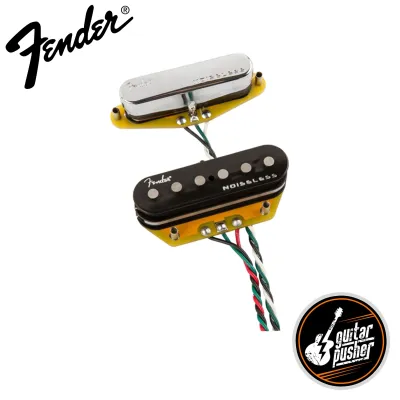

Prices are valid at publication and may change. Please refer to the product page for the latest price.
Over the years, manufacturers have refined these designs across multiple generations, altering the coil wire gauge, magnet types, and shielding methods to target different tonal profiles. Early generations often focused heavily on noise suppression, sometimes resulting in a slightly compressed high-end response compared to traditional single-coils. Modern iterations, however, utilize advanced side-by-side coil configurations or specialized winding techniques designed to restore the open, airy treble response and dynamic sensitivity that guitarists associate with vintage instruments.
When evaluating these designs, you will generally encounter two primary tonal directions: vintage-voiced and modern high-output. Vintage-voiced models aim to replicate the lower output, bright clarity, and scooped midrange of mid-century pickups, making them ideal for expressive, dynamic playing. Modern high-output designs prioritize a stronger signal, a more pronounced midrange push, and increased sustain, which helps push your amplifier into natural overdrive. Because Fender continuously updates its product lineup, model names and internal specifications can change over time. It is essential to verify the exact generation, magnet type (such as Alnico II, III, or V), and output profile on the product packaging or the manufacturer’s official specification sheet before buying.
Matching Noiseless Models to Your Guitar and Playing Style
Selecting the right noiseless pickup set requires careful consideration of your guitar’s physical layout and your primary musical genres. Stratocaster-style and Telecaster-style guitars utilize fundamentally different pickup dimensions and mounting configurations. For instance, a Stratocaster typically uses three identical-looking single-coils, but the bridge pickup is sometimes wound slightly hotter than the neck and middle pickups to balance the overall volume. Telecaster models, on the other hand, feature highly distinct neck and bridge designs; the bridge pickup is mounted directly to a metal plate and has a wider, trapezoidal base, while the neck pickup is narrower and traditionally covered in a metal hood.

Physical compatibility extends beyond the surface of your pickguard. You must verify the routing of your guitar’s pickup cavities. While most modern guitars feature universal routing that can accommodate various pickup depths, some vintage-reissue instruments or budget models have shallow cavities. Because stacked noiseless pickups are physically taller than standard single-coils due to the secondary coil underneath, they require deeper cavities to allow for proper height adjustment. Before purchasing a set from an online marketplace or a local music shop in the Philippines, measure the depth of your guitar’s routing to ensure the new pickups can be lowered sufficiently to achieve your desired string clearance.
Your playing style and musical goals should dictate the output level and EQ curve of the pickups you choose. If your repertoire focuses on jazz, country, or clean funk, you will benefit from a low-to-medium output set that offers high clean headroom and a sparkling treble response. This ensures your chords remain articulate and do not distort prematurely. Conversely, if you play blues, classic rock, or modern fusion, a higher-output set with a boosted midrange will help your solos cut through a dense band mix and provide a smoother transition into overdrive when using boost or distortion pedals.
Key Electrical Specifications to Verify Before Purchase
Upgrading your pickups is not just a mechanical task; it also requires matching the electrical components inside your guitar’s control cavity. The relationship between pickup impedance and potentiometer (pot) values is critical to maintaining a pleasing tonal balance. Traditionally, single-coil guitars use 250kΩ potentiometers to bleed off excess high frequencies, resulting in a warmer tone. Humbuckers, which are naturally darker, typically use 500kΩ pots to preserve treble clarity. Because noiseless pickups are technically humbuckers but voiced to sound like single-coils, some models perform best with 250kΩ pots, while others require 500kΩ or even specialized 1MΩ pots to avoid sounding muddy.
Before finalizing your purchase, consult the manufacturer’s installation guide to see which potentiometer values are recommended for your chosen noiseless model. If your guitar currently has 250kΩ pots and your new pickups require 500kΩ, you will need to purchase and install new potentiometers to prevent your tone from sounding dark and muffled. Additionally, pay close attention to the taper of the pots; high-quality audio-taper potentiometers ensure that volume and tone adjustments roll off smoothly rather than dropping off abruptly.
If you plan to mix a new noiseless pickup with your guitar’s existing standard single-coils, you must account for magnetic polarity and phase alignment. When two pickups are active simultaneously—such as in the middle positions of a Stratocaster or Telecaster—they must be in phase and have opposite magnetic polarities to cancel hum and produce a full, robust tone. Mixing brands or combining noiseless stacked designs with traditional single-coils can result in an out-of-phase relationship, causing the combined positions to sound thin, hollow, and quiet. To avoid this, check the DC resistance, inductance, and wiring diagrams provided by the manufacturer to ensure electrical compatibility across all switch positions.
Installation, Shielding, and Wiring Requirements
To fully realize the benefits of your new noiseless pickups fender upgrade, you must pay close attention to the installation process and the electrical environment inside your guitar. While noiseless pickups are designed to eliminate the hum generated by the coils themselves, they cannot prevent noise from entering the rest of your guitar’s wiring. In highly humid tropical climates like the Philippines, moisture can seep into unshielded control cavities, accelerating the oxidation of solder joints and creating microphonic interference. Applying conductive copper shielding tape or shielding paint to the entire pickup and control cavities is highly recommended to create a Faraday cage that blocks external radio frequency interference.
Proper grounding is equally vital to ensuring a quiet instrument. Implementing a star grounding scheme—where all ground wires from the pickups, potentiometers, output jack, and bridge ground connect to a single, central point—prevents ground loops that can introduce a low-frequency hum. When soldering your new pickups, use a soldering iron with adjustable temperature control to avoid overheating the potentiometer casings, which can damage their internal resistive elements. If you are replacing your tone pots or upgrading your wiring harness, select appropriate capacitor values; a 0.022µF or 0.047µF capacitor is standard for single-coil style circuits, but the specific inductance of your noiseless pickups may warrant experimenting with different values to customize your tone control’s sweep.
While many guitarists enjoy the process of DIY soldering, complex wiring schemes require a steady hand and technical experience. If your upgrade involves active preamps, coil-splitting switches, series-parallel switching, or structural modifications to the guitar body, it is wise to consult a qualified guitar technician. Investing in professional installation ensures that your connections are mechanically secure, properly insulated, and optimized for long-term reliability in humid conditions.
Frequently Asked Questions (FAQ)
Do Fender noiseless pickups completely eliminate 60-cycle hum?
Yes, the dual-coil design of these pickups is effective at canceling the standard 60-cycle hum inherent to traditional single-coils. However, they cannot eliminate other sources of noise, such as electromagnetic interference (EMI) from nearby computer monitors, neon signs, or poorly grounded household wiring. To achieve a quiet performance, you must combine your noiseless pickups with high-quality shielded instrument cables, a properly shielded guitar cavity, and a clean power source or power conditioner.
Can I mix a noiseless bridge pickup with standard single-coils in the neck and middle?
You can mix them, but doing so requires careful planning to avoid phase cancellation and volume imbalances. Because noiseless pickups generally have different output levels and internal impedances compared to traditional single-coils, the combined switch positions may sound thin or hollow if the pickups are out of phase. You will need to verify the magnetic polarity and winding direction of your existing pickups, and you may need to reverse the hot and ground leads of the new pickup during installation to ensure proper phase alignment.
Community discussion
Share your experience or ask a question. Comments are reviewed before publication.