
Upgrading or replacing the tuning pegs on your Les Paul can dramatically improve tuning stability and make string changes much easier. However, purchasing a set of replacement pegs is not as simple as picking a brand and a color. Because various manufacturers and brands have used different production standards over the decades, physical compatibility varies significantly across different model years and factories.
To ensure a seamless drop-in installation without permanently damaging your guitar’s headstock, you must verify three critical specifications: the headstock hole diameter, the mounting screw configuration, and the post height. Checking these dimensions beforehand prevents the need for costly wood modifications or leaving unsightly, exposed holes on the back of your headstock.
Shaft Diameter and Headstock Hole Size
The most critical physical dimension to verify before purchasing is the diameter of the holes drilled into your guitar’s headstock. If the new tuner shafts are too wide, they will not fit through the wood; if they are too narrow, the posts will wobble under string tension, ruining your tuning stability and potentially damaging the headstock.
Products mentioned in this guide
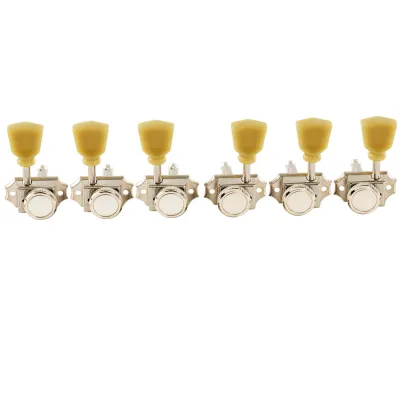
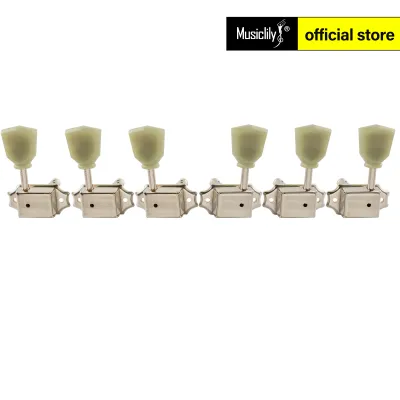
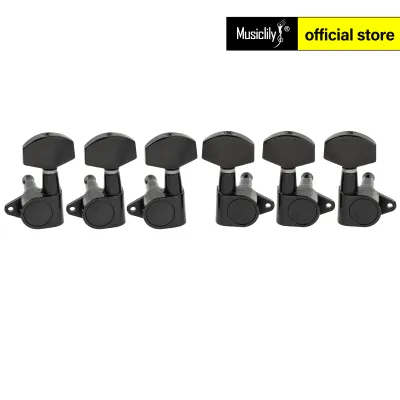
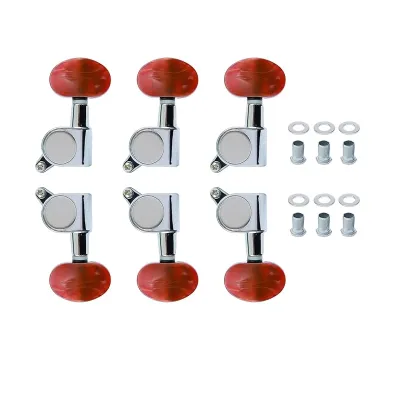

Prices are valid at publication and may change. Please refer to the product page for the latest price.
Generally, modern Les Paul models and contemporary replicas utilize standard 10mm (approximately 0.394 inches) headstock holes designed for modern bolt-bushing tuners. In contrast, vintage models, historical reissues, and many vintage-style instruments feature smaller 8mm to 8.5mm (approximately 0.315 to 0.334 inches) holes designed for press-fit push bushings.
To avoid costly installation mistakes, do not rely on visual estimation or online forum generalizations for your specific model year. Instead, use a set of digital calipers to measure the inner diameter of the headstock holes after removing one of your current tuning pegs. Be sure to measure both the front and back of the headstock, as some vintage-style holes are stepped, meaning they are slightly narrower in the middle of the wood.
If you wish to install modern 10mm tuners into vintage-sized 8mm holes, you will face a major compatibility hurdle. While you can easily purchase adapter or conversion bushings to fit smaller vintage-style tuners into larger modern holes, going the opposite direction is much riskier. Enlarging headstock holes requires reaming or drilling, which can easily crack a delicate mahogany headstock or chip the lacquer finish. Always consult a professional luthier before attempting any irreversible wood modification on your instrument.
Mounting Configuration and Screw Placement
Once you have confirmed the hole size, you must match the physical footprint and mounting screw layout of the new tuners to your headstock. Les Paul guitars universally use a “3+3” configuration, meaning there are three tuners on the bass side and three on the treble side. This is fundamentally different from the “6-in-line” configuration found on Stratocaster-style guitars, where all six tuners mount on a single side of the headstock.

Beyond the basic 3+3 layout, the placement of the small mounting screws on the back of the headstock is highly variable. Tuning peg manufacturers design their mounting tabs at different angles and positions relative to the main tuner shaft. Common styles include a single screw tab positioned at a 45-degree angle, a tab pointing straight down at a 90-degree angle, or vintage-style dual-screw layouts where adjacent tuners share mounting screws.
To achieve a true “drop-in” replacement that requires no new drilling, you must measure the exact distance from the center of the main tuner shaft to the center of the mounting screw hole. If the new tuner’s screw tab does not align perfectly with the existing screw hole in your headstock, you will be forced to drill new pilot holes and leave the old holes exposed. While this does not necessarily affect playability, it can significantly lower the resale value and aesthetic appeal of a premium instrument.
Gear Ratio and Tuner Mechanism
While physical dimensions dictate whether a tuner will fit, the internal mechanism and gear ratio dictate how well it performs. The gear ratio determines how many full rotations of the tuning button are required to turn the string post one complete revolution.
Standard vintage-style tuners often feature a 14:1 gear ratio, which is functional but can make fine-tuning a bit jumpy. Upgrading to a higher ratio, such as 18:1 or 21:1, provides much greater precision. With a higher ratio, each turn of the button makes a smaller, more controlled adjustment to the pitch, making it much easier to lock into perfect tuning, especially when using lighter string gauges.
Selecting the right mechanism also depends heavily on your environment. In tropical climates like the Philippines, where high humidity and ambient salt air can accelerate metal corrosion and degrade lubricants, sealed (die-cast) tuners are highly recommended for long-term durability. Sealed tuners house the gears inside a lubricated, airtight chamber, protecting them from environmental factors. Open-gear tuners, by contrast, expose the brass and steel gears to the air, requiring regular cleaning and lubrication to prevent binding in humid environments.
Locking tuners are an excellent modern upgrade to consider. They feature a mechanical pin inside the post that clamps down on the string, eliminating the need to wrap the string multiple times around the post. This design dramatically speeds up string changes and minimizes string slippage. However, remember that a “locking” mechanism is purely functional; you must still verify that the locking tuners match your headstock’s specific shaft diameter and screw configuration before purchasing. High-quality replacement sets generally fall into broad price bands, with standard sealed tuners starting around ₱1,500 to ₱3,000, while premium locking sets can range from ₱4,000 to over ₱7,000.
Specs That Matter Less for Basic Fitment
When browsing catalogs, it is easy to get overwhelmed by the sheer variety of options. To simplify your decision, recognize which specifications are purely cosmetic and have no bearing on physical compatibility.
The shape and material of the tuning buttons—whether they are classic plastic “tulip” buttons, metal “keystone” buttons, or modern kidney-bean shapes—are entirely interchangeable and do not affect installation. Similarly, hardware finishes like chrome, nickel, gold, or black nickel are aesthetic choices. You can freely choose the look that matches your bridge and tailpiece without worrying about fitment.
Furthermore, do not assume that buying a premium brand name automatically guarantees a direct fit. Even highly respected manufacturers produce tuning pegs in multiple sizes, configurations, and shaft lengths. Always prioritize physical measurements and manufacturer specification sheets over brand reputation or generic model compatibility claims.
Frequently Asked Questions (FAQ)
Can I use Stratocaster or Telecaster tuning pegs on a Les Paul?
No, you cannot use standard Stratocaster or Telecaster tuning pegs on a Les Paul. Fender-style guitars use a 6-in-line configuration where all tuners are designed for one side of the headstock, whereas Les Pauls require a mirrored 3+3 set. Additionally, Fender-style tuners often feature different shaft lengths, staggered post heights, and mounting pin systems that are completely incompatible with the thicker, angled mahogany headstock of a Les Paul. Attempting to force them onto a Les Paul will result in severe alignment issues and potential structural damage.
Do I need to modify my Les Paul headstock to install locking tuners?
Not necessarily. Many reputable aftermarket manufacturers produce locking tuners specifically designed as direct, drop-in replacements for standard Les Paul dimensions. If you select a set of locking tuners that matches your existing headstock’s hole size (typically 10mm for modern models) and utilizes the same mounting screw pattern, you can install them with a simple screwdriver and wrench, requiring absolutely no drilling or permanent modification to the wood.
Community discussion
Share your experience or ask a question. Comments are reviewed before publication.