
Transitioning from a traditional instrument cable to a wireless guitar system is one of the most liberating upgrades a musician can make. Whether you are performing on a crowded stage, practicing in a humid home studio, or busking outdoors, removing physical cable constraints changes how you interact with your instrument and your audience. However, selecting the right NUX wireless guitar system requires a careful balance of technical specifications, physical compatibility, and environmental awareness.
To find the model that fits your playing style and venue, you must evaluate how the system handles signal interference, how its physical design matches your guitar’s output jack, and how its battery system copes with your performance schedule. A system that works flawlessly in a quiet bedroom might struggle on a stage surrounded by active Wi-Fi routers and mobile devices. By understanding the core differences in frequency bands, form factors, and power management, you can make an informed decision that ensures uninterrupted, high-fidelity audio.
Identifying Your Venue and Mobility Requirements
The physical environment where you play most often is the primary factor in determining which wireless system you need. Live music venues, bars, and outdoor stages are highly congested electromagnetic environments. Hundreds of audience members carrying smartphones, combined with the venue’s own wireless networks and stage equipment, create a dense cloud of radio frequency interference. If you frequently perform in these crowded spaces, you require a system designed to navigate signal congestion through automatic channel hopping or a less crowded frequency band. Conversely, if your primary use case is a home studio, a local rehearsal space, or a controlled classroom environment, signal interference is less of a threat, allowing you to prioritize simplicity and compact design over advanced multi-channel switching.
Products mentioned in this guide
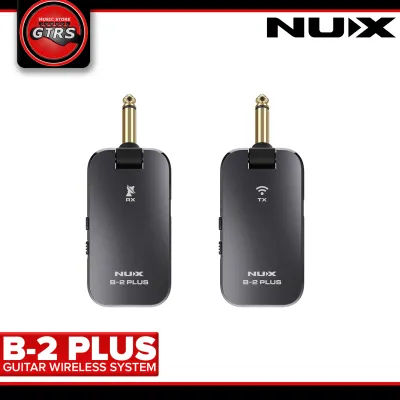
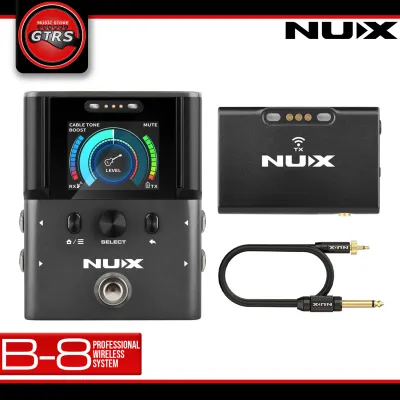
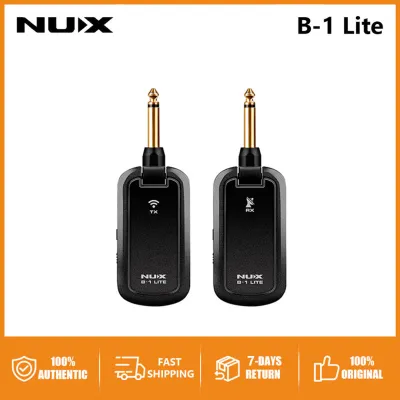
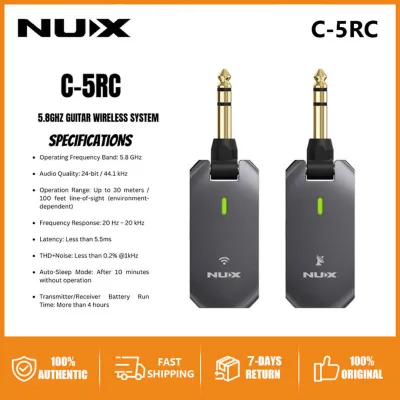
Prices are valid at publication and may change. Please refer to the product page for the latest price.
Your physical movement on stage also dictates your wireless needs. Stationary players, such as keyboardists who occasionally play guitar, sit-down acoustic performers, or studio musicians, do not require extended transmission ranges. For these scenarios, a lightweight, direct-plug transmitter with a modest range is highly efficient. However, if you are an energetic performer who moves across large stages, interacts with the crowd, or needs to perform soundchecks from the front-of-house position, you must verify the system’s maximum line-of-sight range. A robust receiver with external antennas may be necessary to maintain a stable connection over longer distances, preventing embarrassing dropouts during a high-energy set.
Finally, the physical construction of your instrument plays a critical role in your selection. Guitars feature a wide variety of output jack configurations, from the deeply recessed top-mounted jacks of Stratocaster-style bodies to the flush side-mounted jacks of Les Paul-style instruments, and the tight, cup-style jacks found on Telecasters. Acoustic-electric guitars often have their output jacks integrated directly into the bottom strap button, which presents unique clearance challenges. You must choose a transmitter plug design—whether a flexible folding plug, a rigid straight plug, or a short extension cable adapter—that sits securely in your instrument’s jack without obstructing your playing hand, blocking access to control knobs, or putting mechanical stress on the guitar’s internal wiring and wood.
Core Specifications to Evaluate in NUX Systems
When comparing different wireless systems, the operating frequency band is the most critical technical specification to verify. Most modern digital wireless guitar systems operate on either the 2.4 GHz or the 5.8 GHz frequency band. The 2.4 GHz band is highly common and globally compatible, meaning you can use it almost anywhere without licensing issues. However, because this band is shared with home Wi-Fi routers, Bluetooth devices, microwave ovens, and smart home technology, it is highly susceptible to interference in urban areas or crowded venues. The 5.8 GHz band offers a much cleaner spectrum with significantly fewer competing devices, making it an excellent choice for gigging musicians who need a reliable connection in high-traffic environments. However, 5.8 GHz signals have a shorter wavelength, meaning they are more easily blocked by physical obstacles and require a clearer line of sight between the transmitter and receiver.

Audio latency and dynamic range are the specifications that directly impact how the system feels and sounds. Latency is the tiny delay between the moment you pluck a string and the moment the sound emerges from your amplifier. For a natural playing experience, look for systems that specify a latency of under 5 milliseconds. Any delay longer than this can create a distracting disconnect between your hands and your ears, especially during fast, rhythmic passages. Dynamic range, measured in decibels (dB), determines how well the system preserves the quietest whispers and loudest peaks of your playing. A wider dynamic range ensures that your guitar’s natural expression, touch sensitivity, and tone are transmitted to the amplifier without unwanted compression or digital artifacts.
Battery performance and charging convenience are vital for maintaining a stress-free performance routine. Digital wireless systems rely on internal lithium-ion batteries, which must be charged regularly. When evaluating models, compare their rated continuous battery life against your typical playing session length. For casual practice, a system that offers four to five hours of continuous use is generally sufficient. For long gigs, multi-band festivals, or all-day rehearsals, you may want to look for systems that feature a dedicated charging case. These cases not only protect the transmitter and receiver during transport but also recharge the units automatically when they are docked, effectively doubling or tripling your operating time without needing to find a wall outlet between sets.
Matching NUX Wireless Form Factors to Your Setup
The physical form factor of your wireless system should align seamlessly with your existing gear setup and transport habits. Direct-plug systems, consisting of two small, matching dongles that plug directly into your guitar and amplifier, are incredibly popular due to their portability and ease of use. They require no extra cables and can easily slide into your guitar gig bag pocket. Many of these direct-plug models feature a swiveling or folding plug design, allowing the transmitter to fold flat against the guitar body. This minimizes the risk of accidentally bumping the transmitter against a microphone stand or stage monitor, which could damage both the wireless unit and your guitar’s wood.
For musicians who use a complex pedalboard setup, a pedal-format wireless receiver is often the most practical choice. These receivers are designed to sit permanently on your pedalboard, powered by your existing multi-outlet pedal power supply. They often feature a rugged metal chassis, an external antenna for improved signal reception, and a built-in tuner, saving valuable space on your board. The transmitter for a pedal-format system is typically a small bodypack or a direct-plug unit that pairs automatically with the pedal receiver when powered on. This setup is highly reliable for gigging guitarists, as the receiver remains safely positioned on the floor, connected directly to your first pedal or amplifier input via standard patch cables.
If you travel frequently or perform multiple short sets throughout the day, a system with an integrated charging case offers unmatched convenience. The charging case acts as a protective hard shell, preventing the delicate plastic casings and gold-plated plugs of your transmitter and receiver from getting crushed or scratched in your accessory bag. In tropical climates like the Philippines, where sudden downpours and high humidity are common, keeping your wireless units sealed inside a protective case when not in use also helps shield the sensitive internal digital circuitry from moisture and dust accumulation, prolonging the overall lifespan of your investment.
Pre-Purchase Compatibility and Setup Verification
Before finalizing your purchase, it is essential to perform a thorough compatibility check with your specific instruments. While digital wireless systems work flawlessly with the vast majority of passive guitar pickups, they can occasionally encounter issues when paired with active pickups or onboard preamps. Active pickups rely on an internal battery and a stereo (TRS) output jack to switch the battery on when a standard mono (TS) guitar cable is inserted. Some wireless transmitters use a TRS plug configuration to handle charging or power detection, which can conflict with the guitar’s active circuitry, resulting in a loud hum, a weak signal, or no sound at all. To avoid this, verify the manufacturer’s compatibility guidelines or plan to use a short mono extension cable adapter to isolate the transmitter from the active jack.
You must also plan where the receiver will sit in your signal chain to maintain optimal tone. For the cleanest signal path, the wireless receiver should be placed at the very beginning of your chain, before any effects pedals. If you use pedals that are highly sensitive to input impedance, such as vintage-style fuzz faces or Germanium boosters, placing a digital wireless receiver before them can alter their response and tone, making them sound overly bright or harsh. In these scenarios, you may need to experiment with receiver placement or use a dedicated buffer pedal to restore your preferred tonal characteristics. Additionally, ensure the receiver is positioned away from large metal structures, wireless routers, or power amplifiers to minimize the risk of electromagnetic interference.
When purchasing your system from e-commerce platforms or local music retailers in the Philippines, always verify that you are buying from an authorized dealer. This ensures that you receive a genuine product with a valid manufacturer’s warranty, protecting your investment against manufacturing defects. Check the seller’s return policy and customer reviews to confirm their reliability. Because wireless frequencies are regulated differently around the world, buying from an authorized local distributor guarantees that the system operates on frequency bands that are legal and compliant with local telecommunications standards, preventing potential legal issues or unexpected signal blockages. Always verify the retail price in ₱ on authorized dealer platforms to ensure you are getting a legitimate offer.
Frequently Asked Questions (FAQ)
Can I use multiple NUX wireless systems on the same stage?
Yes, you can operate multiple wireless systems simultaneously on the same stage, provided you configure them correctly. Most modern digital wireless systems feature multiple selectable channels or an automatic pairing protocol that assigns each transmitter-receiver pair to a unique frequency sub-band. When setting up multiple units for a band—such as a wireless system for the lead guitar, rhythm guitar, and bass—ensure that each system is paired individually before turning on the next one. This prevents the receivers from accidentally locking onto the wrong transmitter signal. Additionally, maintaining a physical distance of at least a few meters between different receivers on stage will help prevent cross-talk and signal degradation.
Do wireless systems affect my guitar's tone or sustain?
Modern digital wireless systems are designed to deliver high-fidelity audio that is virtually indistinguishable from a high-quality copper cable. They achieve this by converting your analog guitar signal into a high-resolution digital stream (often 24-bit/44.1kHz or higher) before transmitting it. This digital process eliminates the high-frequency signal loss and capacitance issues common with long instrument cables, which can actually make your guitar sound slightly brighter and more detailed. However, because the signal is digitized, it does not interact with your guitar’s volume and tone pots in the exact same analog fashion as a physical cable. For most players, the minor difference in feel is far outweighed by the convenience and consistency of a wireless connection.
How do I maintain the battery health of my wireless system?
To maximize the lifespan of the built-in lithium-ion batteries in your wireless transmitter and receiver, proper storage and charging habits are essential. Avoid leaving your wireless units in high-temperature environments, such as inside a parked car under the sun or in a humid storage room, as excessive heat accelerates battery degradation. In tropical environments like the Philippines, store your gear in a cool, dry place, ideally with a silica gel packet in the case to absorb excess moisture. Try to avoid letting the batteries drain completely to zero percent; instead, recharge them after each gig or practice session. If you plan to store the system unused for several months, charge the units to approximately 50% to 60% capacity beforehand, as storing them completely full or completely empty can permanently reduce their overall capacity.
Community discussion
Share your experience or ask a question. Comments are reviewed before publication.