
Selecting the right managerial statistics book is a critical step for business students and young finance professionals in the Philippines. The local business landscape—ranging from bustling financial districts in Makati and Bonifacio Global City to rapidly expanding regional hubs—increasingly demands data-driven decision-making. Whether you are preparing for university exams, studying for professional certifications, or stepping into an entry-level corporate finance role, your choice of textbook will shape how effectively you translate raw numbers into actionable business strategies.
The ideal book depends heavily on your immediate goals. A student needs a structured, comprehensive text that aligns with university syllabi and board exam requirements. Conversely, a young professional starting in corporate treasury, investment banking, or financial planning needs a highly practical guide focused on software applications and real-world interpretation. Understanding how to evaluate these resources ensures you invest your time and money in a book that truly supports your career trajectory.
How to Evaluate a Managerial Statistics Book for Your Needs
When searching for a managerial statistics book, the first step is to assess the mathematical prerequisites. Some textbooks assume a strong foundation in calculus, utilizing complex mathematical proofs to explain statistical theories. For most business and finance applications, however, an algebra-based approach is more than sufficient. Reviewing the preface or the introductory chapter will help you confirm whether the book matches your current mathematical comfort level, preventing frustration early in your studies.
Products mentioned in this guide
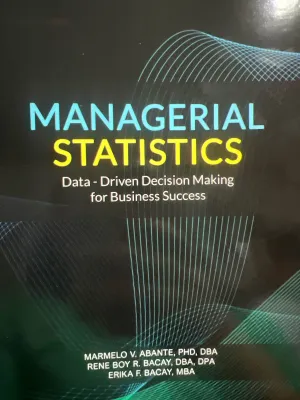
Prices are valid at publication and may change. Please refer to the product page for the latest price.
Another critical factor is the balance between theoretical formulas and practical software applications. Traditional academic courses often require manual calculations to ensure students understand the underlying mechanics of statistical tests. In contrast, modern corporate environments rely almost exclusively on software. Look for books that integrate step-by-step tutorials for tools like Microsoft Excel, which remains the industry standard in Philippine corporate finance. A book that teaches you how to run a regression analysis in Excel and interpret the output is often far more valuable in the workplace than one that focuses solely on manual calculations.
Finally, evaluate the relevance of the case studies and business examples. The most effective books use realistic scenarios from corporate finance, marketing, and operations to illustrate statistical concepts. While many international textbooks feature global corporations, the core principles remain highly applicable to the Philippine market. Look for books that present diverse case studies, such as inventory management for retail chains, risk assessment for commercial loans, or quality control in manufacturing, as these closely mirror the challenges you will face in local industries.
Core Topics Every Beginner-Friendly Book Should Cover
A high-quality introductory book must cover several foundational areas to prepare you for the demands of business and finance. First, it should provide a thorough introduction to descriptive statistics and data visualization. You must learn how to summarize large financial datasets using measures of central tendency (mean, median, and mode) and dispersion (variance and standard deviation). Additionally, the book should teach you how to present this data clearly using charts, histograms, and box plots, which are essential for creating professional business reports.

Second, the book must cover probability distributions and sampling methods. Understanding the normal distribution, binomial distribution, and the Central Limit Theorem is crucial for risk assessment and financial modeling. These concepts allow you to calculate the likelihood of specific financial outcomes, such as portfolio returns falling below a certain threshold or project costs exceeding a budget.
Third, look for comprehensive coverage of hypothesis testing and confidence intervals. These statistical tools enable data-driven decision-making by allowing you to test business assumptions. For example, you might need to determine if a new financial product has significantly increased customer acquisition compared to an older product, or if a change in interest rates has a statistically significant impact on loan defaults.
Lastly, simple and multiple regression analysis is a non-negotiable topic for finance professionals. Regression analysis is the primary tool used for forecasting and identifying relationships between variables. A beginner-friendly book should explain how to build regression models, evaluate their strength using the coefficient of determination (R-squared), and use these models to predict future financial trends based on historical data.
Categories of Managerial Statistics Books to Consider
Managerial statistics books generally fall into two distinct categories: comprehensive academic textbooks and practical professional guides. Understanding the differences between these formats will help you select the resource that best aligns with your current learning environment and professional needs.
Comprehensive Academic Textbooks
Comprehensive academic textbooks are the standard choice for university courses and formal academic programs. These books are characterized by their rigorous, structured approach, offering detailed explanations of statistical theories, step-by-step formula derivations, and an abundance of end-of-chapter exercises. They are designed to build a deep, conceptual understanding of statistics from the ground up.
These textbooks are highly suitable for students preparing for university exams, local board examinations, or graduate school entrance tests. The extensive practice problems help reinforce theoretical concepts and build the computational stamina required for academic success. However, readers should note that new editions of these textbooks often come bundled with access codes for proprietary online homework platforms. If you are self-studying, these online platforms may not be accessible without a course instructor, making the extra cost of a brand-new book less practical.
Practical Guides for Working Professionals
For young professionals already in the workforce, practical guides offer a more direct path to applying statistics in daily business tasks. These books shift the focus away from manual calculations and formula derivations, prioritizing data interpretation, Excel-based analysis, and real-world financial modeling instead.
These guides are structured around common business problems rather than sequential mathematical theories. They teach you how to leverage built-in software functions to analyze data quickly, build dynamic dashboards, and interpret complex reports for senior management. If your primary goal is to improve your efficiency at work, create more persuasive financial presentations, or transition into a data-driven finance role, a practical, software-focused guide is an excellent investment.
Where to Buy and How to Verify Book Editions
Sourcing the right book in the Philippines requires careful verification to ensure you receive the correct edition and format. Always verify the 13-digit International Standard Book Number (ISBN) before making a purchase. Publishers frequently release new editions that update software instructions, refresh case studies, or correct errors. Purchasing an outdated edition might mean missing out on modern Excel functions or encountering mismatched page numbers if you are following a specific course syllabus.
When shopping locally, compare international editions with local university press reprints or international student editions. Major academic publishers often release authorized, low-cost reprints specifically for developing markets like the Philippines. These editions are typically printed on lighter paper with softcovers, making them significantly more affordable—often ranging from ₱1,000 to ₱3,000—while retaining the exact same text and exercises as the expensive imported hardcovers, which can exceed ₱8,000.
Additionally, pay close attention to digital formats and bundled materials. If you prefer e-books or purchase through online marketplaces, verify whether the listing includes the necessary digital access codes or companion files. Many practical statistics books rely on downloadable Excel templates or datasets to complete the exercises. Ensure the seller is authorized and that these digital assets are included, as learning applied statistics is far more difficult without the hands-on data files.
Frequently Asked Questions (FAQ)
Do I need a strong calculus background to understand managerial statistics?
No, a strong background in calculus is generally not required for introductory managerial statistics. Most business-focused statistics books utilize an algebra-based approach, focusing on the practical application of formulas rather than complex mathematical proofs. To confirm the requirements, check the book’s preface or table of contents; if it does not list calculus as a prerequisite, the text will rely on basic algebra and arithmetic, which are easily manageable for most business students and finance professionals.
Should I choose a book that focuses on Excel or specialized software like SPSS?
For most entry-level finance and general business roles in the Philippines, Microsoft Excel is the industry standard. Choosing a book that focuses on Excel will provide immediate, practical value in your daily work. Specialized software like SPSS, R, or Python is highly valuable, but these tools are typically reserved for advanced data science tracks, market research roles, or specific graduate-level academic programs. Start with Excel to build a strong foundation before moving on to specialized programming languages.
Community discussion
Share your experience or ask a question. Comments are reviewed before publication.