
Selecting the right guitar stand is one of the most critical decisions you can make to preserve the longevity, finish, and structural integrity of your instrument. A stand is not merely a resting place; it is a protective system that must support your guitar’s specific weight, balance point, and material composition. Using an incompatible stand can lead to catastrophic falls, warped necks, or chemical reactions that permanently ruin your guitar’s finish.
To make an informed choice, you must evaluate how different stand geometries interact with acoustic, electric, and classical guitar bodies. You also need to consider the chemical compatibility of the stand’s padding with your guitar’s lacquer, and assess how your local environment affects stability. By matching these physical and chemical requirements to your specific instrument, you can ensure your guitar remains secure and ready to play.
Understanding Stand Designs and Support Mechanisms
Guitar stands come in several distinct structural configurations, each offering a different balance of portability, footprint size, and physical security. Understanding these designs allows you to choose a support system that fits both your instrument and your physical space.
Products mentioned in this guide
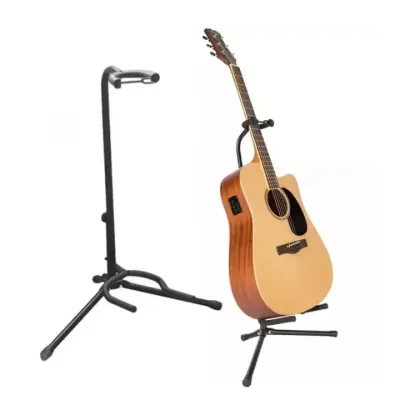
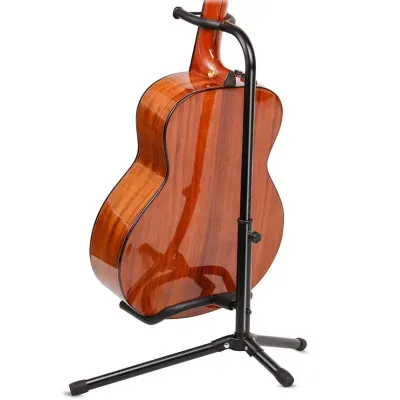

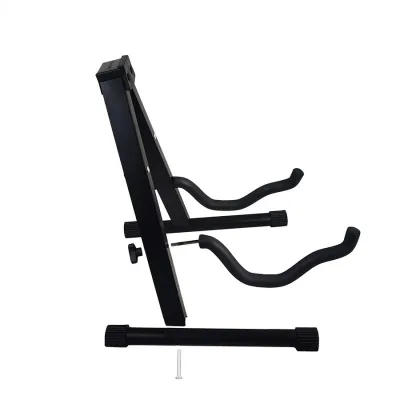
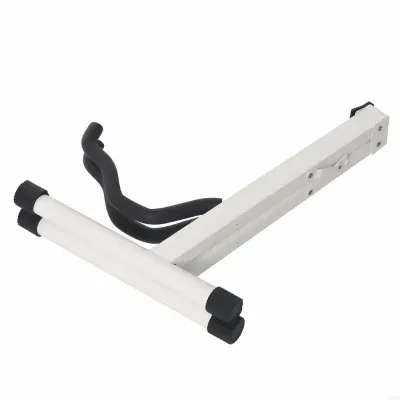
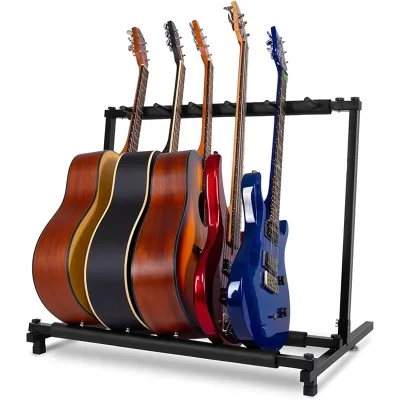
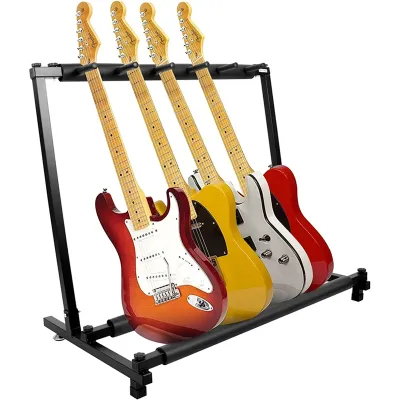
Prices are valid at publication and may change. Please refer to the product page for the latest price.
A-frame stands are characterized by their low profile and triangular shape. They are highly compact, often folding completely flat, making them excellent options for musicians who travel frequently or have limited floor space. Because they lack a neck support column, they rely entirely on a low center of gravity and a deep base cradle to keep the guitar upright. While highly convenient, A-frame stands offer less protection against forward tips if the instrument is accidentally bumped from behind.
Tubular tripod stands feature a vertical post supported by three folding legs, culminating in a neck cradle or yoke at the top. This design provides a much larger footprint, which translates to superior physical stability on various floor surfaces. The neck yoke typically includes a security strap, a rotating gate, or a manual latch to prevent the guitar from falling forward. This three-point contact system—two points at the base and one at the neck—makes tripod stands highly resilient against accidental bumps.
Single-post hanging stands support the guitar from the headstock rather than the base. The instrument hangs vertically, allowing gravity to pull it into a perfectly balanced position. Many hanging stands feature gravity-activated gates that automatically lock around the neck when the weight of the guitar is applied. This design is exceptionally secure because it eliminates the risk of the guitar slipping sideways off a lower cradle, and it accommodates a wide variety of body shapes.
Multi-stand configurations, such as multi-guitar racks or tree stands, are designed to organize multiple instruments within a minimized footprint. Racks hold guitars side-by-side in a row, utilizing padded dividers to keep the bodies separated. Tree stands feature a central vertical pole with multiple hanging or cradled yokes radiating outward. These configurations are ideal for dedicated music rooms or studio spaces where maximizing floor efficiency is a priority.
Matching the Stand Geometry to Your Guitar Type
Different types of guitars possess vastly different physical dimensions, weight distributions, and structural balance points. A stand that securely cradles a thin electric guitar may prove unstable or physically incompatible with a deep-bodied acoustic or a wide-necked classical guitar.

Acoustic guitars feature deep, hollow bodies that require a lower yoke with sufficient clearance. If the base cradle of a stand is too narrow, a deep-bodied acoustic guitar will sit precariously on the outer edges of the support arms rather than resting securely in the center. This elevated position raises the instrument’s center of gravity, making it prone to tipping. When choosing a stand for an acoustic guitar, verify that the lower yoke depth matches or exceeds the depth of your guitar’s lower bout.
Electric guitars are generally much thinner than acoustic guitars but are significantly heavier and often feature asymmetrical body shapes. Offset body designs, such as those found on certain modern or vintage electric models, do not sit evenly on symmetrical lower cradles. To prevent the guitar from sliding or leaning at an extreme angle, look for stands with self-swiveling or independently adjustable lower yokes. Additionally, because electric guitars have a higher density and heavier headstocks, the stand must have a robust, weighted base to prevent top-heavy tipping.
Classical guitars present unique structural requirements due to their wide, flat fingerboards and delicate neck joints. Standard neck yokes designed for electric or acoustic guitars are often too narrow to accommodate the wider nut width of a classical guitar, which typically ranges from 50mm to 52mm. Forcing a wide classical neck into a narrow yoke can scratch the wood or apply uneven lateral pressure to the headstock joint. Ensure the upper cradle of your chosen stand is wide enough to allow a classical guitar neck to rest freely without binding or pinching.
Protecting Your Guitar's Finish and Neck Integrity
Beyond physical stability, a guitar stand must be chemically compatible with your instrument’s finish. Physical scratches, finish melting, and neck warping are often the direct results of using improper padding materials or leaving an instrument improperly supported over long periods.
Nitrocellulose lacquer is a traditional finish used on many high-end, vintage, and custom-shop guitars. While highly prized for its acoustic properties and aesthetic appeal, nitrocellulose is an extremely volatile and chemically reactive substance. Many budget-friendly guitar stands use padding made from synthetic rubbers, neoprene, or plastics containing plasticizers. When these materials come into direct contact with nitrocellulose, a chemical reaction occurs, causing the lacquer to soften, discolor, or literally melt away. If your guitar has a nitrocellulose finish, you must verify that the stand is explicitly certified as safe for nitro finishes, or opt for stands that use inert materials like natural felt, velvet, or specially formulated silicone.
Polyurethane and polyester finishes, which are common on most modern and mass-produced guitars, are significantly more durable and chemically resistant than nitrocellulose. However, they are still susceptible to physical scratching and localized discoloration if left on low-quality padding for extended periods. Over time, cheap foam or rubber padding can degrade, harden, or become sticky, especially when exposed to warmth and humidity. Regularly inspect the padding on your stands for any signs of cracking, flaking, or stickiness, and replace the stand or the padding immediately if degradation is detected.
Neck stress is another critical factor to monitor. While guitars are built to withstand significant string tension, constant localized pressure on the neck from an improperly aligned yoke can cause finish wear or, in extreme cases, contribute to neck bowing. If you notice any indentations, discoloration, or sticky residue at the contact points on your guitar’s neck or lower bout, discontinue using that specific stand immediately. For temporary protection, you can wrap the contact points of a suspect stand with clean, undyed cotton cloth to act as a physical barrier between the padding and the guitar’s finish.
Evaluating Stability and Environmental Factors
An excellent guitar stand must perform reliably within its physical environment. Factors such as floor surfaces, foot traffic, transport requirements, and local climate conditions all play a role in determining the safety of your instrument.
The surface on which your stand rests greatly influences its stability. In tropical environments, residential and studio spaces often feature tiled, polished concrete, or smooth wooden floors. On these slick surfaces, a stand must have high-quality, non-slip rubber footpads to prevent it from sliding when bumped. Conversely, if you are placing a stand on thick carpeting, a wider tripod base is essential to prevent the legs from sinking unevenly and causing the stand to lean.
For musicians who travel, perform live, or move their gear frequently, portability and mechanical durability are paramount. Folding mechanisms must operate smoothly without excessive play in the joints. Look for stands with heavy-duty locking pins, robust metal hinges, and tight tolerances. A stand with loose joints or flimsy plastic locking collars can easily collapse under the weight of a heavy instrument or during a hectic stage setup.
Environmental factors like humidity and temperature also interact with both your stand and your guitar. In highly humid tropical climates, metal stands are susceptible to rust and corrosion, particularly at the adjustment joints and weld points. High humidity can also accelerate the breakdown of synthetic foam padding, making it sticky and hazardous to your guitar’s finish. Furthermore, direct sunlight streaming through a window can heat up a stand’s rubber padding, accelerating chemical reactions with the guitar’s lacquer. Always position your guitar stands in shaded, well-ventilated areas away from direct sunlight and air conditioning vents.
Building Your Shortlist: Specifications to Verify Before Buying
Before finalizing your purchase, compile a shortlist of potential stands and systematically verify their technical specifications against your guitar’s physical measurements.
First, check the maximum weight capacity of the stand. While most standard stands can easily support a typical acoustic or electric guitar, heavier instruments like double-neck electrics, heavy bass guitars, or solid-body electrics require heavy-duty stands with reinforced steel tubing. Next, measure your guitar’s lower bout width, body depth, and neck width, and compare these dimensions to the stand’s adjustable width and height ranges. The stand should allow your guitar to sit at a natural angle without the bottom of the body touching the floor or the headstock hitting the upper support column.
Second, carefully review the manufacturer’s documentation regarding finish compatibility. Look for explicit statements regarding nitrocellulose safety if your instrument requires it. Be aware that many manufacturers include warranty disclaimers stating they are not responsible for finish damage, even on stands marketed as safe. Reading user experiences and checking the manufacturer’s specific care instructions will help you identify any potential red flags before you place your instrument on the stand.
Finally, perform a thorough physical inspection immediately upon unboxing your new stand. Check all weld points for cracks or uneven finishes, and ensure that all adjustment screws and locking collars tighten securely without slipping. Feel the padding to ensure it is smooth, non-sticky, and securely adhered to the metal frame. Testing the stand’s stability with a secondary, less valuable instrument first can give you peace of mind before trusting it with your primary guitar.
Frequently Asked Questions (FAQ)
Is it safe to leave a guitar on a stand long-term?
Leaving a guitar on a stand long-term is generally safe only if the environment is strictly controlled and the stand is located in a secure, low-traffic area. In tropical climates, the primary hazard of long-term stand storage is exposure to fluctuating humidity and temperature, which can cause wood to warp, glue joints to weaken, and metal hardware to tarnish. If your room is not climate-controlled with a stable relative humidity, storing your guitar in a high-quality hard case with a dedicated humidifier or dehumidifier packet is much safer.
Additionally, stands left in high-traffic areas of the home are vulnerable to accidental bumps from pets, children, or vacuum cleaners. If you prefer to keep your guitar on a stand for quick access, place the stand in a dedicated, low-traffic music room or corner, and ensure the room’s humidity levels remain stable.
Can I use the same stand for both acoustic and electric guitars?
Yes, you can use the same stand for both acoustic and electric guitars, provided the stand features highly adjustable support mechanisms. Because acoustic guitars are much deeper than electrics, the lower yoke must be deep enough to accommodate the acoustic body without pinching, while still being able to support the thinner electric guitar without letting it slide forward.
If you plan to swap instruments frequently, a hanging stand with a gravity-activated neck gate is often the most versatile option. These stands support the guitar by the headstock, meaning the body depth of the instrument does not affect the stand’s stability. However, you must still ensure that the neck width of your classical or wide-necked acoustic guitars fits comfortably within the hanging yoke.
How do I clean and maintain the padding on my stand?
To clean the padding on your guitar stand, use a soft, slightly damp microfiber cloth to wipe away dust, sweat, and oils transferred from your hands or the guitar. Avoid using harsh chemical solvents, alcohol, or petroleum-based cleaners, as these substances will rapidly break down synthetic rubber and foam padding, making it sticky, brittle, or chemically reactive.
Inspect the padding every few months for signs of wear, hardening, or discoloration. If the padding feels sticky to the touch or begins to crumble, it must be replaced immediately. You can purchase replacement foam sleeves from instrument accessory manufacturers, or temporarily wrap the contact points with clean, undyed cotton cloth to protect your guitar’s finish until a permanent replacement is installed.
Community discussion
Share your experience or ask a question. Comments are reviewed before publication.