
The nut and saddle are two small but critical contact points on a guitar or ukulele that anchor the strings and transfer their vibrational energy directly to the instrument’s body. Upgrading these components to natural bone is one of the most effective ways to enhance tone, sustain, and overall playability. While many entry-level instruments come with soft plastic parts that can dampen sound and wear down quickly, bone offers a dense, rigid alternative that helps your strings ring out with greater clarity and consistent action.
What Are the Nut and Saddle on a Stringed Instrument?
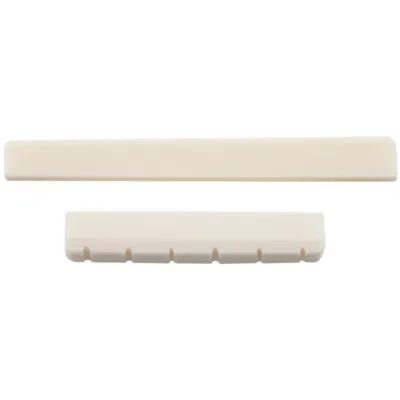
To understand how these tiny components affect your music, it helps to look at where they sit on your guitar or ukulele. The nut is the slotted strip of material located at the junction where the fretboard meets the headstock. It guides the strings from the tuning pegs down the neck, keeping them properly spaced and elevated at a precise height above the frets.
At the opposite end of the instrument sits the saddle, which is nestled inside the bridge slot on the body. While the nut controls the string height and spacing at the headstock, the saddle determines the action height and intonation near the body. Together, these two components act as the boundary walls for the vibrating portion of the strings, establishing the scale length of your instrument.
Products mentioned in this guide
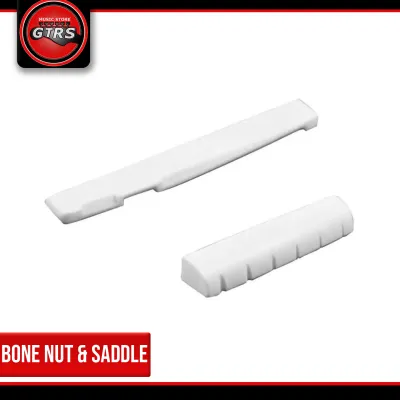
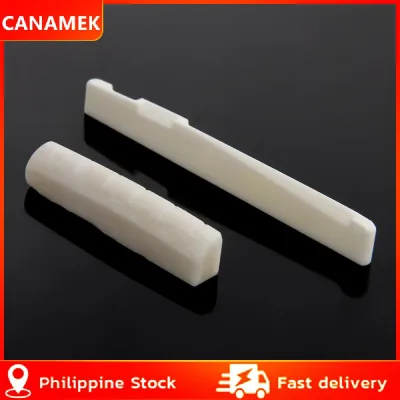
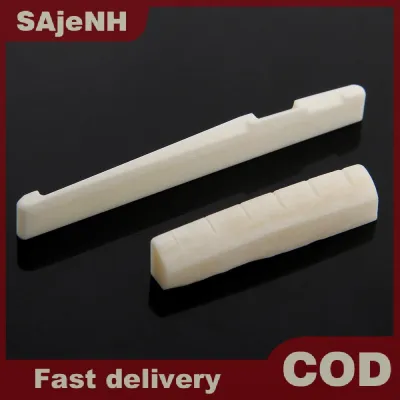
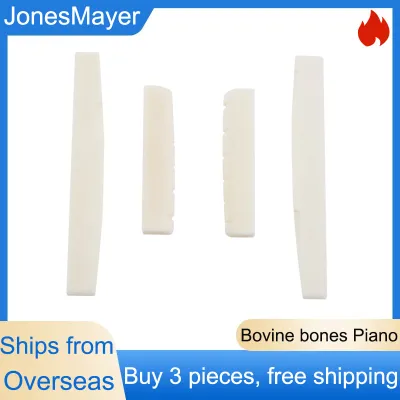
![[ammoon]Guitar Saddle and Nut Real Bone Material 2PCS for 6 Strings Acoustic Guitar](https://img.lazcdn.com/g/p/3d3ecec49a925b79d9f99a7448e19224.jpg_400x400q80.jpg_.webp)
![[LIXIAOJU] White Guitar Parts 6 String Classical Guitar Bone Bridge Saddle And Nut Set](https://img.lazcdn.com/g/p/dc1d49c4d86d15412bc51c059a3c3d99.jpg_400x400q80.jpg_.webp)
Prices are valid at publication and may change. Please refer to the product page for the latest price.
Every time you pluck or strum a string, the resulting vibration travels through these two contact points. The nut and saddle must be hard enough to support this high-tension energy without absorbing or muffling it. If either component is poorly aligned, incorrectly slotted, or made of soft material, your instrument may suffer from buzzing, uneven string spacing, or a noticeable loss of volume.
Why Bone is a Preferred Material for Nuts and Saddles
Instrument makers and repair technicians have favored natural bone for centuries due to its unique physical properties. Bone is highly dense and rigid, which allows it to withstand the constant downward pressure of steel or nylon strings without compressing. This structural integrity means that when a string vibrates, the energy is transferred directly to the neck and soundboard rather than being lost to a soft, yielding material.

In contrast, many mass-produced guitars and ukuleles feature nuts and saddles made of cheap, injection-molded plastic. Plastic is relatively soft and flexible, which can act like a tiny shock absorber under the strings, dampening the high frequencies and reducing the overall resonance of the instrument. Over time, the high tension of the strings can even cut deep, uneven grooves into plastic slots, leading to tuning issues and string binding.
While high-end synthetic composites exist that mimic some properties of bone, natural bone remains a benchmark for traditional luthiers. Because bone is a natural material, its density can vary slightly from piece to piece, but high-quality, well-selected bone offers a consistent hardness that synthetic plastics simply cannot match. This hardness ensures that the string slots remain clean and smooth, preventing the strings from getting caught when you tune your instrument.
How Upgrading to Bone Affects Tone, Sustain, and Playability
Upgrading to a bone nut and saddle can noticeably transform the acoustic character of your guitar or ukulele. Many players report an immediate increase in brightness, clarity, and note definition, especially when playing complex chords where individual notes might otherwise sound muddy. The natural hardness of the bone helps preserve the high-frequency overtones of the strings, giving your instrument a more articulate and crisp voice.
Sustain and volume also tend to improve after a bone upgrade. Because bone transfers vibrational energy more efficiently than soft plastic, the soundboard of your guitar or ukulele receives a stronger, more direct signal. This allows the notes to ring out longer after you pluck them and can make your instrument feel more responsive to dynamic changes in your playing style.
Beyond the purely acoustic benefits, a bone upgrade can significantly enhance playability. When a professional technician installs a new bone nut, they custom-cut each string slot to match your preferred string gauge and playing style. This precise slotting lowers the action at the first fret, making chords easier to press down and reducing hand fatigue during long practice sessions in warm, humid tropical climates where wood can shift.
How to Decide if Your Guitar or Ukulele Needs a Bone Upgrade
Deciding whether to invest in a bone nut and saddle depends largely on the current state of your instrument and your musical goals. If you notice that your guitar or ukulele frequently goes out of tune, makes a clicking sound when tuning, or has a dull, lifeless tone even with fresh strings, your factory plastic components may be the culprit. Inspect the string slots; if they look worn, uneven, or deeply grooved, an upgrade is highly recommended.
You should also evaluate the overall quality of your instrument to determine if the upgrade makes financial sense. For an entry-level instrument, a bone upgrade can provide a noticeable boost in playability and tone, making it much more enjoyable to practice on. However, if the instrument has severe structural issues, such as a warped neck or a lifting bridge, those problems must be addressed first, as a new nut and saddle cannot fix fundamental structural damage.
In the Philippines, a professional nut and saddle replacement typically involves both the cost of the bone blanks and the labor fees of a skilled luthier. While you can find cheap pre-slotted bone parts on online marketplaces, these rarely fit perfectly without custom sanding and filing. Budgeting for a professional setup alongside the upgrade ensures that your action and intonation are perfectly calibrated, making the investment well worth the improved playing experience.
What to Expect During a Professional Nut and Saddle Replacement
A proper nut and saddle replacement is a highly precise craft that requires specialized tools and experience. A professional luthier will start by carefully removing the old components without damaging the surrounding wood or finish. They will then shape a raw bone blank using files and sandpaper to match the exact dimensions of your instrument’s nut slot and bridge cavity.
Many players make the mistake of buying “drop-in” bone replacements online, expecting them to fit perfectly out of the box. In reality, every guitar and ukulele neck has a slightly different fretboard radius, neck width, and bridge depth. A drop-in part will almost always require careful sanding of the bottom and sides to sit flush, as well as precise filing of the string slots to prevent buzzing or high action.
Filing the string slots is perhaps the most delicate part of the process, requiring specialized nut files that match the exact gauge of your strings. If a slot is cut too deep, the string will buzz against the first fret; if it is too shallow, the action will be uncomfortably high. If you do not have the proper tools or experience, attempting a DIY replacement can easily ruin the bone blank or damage your instrument’s neck, making it best to trust a qualified local technician.
Frequently Asked Questions (FAQ)
Does a bone nut and saddle make a cheap guitar sound expensive?
While upgrading to a bone nut and saddle will improve the clarity, sustain, and playability of a budget guitar, it cannot completely transform a cheap instrument into a high-end masterpiece. The overall sound of an acoustic instrument is heavily dependent on its construction, bracing, and the quality of its tonewoods. A bone upgrade will help you get the absolute best possible sound out of your current instrument, but it cannot compensate for poor craftsmanship or low-grade laminate woods.
How can I tell if my current nut and saddle are made of bone or plastic?
You can often identify the material through a few simple visual and physical checks. Plastic components are usually perfectly uniform in color, often showing tiny mold lines or seams from the manufacturing process, and they feel relatively light and warm to the touch. Natural bone typically has subtle color variations, tiny organic pores visible under a magnifying glass, and feels noticeably colder and heavier.
Another common method is the heated pin test, though it must be done with extreme caution to avoid damaging the instrument. If you touch a hot needle to an inconspicuous spot on the underside of the removed component, plastic will melt easily and give off a chemical, synthetic smell. Bone will not melt and will instead produce a distinct smell similar to burning hair. If you are unsure, it is always safest to have a local luthier inspect the parts for you.
Community discussion
Share your experience or ask a question. Comments are reviewed before publication.