
Selecting the right managerial statistics book is one of the most critical decisions a business student in the Philippines can make. Whether you are pursuing a degree in Business Administration, Management, Marketing, or Finance, quantitative analysis forms the backbone of modern corporate decision-making. The challenge is that statistics can often feel like an abstract branch of pure mathematics rather than a practical tool for solving real-world business problems. A well-chosen textbook acts as a bridge, translating complex formulas into actionable insights that can guide a company’s strategy.
How to Evaluate a Managerial Statistics Textbook
Readability is the first and most crucial factor to consider when evaluating a textbook. For many business students, mathematics is not their primary passion, and a book that immediately plunges into dense, formal proofs can quickly lead to frustration. Look for an introductory approach that prioritizes conceptual clarity. The writing style should be conversational yet professional, explaining the practical purpose of a statistical method before detailing how to calculate it.
A balanced pedagogical approach is essential for non-math majors. The ideal book should focus on the interpretation of statistical outputs rather than the mechanical process of manual calculation. In a modern corporate environment, managers rarely calculate standard deviations or perform hypothesis testing by hand because they rely on software to generate these figures. Therefore, the textbook must teach you how to read, analyze, and question these results to make sound business decisions.
Products mentioned in this guide
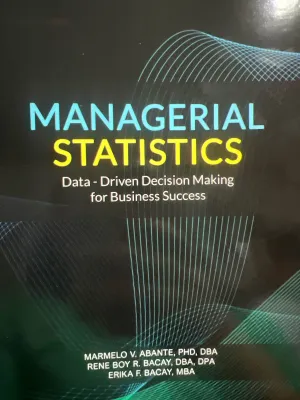
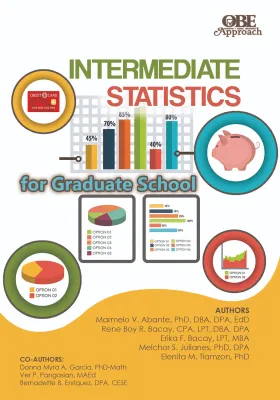
Prices are valid at publication and may change. Please refer to the product page for the latest price.
Alignment with local university curricula is another vital consideration. Business schools across the Philippines—from major universities in Metro Manila to regional institutions—typically follow structured syllabi aligned with local educational standards. These programs emphasize practical application in marketing research, financial analysis, and operations management. Ensuring your book covers these core areas prevents you from studying irrelevant mathematical theories while missing critical business applications.
Always check the book’s explicitly stated target audience. Publishers usually print this information on the back cover or in the preface. Look for phrases like “for business and economics,” “for managers,” or “applied statistics.” Books designed for engineering, computer science, or pure mathematics majors will focus heavily on calculus-based proofs and theoretical probability, which are unnecessary and overly complicated for a standard business administration curriculum.
Key Features to Look for in Business Statistics Books
To truly master quantitative methods, look for books that feature rich, real-world business case studies. These cases should not be simple, single-sentence word problems. Instead, they should present complex, multi-faceted business scenarios, such as assessing the success of a marketing campaign, optimizing a supply chain, or forecasting quarterly sales. When a book demonstrates how a specific statistical tool directly impacts a company’s bottom line, the abstract formulas suddenly make practical sense.

Step-by-step solved examples are the cornerstone of effective self-study. A high-quality textbook will walk you through a problem from start to finish, explaining each transition and calculation. This structured breakdown helps you identify where you might have made an error in your own calculations. It also builds confidence, allowing you to tackle more complex, unstructured problems independently.
Visual data representation is an increasingly critical skill for modern managers. Look for textbooks that emphasize the creation and interpretation of charts, graphs, and dashboards. A good book will teach you not just how to generate a histogram or a scatter plot, but how to design these visuals to communicate findings clearly to stakeholders. Since managers must present data to non-technical executives, learning the art of data visualization is just as important as understanding the underlying math.
End-of-chapter exercises should offer a progressive learning curve. The ideal book starts with basic conceptual checks to ensure you understand the terminology, moves on to direct computational problems to practice the formulas, and finishes with comprehensive, multi-step business scenarios. These advanced scenarios force you to decide which statistical test to apply, mimicking the real-world challenges you will face in your professional career.
Aligning Your Choice with University Syllabi and Software
Before purchasing any textbook, your first step must always be to review your official course syllabus and consult your professor. Every instructor has a unique teaching style and specific learning objectives. Some professors follow a textbook chapter-by-chapter, while others use a curated selection of readings from multiple sources. Confirming the exact title, author, and edition required for your specific class prevents costly purchasing mistakes.
Modern business statistics is inseparable from software. You must verify which digital tools your course uses and ensure your textbook supports them. Microsoft Excel is the most common tool taught in Philippine business schools, often utilizing the built-in Data Analysis Toolpak. However, some advanced courses may require specialized software like SPSS, R, or Python. A textbook that includes step-by-step software tutorials, screenshots, and dedicated data files for your specific software will save you hours of confusion.
Be aware of the differences between international, global, and regional editions. Global editions are often adapted for markets outside the United States, which can result in altered chapter sequencing, different end-of-chapter problem sets, or localized case studies. While the mathematical formulas remain identical, a difference in chapter numbering or problem sets can make it difficult to follow your syllabus or complete assigned homework. Always verify content completeness and chapter alignment before buying.
Access to digital resources is another critical factor. Many modern textbooks are bundled with online learning platforms, downloadable datasets, and interactive practice files. Instructors often use these platforms for graded homework, quizzes, and exams. If your course requires an online access code, buying a used book or an unauthorized copy might leave you unable to complete your coursework, forcing you to purchase the digital access separately at a higher cost.
Navigating Editions, Formats, and Availability in the Philippines
When sourcing your textbook in the Philippines, you will encounter various editions, including global editions, Asian editions, and local Philippine adaptations. Core statistical theories are universal, but local or Asian editions are specifically tailored to be more accessible. These editions often feature regional business examples—such as retail trends in Southeast Asia or manufacturing logistics in local economic zones—and are typically priced more affordably in Philippine Pesos (₱) to match the local student budget.
Choosing between a digital e-book and a physical print book involves several practical trade-offs. Print books are highly favored for quantitative subjects because they allow you to easily flip back and forth between a problem, a formula sheet, and the statistical tables in the appendix. You can also physically write notes and highlight key steps directly on the page. However, physical books are heavy to carry around campus and can be susceptible to damage from tropical humidity and unexpected rain.
E-books offer unmatched portability and convenience. You can store your entire semester’s reading list on a single tablet or laptop, and the search function allows you to find specific terms or formulas instantly. If you opt for a digital format, verify your device’s compatibility with the publisher’s e-reader platform. Ensure that the digital layout renders complex mathematical symbols, fractions, and high-resolution charts clearly, as poorly formatted e-books can make formulas illegible.
To ensure you receive a complete, authorized, and legal copy of your textbook, always purchase from reputable sources. These include official university bookstores, authorized local distributors, and established online marketplaces that feature verified bookstore storefronts. Buying from authorized channels guarantees that your book contains all necessary chapters, high-resolution visual aids, complete appendices, and valid digital access codes for online learning platforms.
Avoid the temptation of downloading unauthorized, pirated, or incomplete PDF copies from unreliable online sources. Aside from the ethical and legal issues, these pirated files are frequently missing crucial sections, such as the statistical tables required for exams, detailed appendices, or high-resolution charts. Furthermore, they do not include the mandatory access codes for online homework systems, meaning you may end up spending more money in the long run to purchase the digital access separately.
Frequently Asked Questions (FAQ)
Do I need a local Philippine edition for my business statistics class?
No, a local edition is not strictly mandatory because fundamental statistical theories, formulas, and methodologies are universal across the globe. An international or global edition will fully cover the academic requirements of your course. However, a local or Asian edition offers significant practical advantages. These editions often feature regional business case studies and local economic data that make the concepts easier to relate to, and they are generally sold at a much more accessible price point in Philippine Pesos (₱) to accommodate student budgets. Always check with your professor to ensure that the specific edition you choose aligns with the assigned homework problems and reading schedule.
Can I use an older edition of a recommended managerial statistics textbook?
In many cases, yes. Fundamental statistical concepts—such as probability distributions, hypothesis testing, and linear regression—do not change from year to year. If your professor does not require an integrated online homework platform, an older edition can be an incredibly cost-effective and academically sound alternative. However, you must exercise caution. Older editions may contain outdated software instructions, different datasets, and completely different end-of-chapter homework questions. If your instructor assigns specific problem numbers from the latest edition, using an older version might cause you to submit the wrong homework.
Is it better to buy a print book or an e-book for statistics?
The choice depends on your study habits and lifestyle. Print books are highly recommended for quantitative subjects like statistics because they allow you to quickly flip between the text, formulas, and statistical tables in the appendix, while making physical annotations in the margins. On the other hand, e-books offer excellent portability, instant search functionality, and often a lower upfront cost. If you choose an e-book, make sure to check the digital rights management (DRM) restrictions and device compatibility. Ensure that the digital format displays complex mathematical equations, fractions, and detailed charts clearly on your screen without distortion.
Community discussion
Share your experience or ask a question. Comments are reviewed before publication.