
To master accounting for business combination in the Philippines, the most effective introductory books are those that successfully bridge global accounting principles with the localized application of Philippine Financial Reporting Standards (PFRS). Beginners should look for comprehensive local textbooks authored by experienced Philippine CPAs, structured review books designed for the CPA licensure exam, or international classics paired with local regulatory supplements. The ideal choice depends on your current accounting proficiency, your specific learning goals, and your need to understand local tax and SEC compliance.
Navigating this specialized field of advanced financial accounting requires a clear roadmap. Because business combinations involve complex corporate transactions—such as mergers, acquisitions, and consolidations—relying on a single generic textbook is rarely sufficient. Instead, a strategic combination of conceptual guides, local regulatory updates, and practical problem-solving manuals will provide the comprehensive foundation needed to excel in both academic exams and professional practice.
Understanding Core Requirements for the Philippine Context
When studying the accounting for business combination in the Philippines, it is crucial to understand that local corporate transactions are governed by Philippine Financial Reporting Standards (PFRS). Specifically, PFRS 3 (Business Combinations) is the local counterpart of the international standard, IFRS 3. While these standards are highly converged, local regulatory interpretations, disclosure requirements set by the Securities and Exchange Commission (SEC), and tax guidelines issued by the Bureau of Internal Revenue (BIR) introduce unique local nuances that international textbooks do not cover.
Products mentioned in this guide
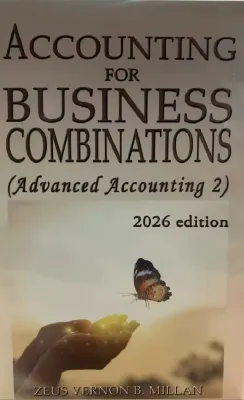
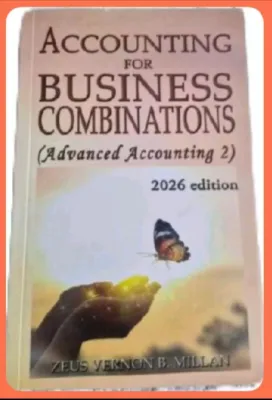
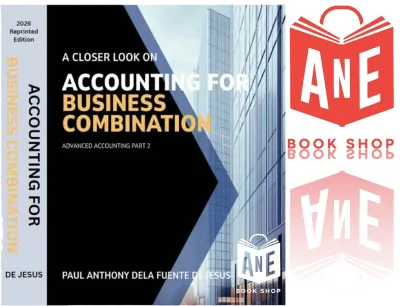
Prices are valid at publication and may change. Please refer to the product page for the latest price.
A foundational textbook must guide beginners through the core mechanics of the acquisition method, which is the mandatory framework for recording business combinations. This includes identifying the acquirer, determining the acquisition date, and recognizing and measuring the identifiable assets acquired, the liabilities assumed, and any non-controlling interest (NCI) in the acquiree. Beginners must also learn how to calculate and record goodwill or a gain from a bargain purchase, which requires a precise understanding of valuation principles.
Furthermore, local business scenarios in the Philippines often involve complex corporate structures, family-owned conglomerates, and specific tax-free exchange rules under the National Internal Revenue Code (NIRC). An introductory book that incorporates these local realities helps readers transition from abstract theory to practical application. Understanding how local conglomerates structure their acquisitions and present their consolidated financial statements is essential for anyone aiming to work in local audit, corporate finance, or financial analysis.
Key Criteria for Evaluating Introductory Accounting Books
Selecting the right textbook requires evaluating several critical dimensions to ensure the material is both accurate and accessible. First and foremost, verify that the book explicitly states its alignment with the latest PFRS updates. Because accounting standards are subject to periodic amendments, using an outdated text can lead to mastering obsolete methods, particularly regarding goodwill impairment testing, step acquisitions, and the treatment of acquisition-related costs.

The background of the author is another vital indicator of a book’s quality and relevance. Prioritize textbooks written by local Certified Public Accountants (CPAs), prominent accounting professors from top-tier Philippine universities, or seasoned audit partners from major local accounting firms. These authors possess firsthand experience navigating the local regulatory landscape and are adept at explaining how theoretical standards translate into actual filings submitted to the SEC and the Board of Accountancy (BOA).
Pedagogical tools within the book are equally important for self-study and classroom learning. Look for chapters that feature clear, step-by-step computational illustrations, comprehensive summaries, and a robust selection of practice problems. The inclusion of consolidation worksheets with detailed column-by-column explanations is particularly helpful, as visualizing the elimination of intercompany transactions is often the most challenging hurdle for beginners.
Finally, consider the language complexity and overall layout of the book. The text should explain advanced financial concepts in a clear, approachable manner without relying on unnecessary jargon. Visual aids such as flowcharts, comparative tables, and highlighted key terms can significantly reduce cognitive overload, making the transition from intermediate financial accounting to advanced consolidation topics much smoother.
Categories of Books to Explore for Beginners
Since a single book may not meet every learning need, beginners often benefit from exploring different categories of accounting literature. Local university press textbooks are generally the most reliable starting point for understanding PFRS. These books are specifically designed to align with the curriculum prescribed by the Commission on Higher Education (CHED) for accounting programs in the Philippines. They use the Philippine Peso (₱) for all illustrative problems, reference local business laws, and provide a structured, academic approach to building foundational knowledge.
International classic textbooks offer another valuable avenue, particularly for readers seeking deep theoretical explanations and world-class case studies. Renowned global editions provide exceptional conceptual clarity on complex topics like consolidated financial statements and joint arrangements. However, because these books typically use foreign currencies and may reference US GAAP or pure IFRS, they are best utilized as reference materials alongside local study guides to ensure compliance with specific Philippine regulatory practices.
For those focused on practical application and exam preparation, CPA licensure examination review materials—commonly referred to as “reviewers” in the Philippines—are highly effective. These books are tailored specifically for the Advanced Financial Accounting and Reporting (AFAR) board exam. They focus heavily on computational speed, offering concise summaries of key rules, multiple-choice questions, and step-by-step shortcut methods for calculating goodwill, non-controlling interests, and consolidated balances. While they may lack the extensive narrative explanations of traditional textbooks, they are unmatched for reinforcing problem-solving skills.
How to Verify Edition and Standard Compliance Before Buying
Before purchasing any accounting book, performing a quick pre-purchase check can save you from acquiring outdated or non-compliant materials. Start by verifying the publication year and the edition number. In the field of accounting, standards change rapidly; a book published several years ago may not reflect current rules on joint ventures, segment reporting, or the disclosure of interests in other entities. Always aim for the most recent edition available to ensure you are studying current standards.
Next, inspect the table of contents for dedicated chapters on key standards. A comprehensive introductory book on business combinations must include detailed sections on PFRS 3 (Business Combinations), PFRS 10 (Consolidated Financial Statements), and PFRS 12 (Disclosure of Interests in Other Entities). If the table of contents still references obsolete accounting terms or fails to dedicate sufficient space to the consolidation process, it is best to look for an alternative text.
Consider the format and medium that best support your active learning style. Physical textbooks are highly favored by accounting students because they allow for easy side-by-side comparison of consolidation worksheets, ledger accounts, and journal entries. However, digital editions or e-books can also be highly practical, offering search functions, interactive links, and the convenience of studying on multiple devices. Ensure that whichever format you choose supports highlighting, note-taking, and easy navigation.
Lastly, always validate the authorization status of the seller. When shopping on online marketplaces or local bookstores, purchase directly from official university presses, authorized publishers, or reputable distributors. Counterfeit or pirated copies of accounting textbooks are common and often contain critical printing errors, missing pages, illegible numbers in financial tables, or outdated answer keys that can severely disrupt your learning progress.
Building a Practical Study Plan with Your Selected Books
Acquiring the right books is only the first step; mastering the accounting for business combination requires a structured and disciplined study plan. Begin by solidifying your prerequisite knowledge. Before diving into complex consolidation worksheets, spend time reviewing intermediate accounting concepts, particularly the equity method of accounting for long-term investments, basic corporate equity transactions, and the preparation of individual financial statements.
Once your foundation is secure, progress systematically through your selected textbooks. Start with the simplest scenarios, such as a 100% acquisition of a subsidiary on the acquisition date. Master the journal entries required to record the investment and the subsequent elimination entries needed to prepare a consolidated balance sheet. Only after you are comfortable with these basic steps should you advance to more complex topics, such as mid-year acquisitions, non-controlling interests, intercompany inventory transactions, and step acquisitions.
To bridge the gap between academic theory and real-world practice, pair your textbook exercises with actual financial data. Download the publicly available consolidated financial statements of major listed conglomerates in the Philippines from the SEC or company investor relations websites. Try to locate the business combination disclosures in their notes to financial statements, and trace how they calculate goodwill, report non-controlling interests, and present their consolidated balances. This practical exercise will make the concepts in your books come alive and prepare you for professional challenges.
Frequently Asked Questions (FAQ)
Do I need to read basic accounting books before studying business combinations?
Yes, a strong foundation in basic and intermediate financial accounting is absolutely essential. Business combination accounting is an advanced topic that builds directly on your understanding of asset valuation, liability recognition, and equity transactions. Before tackling complex consolidation worksheets, you must be thoroughly comfortable with the equity method of accounting for investments and the preparation of individual financial statements. Attempting to study business combinations without these prerequisites can lead to significant confusion and frustration.
Are international textbooks useful if they do not specifically mention PFRS?
Yes, international textbooks are highly valuable because Philippine Financial Reporting Standards (PFRS) are fully converged with International Financial Reporting Standards (IFRS). Any international textbook that teaches IFRS-compliant business combinations will provide excellent theoretical frameworks and rigorous problem sets that are directly applicable in the Philippines. However, you must remain mindful of local differences, such as specific SEC filing requirements, local tax treatments of corporate mergers, and the unique presentation formats preferred by Philippine regulatory bodies.
Where can I find supplementary materials for local business scenarios?
You can access excellent supplementary materials directly from official local sources. The Philippine Securities and Exchange Commission (SEC) provides public access to the audited consolidated financial statements of listed local corporations, which serve as perfect real-world case studies. Additionally, the Philippine Institute of Certified Public Accountants (PICPA) and major local accounting firms frequently publish free newsletters, technical bulletins, and summary guides detailing the practical application of PFRS 3 in the local market.
Community discussion
Share your experience or ask a question. Comments are reviewed before publication.