
Finding the right tuning pegs for your bass guitar in the Philippines requires balancing physical compatibility, mechanical precision, and environmental durability. Because the local climate features high relative humidity and seasonal temperature shifts, choosing hardware with robust plating and sealed or well-lubricated gears is essential to prevent premature corrosion and tuning slippage. Rather than searching for a single universal “best” model, the ideal upgrade depends entirely on your instrument’s headstock dimensions, your preferred gear ratio, and the physical weight balance of your bass. By verifying technical specifications and sourcing from authorized local channels, you can ensure a seamless installation that enhances both tuning stability and playing comfort.
How to Measure Your Bass Headstock for Compatible Tuners
Before purchasing any new hardware, you must accurately measure your bass headstock to ensure a perfect fit. Installing incompatible tuners can lead to permanent damage, such as cracked wood or misaligned strings. The most critical measurement is the peg hole diameter, which is the actual hole drilled through the headstock wood. To measure this accurately, it is highly recommended to use a digital caliper rather than a standard ruler. Standard modern bass peg holes typically measure around 14mm (9/16 inch) or 17.5mm (11/16 inch), but vintage instruments or specific regional models may feature unique dimensions that require careful verification.
Next, you must differentiate between the two primary types of tuner bushings: press-fit and threaded hex bushings. Press-fit bushings are tapped directly into the front of the headstock and rely on friction to stay in place, which is common on vintage-style open-gear tuners. Threaded hex bushings, on the other hand, screw directly into the tuner collar from the front of the headstock, clamping the wood securely. If your bass currently uses press-fit bushings and you wish to upgrade to threaded hex bushings, you must verify that the outer diameter of the new bushing matches your existing peg holes, as forcing a larger bushing into a small hole can easily split the headstock wood.
Products mentioned in this guide
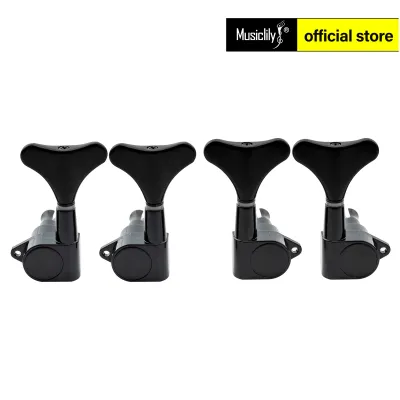
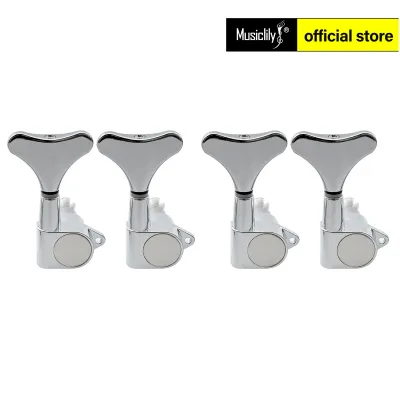
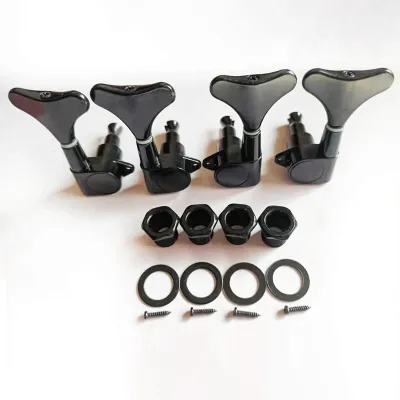
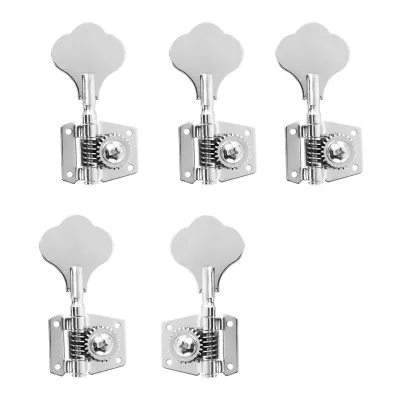
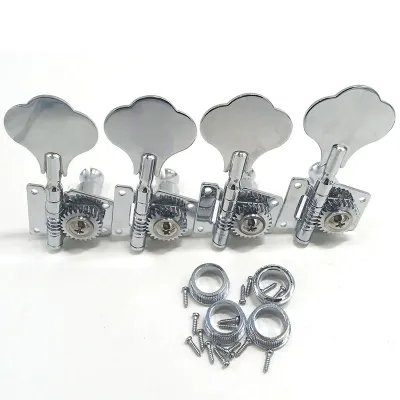

![[ammoon]1PCS Right Bass Tuner Peg Guitar Tuning Pegs](https://img.lazcdn.com/g/p/3bf44b85b8511ec3e424c52e96082248.jpg_400x400q80.jpg_.webp)
Prices are valid at publication and may change. Please refer to the product page for the latest price.
In addition to the peg holes, you must carefully check the mounting screw hole alignment, spacing, and overall orientation. Tuning pegs are secured to the back of the headstock by one or more small wood screws, and these screw holes vary significantly between brands and models. Measure the distance from the center of the main tuner post to the center of the mounting screw hole, and note the angle of the screw tab (such as 45 degrees or 90 degrees). If the new tuners do not align with your existing screw holes, you will need to fill the old holes and drill new pilot holes, which requires extra preparation and tools.
Evaluating Gear Ratios and Mechanisms for Tuning Precision
The mechanical design of a tuning peg directly dictates how smoothly your bass tunes and how well it holds its pitch under heavy playing conditions. The gear ratio is the primary specification that defines this mechanical advantage. For example, a gear ratio of 20:1 means that you must turn the tuning button twenty full rotations to spin the string post one complete revolution. Higher gear ratios, such as 20:1 or 24:1, provide exceptional precision, allowing you to make micro-adjustments to your tuning. This is particularly valuable for the low-B string on a five-string bass, where even a tiny physical movement of the post can cause a significant shift in pitch.

Conversely, lower gear ratios like 14:1 or 17:1 allow you to wind the strings up to pitch much faster during string changes, but they offer less fine-tuning control. For most bass players, a mid-to-high gear ratio offers the best balance of speed and precision. When evaluating these mechanisms, also consider the internal gear design. High-quality tuners utilize precision-cut worm gears made of durable materials like brass or steel, which mesh together tightly to eliminate “backlash”—the loose play or dead zone you sometimes feel when turning a tuning button back and forth.
Regardless of whether you choose standard or locking tuners, pay close attention to the build materials and plating quality. In the humid tropical climate of the Philippines, metal hardware is highly susceptible to oxidation, rust, and pitting. Look for tuners with high-quality chrome, black nickel, or gold plating that has been treated to resist corrosion. Sealed housing tuners are particularly advantageous in humid environments because the internal gears are permanently lubricated and completely enclosed, protecting them from airborne moisture, dust, and sweat.
Balancing Tuner Weight and Configuration for Your Playing Style
One of the most overlooked aspects of choosing tuning pegs for a bass guitar is the physical weight of the hardware. Because the headstock sits at the very end of a long neck, any weight added to it is mechanically magnified. This often leads to a frustrating phenomenon known as “neck dive,” where the neck of the bass constantly pulls downward when you play standing up with a strap. Neck dive forces your fretting hand to constantly support the weight of the neck, leading to muscle fatigue, poor playing posture, and shoulder strain during long practice sessions or live performances.
To combat neck dive, many manufacturers offer lightweight tuning pegs that utilize aircraft-grade aluminum, carbon fiber, or specialized composite materials for the housing and buttons while retaining durable steel or brass for the actual gears. Upgrading from standard heavy steel tuners to a set of lightweight tuners can reduce the overall weight of your headstock by up to fifty percent. This weight reduction instantly improves the balance of your instrument, allowing the bass to sit naturally at a comfortable playing angle without requiring constant physical correction from your left hand.
When selecting your new tuners, you must also match the physical configuration of your bass headstock. Basses come in various headstock layouts, such as 4-in-line (all four tuners on one side, typical of classic J-bass or P-bass designs), 2+2 (two on each side), or asymmetrical layouts like 3+2 or 4+1 for five-string models. Ensure you purchase the correct orientation for each tuner post. Treble-side and bass-side tuners are mirrored mechanically; installing a treble-side tuner on the bass side of the headstock will force you to turn the button in the opposite direction to tune up, and the internal gears will not resist string tension correctly, leading to rapid tuning instability.
Sourcing Authentic Bass Hardware from Reliable Local Sellers
Finding authentic, high-quality bass hardware in the Philippines requires careful navigation of local music stores and online marketplaces. Because premium tuning pegs are a significant investment, counterfeit products made from cheap, brittle zinc alloys are unfortunately common. These counterfeit tuners often look identical to premium brands in photos but suffer from loose tolerances, gears that strip under tension, and plating that flakes off within weeks of exposure to local humidity. To protect your investment, always prioritize purchasing from authorized local distributors or highly reputable specialized music retailers.
When shopping on online marketplaces, look for sellers with official mall badges, high positive feedback ratings, and detailed product descriptions. Avoid listings that use generic stock photos or offer premium brand names at prices that seem too good to be true. Authentic hardware is packaged in branded boxes that include specific mounting hardware, detailed installation templates, and clear warranty information. If a listing offers “loose” or unpackaged tuners at a massive discount, they are highly likely to be factory rejects or counterfeit replicas.
Lastly, consider the shipping conditions. Tuning pegs are precision mechanical instruments with moving parts that can be damaged by rough handling during transit. Ensure the seller packages the hardware securely in bubble wrap and a sturdy outer box to prevent the tuner shafts from bending or the buttons from getting scratched during delivery across the archipelago. Sourcing from local physical shops in major metropolitan areas like Metro Manila, Cebu, or Davao is often the safest route, as it allows you to physically inspect the hardware and verify its compatibility before handing over your money.
Planning Your Installation: Drop-In Replacements vs. Professional Setup
Once you have sourced your new tuning pegs, you must decide whether to install them yourself or seek the services of a professional luthier. A true “drop-in” replacement is the ideal scenario for a do-it-yourself project. If the new tuners perfectly match the peg hole diameter, bushing style, and mounting screw locations of your old hardware, the installation process is straightforward. All you need is a screwdriver that fits the mounting screws perfectly to prevent stripping the heads, and a small wrench or socket to tighten the hex bushings on the front of the headstock.
However, if the new tuners require physical modifications to your headstock, the difficulty level increases significantly. If the new tuner bushings are larger than your existing peg holes, the holes must be enlarged. This should never be done with a standard power drill bit, as the spinning bit can easily catch on the wood grain, splintering the face of the headstock or cracking the delicate lacquer finish. Instead, a specialized hand-held reamer must be used to slowly and evenly shave away micro-layers of wood until the new bushing fits snugly.
If you do not own the correct tools, such as a digital caliper, a hand reamer, and precise micro-drill bits, or if you feel uncomfortable making permanent modifications to your instrument, it is highly recommended to take your bass to a professional guitar technician or luthier. A professional has the specialized jigs, drill presses, and experience to perform the installation flawlessly, ensuring your new tuners are perfectly aligned and structurally sound. Investing in a professional setup not only protects your bass from costly physical damage but also ensures that the new hardware performs at its absolute best.
Frequently Asked Questions (FAQ)
Can I use standard guitar tuning pegs on a bass guitar?
No, you cannot use standard guitar tuning pegs on a bass guitar. Bass strings are significantly thicker and operate under much higher physical tension than guitar strings, typically requiring forty to fifty pounds of tension per string. Guitar tuners have much thinner string posts that cannot accommodate the thick gauge of bass strings, and their internal gears are not engineered to withstand the immense load. Attempting to install guitar tuners on a bass will result in immediate gear stripping, bent tuner shafts, and a complete failure to hold pitch.
Do locking tuners significantly improve tuning stability on a bass?
Locking tuners do not significantly improve tuning stability on a bass guitar compared to standard tuners. On an electric guitar, locking tuners prevent tuning drift by eliminating the need for multiple string wraps around the post, which can slip during heavy tremolo bar use. However, because bass guitars do not typically use tremolo systems and bass strings are highly rigid, standard tuners are incredibly stable when the strings are wound correctly. The primary benefit of locking tuners on a bass is the speed and convenience of string changes, rather than a noticeable improvement in tuning stability. True tuning stability on a bass is achieved through a properly cut nut, correct string tree placement, and thoroughly stretching new strings.
Community discussion
Share your experience or ask a question. Comments are reviewed before publication.